5 Cybersecurity Predictions That Will Redefine Your SOC in 2026
In 2026, the SOC shifts from manual triage to autonomous orchestration. Here is how AI redefines security:
- Analyst as Supervisor: AI resolves 90%+ of routine alerts, pivoting human roles toward strategic oversight and complex judgment.
- The Governance Mandate: ISO 42001 certifications and private LLMs become mandatory for auditability and data privacy.
- High-Volume Ransomware: AI automates the attack lifecycle, making it profitable for adversaries to target small businesses at scale.
- Supply Chain Pandemic: Attackers target common dependencies and MSPs to achieve widespread, multi-victim compromises.
- Resilience via Internal Frameworks: Custom, business-aligned security standards replace generic regulatory checkboxes.
Like it or not, 2025 was the year of agentic AI. While it’s no longer a question of whether organizations will adopt AI, many are still grappling with how to distinguish AI hype from pragmatic use cases. I hope 2026 brings clarity to the AI vendor chaos and that we can be a voice of reason to help you cut through the noise.
When I think about AI in 2026, I see a change agent. Organizations seeking to maximize the value of AI may need to rethink their SOC architecture. The technology will also redefine (not replace) the human’s role in security operations, providing an opportunity for SOC analysts, engineers, and architects to be change agents themselves, helping organizations ride the AI SOC wave.
Keep reading this blog for my top 5 pragmatic AI predictions for 2026.
Prediction 1: The Analyst Role Will Be Largely Redefined as a Supervisor
The Tier 1 SOC analyst performing repetitive triage will officially end in 2026. AI is not coming to replace humans; it’s coming to upskill them for supervisory roles.
- The Shift: AI automation will autonomously resolve or escalate 90+% of Tier 1 alerts, covering triage, initial enrichment, categorization, and even some containment actions.
- The Role of Humans in an AI SOC: Analysts will pivot their contributions from execution to judgment, business context, AI prompt engineering, workflow management and oversight. Their primary job will be validating ambiguous verdicts and handling complex edge cases that require true strategic reasoning.
- The Outcome: The most secure organizations will be those that master AI use, leveraging it as a force multiplier to enhance team proficiency and overall SOC performance.
Prediction 2: AI Governance and Privacy Will Become a Mandatory Compliance Standard
In 2026, CISOs, insurers, and stakeholders will prioritize trust and auditability. The use of uncontrolled, publicly available Large Language Models (LLMs) will become a recognized liability, necessitating architectural changes.
- The Governance Mandate: Certifications such as ISO 42001 for AI governance will shift from aspirational to required, particularly in regulated industries. Organizations will demand platforms that guarantee transparency and auditability of AI decisions.
- The Privacy Pivot: The need for private LLMs will accelerate. Security leaders will mandate that their platforms isolate and secure sensitive proprietary data used by AI, ensuring that customer context is never used to train public models.
- The Outcome: To ensure data safety and trust, organizations will adopt platforms with foundational certifications and private data controls.
Prediction 3: AI Turns Ransomware into a Volume Business, Threatening the Smallest Companies
The commercialization of cybercrime through Ransomware-as-a-Service (RaaS) has already lowered the barrier to entry, but in 2026, generative AI will allow attackers to automate the entire attack lifecycle, transforming ransomware from a high-cost, big-game-hunting operation into a low-cost, high-volume threat.
- The Shift: The human element in attack preparation will be fully replaced by AI. This includes the automated generation of realistic, personalized phishing and vishing (voice phishing) content, rapid vulnerability scanning and exploitation, and autonomous, adaptive negotiation with victims. Attacker profitability will now also rely on volume, enabling them to target organizations too small to have previously been worth the manual effort.
- The Role of Humans: Defenders must pivot from signature-based detection which AI-driven attacks easily bypass through polymorphism and novel code to behavioral analytics and predictive defense. This requires investment in AI-driven security tools that monitor activity for intent and anomaly at a speed that matches the machine adversary. Human security teams will focus on tuning AI defenses, validating high-fidelity anomalies, and creating, refining, and rehearsing incident response plans.
- The Outcome: We will see a record number of ransomware victims with a sharp increase among smaller businesses. The aggregate financial impact of these high-volume, automated attacks will result in a record total volume of ransom payments (paid by victims, insurers, and consultants), pushing more unprepared SMBs into permanent closure after a successful breach.
Prediction 4: The Continued Meteoric Rise of Supply Chain Attacks
In 2026, the software supply chain is expected to become a primary focus of major cyber conflicts. With advanced nation-state tactics and the growing power of AI, organizations will face more devastating and widespread third-party compromises than in any previous year. Attackers are no longer targeting just one company, but the common dependencies that connect thousands of them.
- The Shift: Adversaries have realized that compromising a single widely used component, such as an open-source library or a managed service provider (MSP), yields a significant return on investment. This strategy, highly effective for attacking large organizations, allows a single breach to spread like a digital pandemic.
- The Role of AI and Actors: AI’s scalability will enable more sophisticated social engineering, reconnaissance, and the creation of highly evasive malware, making these attacks harder to detect and defend against. Nation-state actors are increasingly likely to target these centralized points of failure to compromise Critical National Infrastructure (CNI) simultaneously.
- The Outcome: The high volume and severity of these attacks will rapidly erode trust in vendors, MSPs, and open-source software. Furthermore, cyber insurance premiums will increase sharply as supply chain attacks become more common and harder to defend against.
Prediction 5: Internal Frameworks Will Shape the Most Resilient Security Programs
The era of relying solely on external mandates to define security success is coming to an end. More than half of organizations are now developing their own internal cybersecurity frameworks, signaling a significant redefinition of security success in 2026.
- The Agility Pivot: Rather than merely tracking government standards (such as NIST or ISO), security leaders will prioritize strategies tailored to their unique operational needs, business objectives, and risk appetite.
- Redefining Success: These custom frameworks enable organizations to move with greater agility and respond more quickly to emerging threats. Leaders will measure effectiveness not by regulatory checkboxes, but by their ability to maintain uptime, protect critical assets, and recover quickly under pressure.
- The Outcome: In 2026, the most mature security programs will be those guided by internal standards explicitly designed for real-world business resilience.
Architect the Future of Autonomous Defense
In summary, 2026 won’t be the year that AI simply arrives, but the year AI fundamentally reshapes the Security Operations Center (SOC). From redefining the analyst role as a sophisticated supervisor to demanding a new, high-speed, agent-based SOC architecture, the shift is comprehensive. Success in the year ahead will hinge not on fearing this transformation, but on embracing the agility, governance, and internal frameworks necessary to leverage AI as the ultimate companion.
TL;DR: The 2026 SOC Forecast
- Prediction #1: Analyst as Supervisor: AI handles 90%+ of T1 triage; humans move to strategic oversight.
- Prediction #2: Governance Mandate: ISO 42001 and private LLMs become mandatory for trust and auditability.
- Prediction #3: Ransomware Volume: AI automates the attack lifecycle, making high-volume targeting of SMBs profitable.
- Prediction #4: Supply Chain Crisis: Compromising common dependencies becomes the primary nation-state tactic.
- Prediction #5: Internal Frameworks: Custom, business-specific standards replace generic regulatory checklists for resilience.
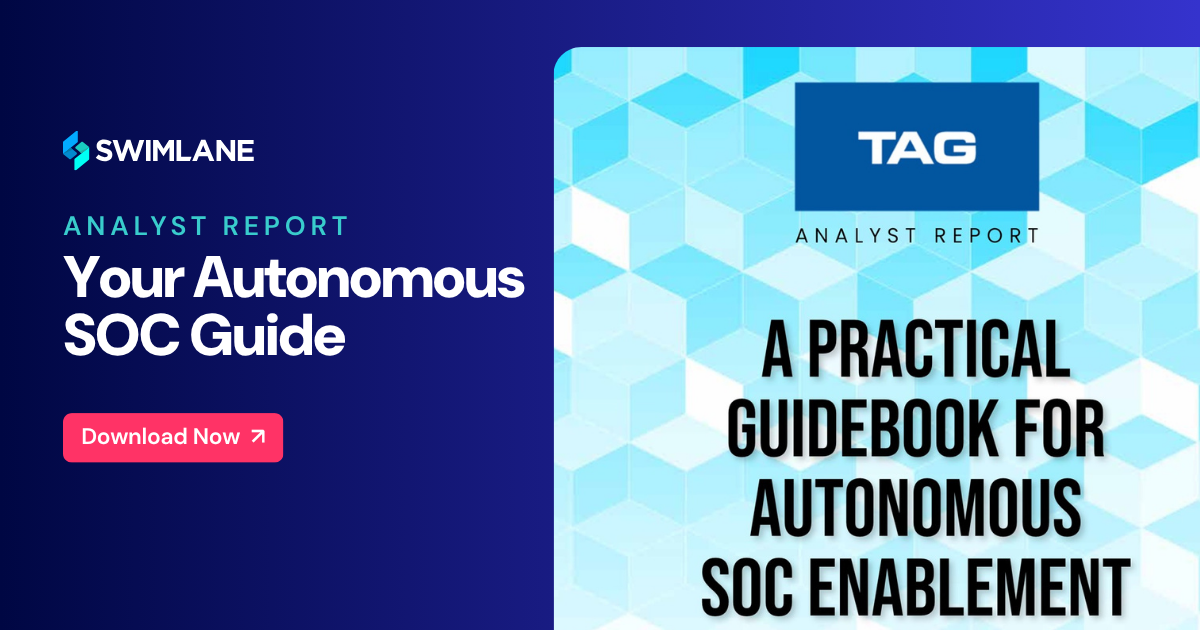
Analyst Report: Your Guidebook for Autonomous SOC Enablement
Security leaders are under pressure to reduce costs, address skilled analyst shortages, and defend against continuous, adaptive AI-enabled attacks. This report provides the roadmap you need to advance your SOC maturity without compromising your human capital.
Download Report




 English
  Français
 Deutsch
 日本語
日本語
 한국어
한국어
 Português
 Español
