

AI 기반 보안 운영 센터: AI SOC에 대한 설명
더 읽어보기

We’ve all been there. You rip open the box, toss the instruction booklet aside, and start assembling the IKEA shelf with the confidence of someone who has definitely never had leftover screws before. Twenty minutes in, the legs are on backwards, the dowels are in the wrong holes, and you’re staring at a structure that technically stands, but only if you don’t breathe near it.
So you stop. You backtrack. You finally crack the instructions. And suddenly the whole thing comes together in half the time the first attempt took.
Now replace “shelf” with “automation playbook” and “IKEA” with “your 사회.” Sound familiar?
Security teams face relentless pressure to automate. A new threat surfaces, leadership wants faster response times, and the SOAR platform is right there, ready to go. So an analyst jumps in: drag a node here, connect an enrichment step there, wire up a containment action, ship it.
It works. Once. Maybe twice. Then an edge case hits, a permission the service account doesn’t have, a conditional branch nobody accounted for, or a dependency on an integration that was configured in a sandbox but never promoted to production. The playbook breaks at 2 a.m. during an actual incident, and now the team is debugging automation 그리고 triaging a threat simultaneously.
This isn’t a failure of skill. It’s what happens when experienced people build under pressure or skip critical steps. The instinct to move fast is correct; the problem is moving fast without a framework to catch what you miss.
Here’s where AI changes the equation, not by replacing the analyst or engineer, but by acting like the instruction manual you finally pick up after the dowels are already in the wrong places.
Think of 히어로 AI-assisted SOAR as a co-builder that sits alongside your team and provides step-by-step guidance during the build itself. It surfaces documentation inline, flags logical gaps before they become 2 a.m. pages, and offers click-by-click help when an analyst hits a wall mid-construction.
A quick scenario: An analyst is building a phishing triage playbook during an active campaign. She wires up the email header extraction, adds a URL detonation step, and connects a user notification action. But the playbook fails on test, the sandbox detonation API expects a different authentication method than what’s configured. Instead of spending 30 minutes digging through vendor docs and Slack threads, she asks the AI assistant embedded in the platform. It identifies the auth mismatch, suggests the correct configuration, and walks her through validating the fix. The playbook is live in minutes, not hours.
That’s not magic. It’s the same outcome as finally reading the IKEA instructions, except the instructions are contextual, searchable, and available at the exact moment you need them.
Getting a playbook to work once is table stakes. Getting it to work every time, across shifts, across team members, across the weird edge cases that only show up on weekends—that’s where 날기 paired with AI earns its keep.
Swimlane brings this to life by combining orchestration with the structure that makes automation sustainable:
The engineering and training background of your team still matters enormously. AI doesn’t replace the analyst who understands attacker TTPs or the engineer who knows why a particular API behaves the way it does. What it does is help those people recover faster when something goes sideways and build more consistently from the start. It turns tribal knowledge into documented, reusable process.
Every SOC has a shelf that’s standing at a slight angle, a playbook that works but nobody wants to touch, an automation that’s held together by one person’s institutional memory. AI-powered SOAR doesn’t just fix the shelf. It gives your team a way to build the next one right the first time, and the one after that, and the one after that.
Ready to stop guessing and start building playbooks that hold up? Learn how Swimlane combines SOAR and AI to give your SOC the repeatability, guardrails, and auditability that automation actually requires.
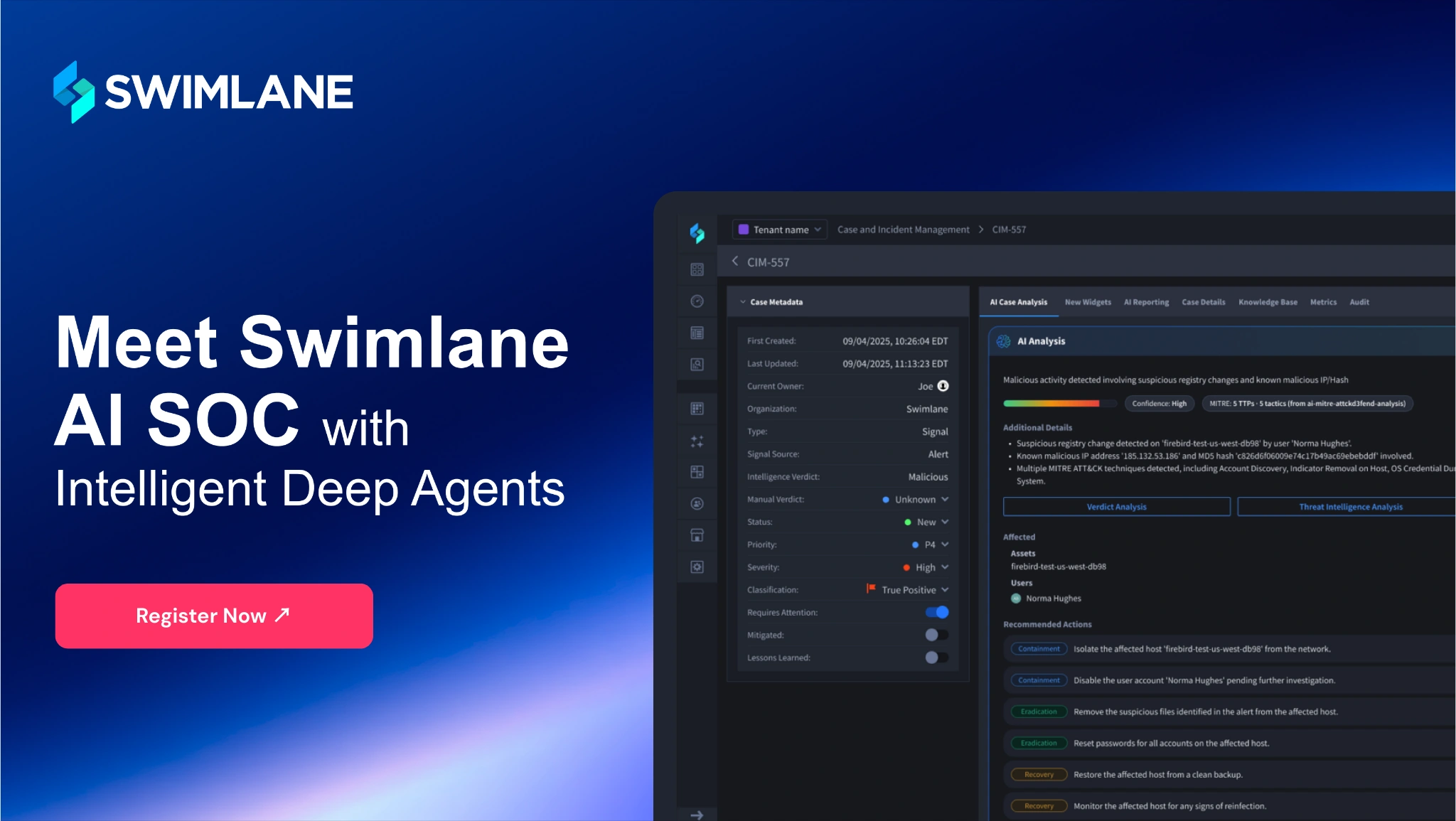
Learn how to deploy autonomous deep agents that take on the cognitive load of your SOC. Get expert tips on building investigation plans and playbooks to redefine your SecOps while maintaining transparency and control.

 English English
  Français
 Deutsch
 日本語
日本語
 한국어
한국어
 Português
 Español