
Sommet virtuel sur les SOC IA : De SOAR à la préparation des SOC IA
Regardez maintenant



Every security leader is getting asked some version of the same question right now: what’s your AI strategy for the SOC? The pressure to answer is real. Alert volumes keep climbing, analyst headcount isn’t keeping pace, and vendors are happy to fill the gap with AI branded onto everything.
En bref: AI SOC readiness depends less on the AI itself and more on the maturity of the security operations and automation environment it’s being introduced into. Assess that environment first, close the gaps you find, and only then decide where AI fits.
That was the thesis running through Swimlane’s recent AI SOC Virtual Summit, a two-session event built around a single idea: don’t start the AI conversation with the technology. Start it with an honest look at how your operation actually functions today. Here’s the progression the summit laid out, and why it holds up once you try to apply it.
Alert fatigue. Analysts stretched thin. Automation that used to feel comprehensive now straining at the edges. Tool sprawl that makes coordination harder instead of easier.
It’s tempting to read these as evidence that your SOAR program failed. It usually isn’t. Alert volume, environment complexity, and operational demands all grow, while the automation built for an earlier, smaller version of the problem stays roughly the same size.
The distinction that matters: having a large library of automated playbooks is not the same thing as having an automation strategy that scales with the operation. A team can run considerable automation and still hit a wall, because the wall isn’t about how much automation exists. It’s about whether that automation was built for the scale, complexity, and speed the organization now operates at.
The friction you’re feeling isn’t a verdict on past decisions. It’s information about where to look next.
When something stops scaling, the instinct is to rip it out and start fresh, especially with vendors pitching a clean break from “legacy SOAR.” Resist that instinct.
Deterministic playbooks represent defined processes: work the organization already did to figure out how a given security process should run. That’s institutional knowledge, and it doesn’t stop being valuable just because a newer technology showed up.
Ask this instead: not “how do we start over?” but “what do we already have that works, where are we hitting limits, and what needs to evolve?”
That turns modernization into a roadmap built on what’s already there, rather than a rebuild from zero. The progression looks like this:
Mature operations don’t have to choose between deterministic automation and AI. They use each where it actually fits.
Before you can say whether AI improved anything, you need a clear picture of what “before” looked like. That means answering some unglamorous questions:
Skip this step and there’s no way to prove an AI investment moved the needle, because there’s nothing to measure it against.
“AI in the SOC” isn’t one capability, so “are we AI ready?” isn’t really a well formed question. AI functions split into distinct categories: AI assisted or agentic investigations, AI assisted building of playbooks and integrations, and assistant style functions like case reference and tool calling. Readiness gets assessed against each one specifically, not decided once for the entire operation.
That distinction matters because it’s easy to get stuck on the wrong questions:
Those are easy to answer and tell you almost nothing. The questions that actually reveal something are harder:
Readiness also isn’t as subjective as it sounds. It shows up in specific, checkable characteristics: clear objectives and success metrics, documented and repeatable processes, high quality and accessible data, a strong existing automation foundation, governance alignment across security, risk, and compliance, and defined analyst oversight. An organization that’s ready tends to have stakeholder sign off, solid alert quality, and well documented runbooks. One that isn’t tends to have unclear objectives, thin documentation, and no budget set aside for the tooling or training an AI initiative requires. Both are useful things to know. Neither is a surprise once you’ve actually looked.
Here’s the part that runs against how most AI rollouts get pitched: finding a gap before introducing AI isn’t a negative outcome. Missing documentation, inconsistent alert quality, weak enrichment, unclear governance. These are findings, not failures, and surfacing them is exactly what a readiness assessment is for.
Treat readiness as a loop, not a one time gate:
Then the loop starts again. That structure matters because readiness isn’t a certification you earn once. It’s a standing practice, and it means you can introduce AI into one well prepared process at a time instead of feeling like you have to fix the entire SOC before starting anywhere.
There’s an assumption built into a lot of AI in security messaging: that efficiency gains and analyst autonomy are the same goal, and that more AI naturally means less human involvement. It doesn’t hold up. Improving efficiency does not require removing analyst oversight.
Oversight has to be designed into the strategy from the start, not bolted on after something goes wrong:
The goal isn’t maximum autonomy. It’s the right level of autonomy for the specific process and its risk profile, and that’s a judgment call that has to be made on purpose, not defaulted into.
Put the whole progression together: modernize the operational foundation, assess its maturity against specific AI use cases, close the gaps that assessment turns up, then apply AI with oversight built in from day one rather than added later.
That’s a slower path than “buy the AI platform and turn it on.” It’s also a more durable one, because the AI you introduce is landing on ground that can actually support it.
The organizations best positioned to benefit from AI in the SOC may not be the ones moving toward AI the fastest. They may be the ones doing the work to modernize, assess, and genuinely understand their security operations first.
The goal isn’t to race toward AI adoption. It’s to build a security operations foundation that lets your organization introduce AI with confidence.
Want the full conversation? Watch both sessions of the AI SOC Virtual Summit on demand for the complete modernization and readiness discussion.
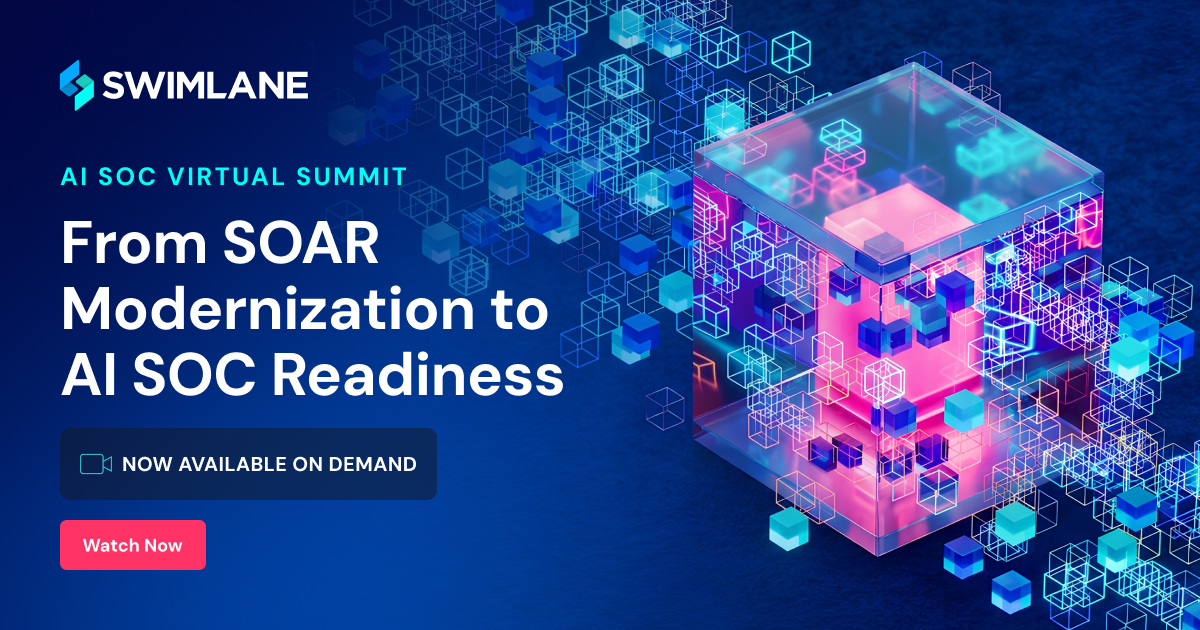
Watch both sessions of the AI SOC Virtual Summit on demand to see how leading security teams modernize automation, evaluate maturity, and introduce AI into the SOC with confidence.

 English English
  Français
 Deutsch
 日本語
日本語
 한국어
한국어
 Português
 Español