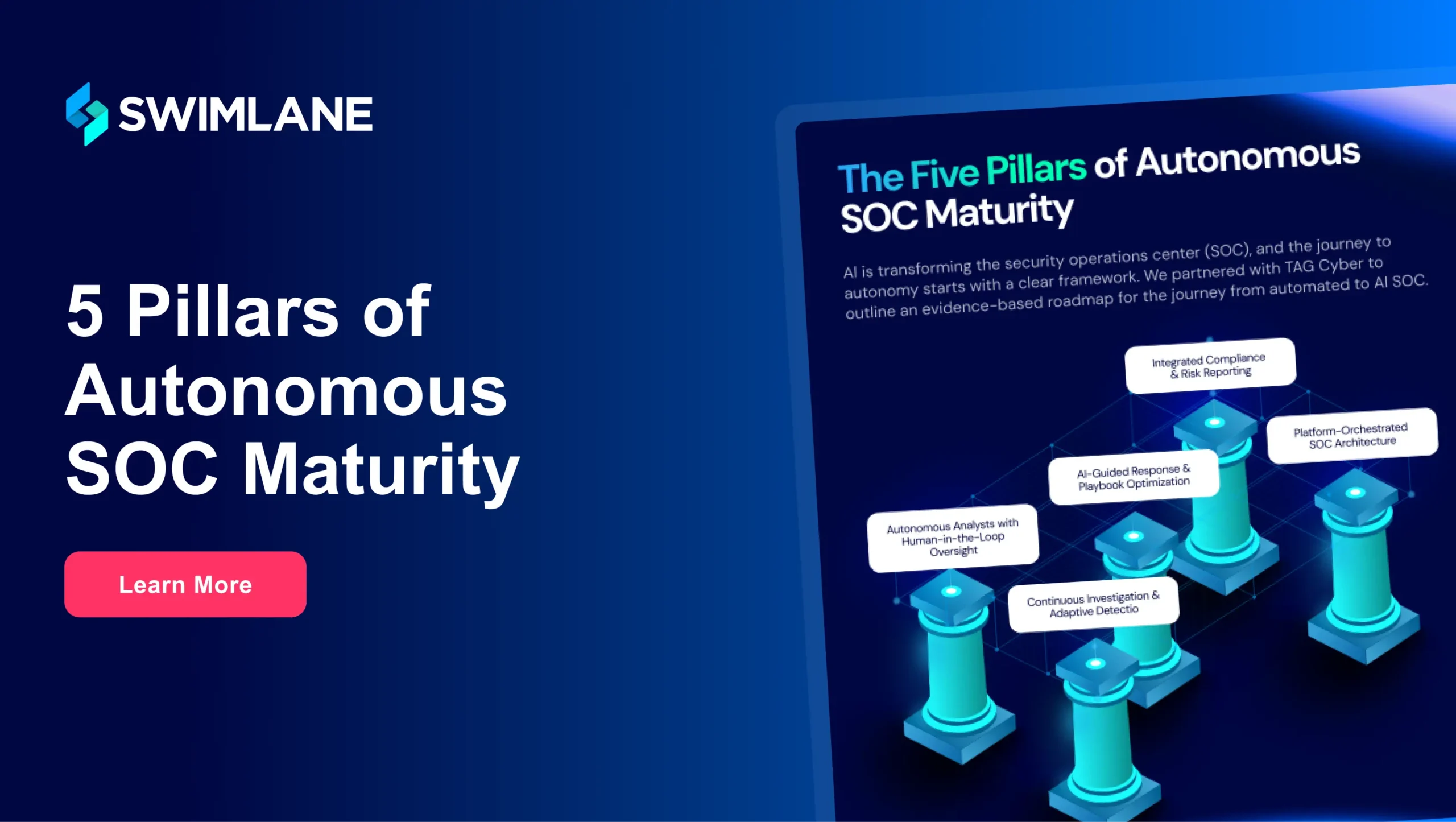

Guide du RSSI pour l'activation autonome des SOC
Regardez maintenant



Security operations have reached a point where incremental efficiency gains are no longer enough.
Most SOCs already use automation in some form, yet analysts still spend too much of their day validating alerts, gathering context, coordinating next steps, and documenting work that follows familiar patterns.
The problem is not a lack of tooling. It is that too much of the operating burden still sits with people.
That is where the idea of the autonomous SOC starts to carry real operational weight.
An autonomous SOC is a security operations model where AI-driven systems can carry out meaningful portions of triage, investigation, and response with context, structure, and defined decision boundaries.
Instead of stopping at task execution, the system can keep work moving across tools and workflows with less manual intervention.
For CISOs, SOC leaders, security architects, and MSSP operators, the challenge is scaling operations without adding headcount. Autonomous security operations help reduce manual work across workflows so teams can keep up with growing demand.
An autonomous SOC is a security operations environment where AI agents can execute workflows, make decisions within defined boundaries, and continuously adapt response logic based on context and outcomes.
This does not mean human teams disappear. The difference is that the SOC spends less time on predictable tasks and more time handling incidents that truly require judgment.
At its core, an autonomous SOC is built to do four things well:
That shift matters because modern SOC performance is no longer defined only by whether a team can automate tasks. It is defined by whether it can operate with speed, continuity, and consistency at scale.
“Cybersecurity requires a risk-based approach that integrates people, processes, and technology to manage and reduce risk.”
Source: CISA
This distinction matters because many organizations describe their SOC as advanced when what they really have is workflow automation.
An automated SOC relies on predefined rules, triggers, and playbooks. If a condition is met, the workflow runs. This is useful and often necessary. It helps teams reduce manual effort, standardize common processes, and move faster on repetitive tasks.
But automated workflows are still limited by the assumptions built into them. They work well when the environment stays predictable and the incident follows a known path. Once conditions change, the workflow usually stalls, or hands control back to the analyst.
An autonomous SOC takes the next step. Instead of only following static instructions, it can interpret context, decide what information matters, and adjust the workflow as the situation develops. It can coordinate multiple steps across tools and keep investigations moving even when an incident does not match a perfectly scripted path.
That is the real difference. Automation executes predefined logic. Autonomy applies decision-making within defined boundaries.
Automation improves efficiency. Autonomy improves operational adaptability.
Conseil de pro : Do not measure SOC maturity by how many playbooks you have. Measure it by how often the workflow can continue, adapt, and reach the right next action without relying on an analyst to step in and interpret what to do next.
The engine behind an autonomous SOC is Agentic AI. It is a model of execution where AI agents perform specific tasks, share context, and move work forward in a structured way.
To understand how this works, it helps to think in layers.
Expert Agents are specialized agents that handle focused parts of the workflow. Each one has a narrow job and operates within a defined scope.
That might include enriching an alert with identity information, analyzing endpoint behavior, checking threat intelligence, reviewing related cases, or validating whether a signal reflects real risk.
Analysts spend a great deal of time jumping between these steps manually. Expert Agents reduce that burden by completing focused work quickly and consistently.
Deep Agents operate at a higher level. They coordinate the work of Expert Agents and keep the broader workflow on track.
Instead of handling a single step, they manage the sequence, decide the next action, and keep the investigation moving.
Autonomy starts to make a clear difference in how the SOC works at this stage. An autonomous Deep Agent can assess findings, call on the right Expert Agents, and move the workflow forward without requiring an analyst to manually orchestrate every step.
Together, Expert Agents and Deep Agents create a practical architecture for autonomous security operations.
Swimlane Turbine Canvas includes agent-builder capabilities that let customers create their own agents. That gives teams a way to extend agentic execution beyond prebuilt logic and tailor it to their environment without adding unnecessary development overhead.
“Organizations are increasingly adopting automation to handle routine cybersecurity tasks and allow personnel to focus on more complex activities.”
Source: Center for Internet Security (CIS)
Security leaders do not need to make the whole SOC autonomous at once. In fact, most should not. The right place to begin is where work is high-volume, repetitive, and structurally consistent enough to benefit from AI-guided execution.
Triage is one of the clearest entry points. Alerts arrive in large numbers, many lack context, and analysts often spend too much time proving that a signal does not matter.
Swimlane sharpens this process by combining agentic AI, orchestration, and playbook-driven execution to pull in context from connected tools, validate the alert against related activity, and move higher-priority incidents forward with less manual triage overhead.
Many investigations begin with the same set of questions. What user was involved? What endpoint was affected? Are there related detections? Has this behavior appeared elsewhere?
These are ideal steps for Expert Agents and Deep Agents to coordinate. They are structured enough to automate, but important enough that better execution has a real operational payoff.
Case quality often suffers when teams are overloaded. Timelines are incomplete, notes are inconsistent, and institutional knowledge gets lost in the rush to move on to the next alert.
Autonomous workflows can produce structured case updates, summaries, and records as part of the investigation itself. That improves continuity, reporting, and long-term knowledge retention.
Certain response actions can also be coordinated within policy boundaries.
Disabling an account, isolating a host, notifying stakeholders, escalating the case, or triggering downstream workflows can all be part of an autonomous process when the logic and approvals are clearly defined.
Conseil de pro : Start where analyst time is most predictably consumed, not where the risk feels highest. High-volume workflows like triage and initial investigation create the strongest early impact because small gains in consistency and speed compound quickly across the entire SOC.
An autonomous SOC does not just make security operations effortless. What it does is shift effort away from manual coordination and repetitive execution so the SOC can work in a more controlled and sustainable way.
The first and most obvious benefit is reduced manual effort. Analysts no longer need to spend the bulk of their time gathering context, clicking through tools, and updating records for routine cases.
That work can be handled by the system, allowing humans to focus on higher-value analysis and decision-making.
Manual processes vary from analyst to analyst and shift to shift. That creates uneven outcomes, especially in larger teams and round-the-clock operations.
Autonomous workflows apply logic more consistently, which improves case quality and reduces the operational drift that often develops over time.
When workflows do not pause at every step waiting for a person to review and trigger the next action, the SOC moves faster.
Investigations begin sooner, response actions happen more quickly, and cases progress with less friction.
One of the biggest long-term benefits is that logic, decisions, and process knowledge become embedded in the workflow itself. That matters because SOCs often depend too heavily on tribal knowledge.
If critical understanding lives only in a few analysts’ heads, continuity suffers. An autonomous model helps preserve and operationalize what the team has learned.
Security leaders should also be realistic about the risks. Autonomous security can improve operations, but only if it is implemented with strong governance and clear boundaries.
Not every decision should be delegated. Some incidents require human judgment, especially when business impact, legal exposure, or unclear evidence is involved. The goal is not unlimited autonomy. The goal is appropriate autonomy.
If the SOC cannot clearly see what the system did, why it did it, and what inputs shaped the outcome, trust will break down quickly. Transparency is essential. Security operations cannot rely on opaque behavior.
Autonomy depends on connected systems and usable data. If key tools are not integrated or the data flowing between them is incomplete, the workflow will be limited.
Autonomous operations are only as strong as the operational fabric underneath them.
As the model changes, teams need support. Analysts are not being removed from the process, but their role does shift.
More time goes into oversight, refinement, exception handling, and process improvement. That change needs to be managed deliberately.
Conseil de pro : Treat autonomy as a governed system, not a set-and-forget capability. Define clear boundaries, approval thresholds, and audit visibility from the start so the SOC knows exactly when AI can act independently and when human oversight must step in.
Security operations do not need more disconnected tools or heavier workflows. They need an operating model that can keep pace with real-world demand without placing every decision and action on the analyst.
The autonomous SOC gives teams a more practical way to handle growing workload and complexity. By combining structured automation with Agentic AI, teams can reduce manual effort, improve consistency, and ensure that investigations and responses move forward without unnecessary delays.
For organizations ready to take this step, the focus should be practical. Start with high-volume workflows. Introduce agent-driven execution where it adds clarity and speed. Build toward a Live Response Plan that adapts to your environment while staying aligned with governance and control.
Swimlane provides the foundation to make this transition real.
With agentic execution, low-code playbooks, and orchestration across the security stack, Swimlane helps teams turn autonomous SOC concepts into governed workflows that actually reduce manual coordination, keep investigations moving, and make outcomes easier to measure.
Experience how Swimlane operationalizes autonomous SOC workflows at enterprise scale.
An autonomous SOC is a security operations model where AI-driven systems can carry out much of the work involved in triage, investigation, and response with limited human intervention.
An automated SOC follows predefined rules and playbooks. An autonomous SOC can adjust its workflow based on what it finds, which makes it more flexible and better suited for incidents that do not follow a fixed script.
A Live Response Plan is Swimlane’s dynamic response model that adjusts actions based on real-time findings, incident context, and changing conditions in the environment. It sits in the workflow layer, helping response logic stay aligned with what the investigation is uncovering rather than forcing every case through a fixed playbook. It is more adaptive than a static playbook and better aligned with how real investigations unfold.
Swimlane supports the autonomous SOC through AI-driven security automation, agentic execution, low-code playbooks, and orchestration across tools. This helps teams operationalize autonomy in a structured, scalable, and measurable way.

 English English
  Français
 Deutsch
 日本語
日本語
 한국어
한국어
 Português
 Español