
Inside Our AI SOC: How Swimlane Cut MTTR in Half
Read More


This blog post, the second in a series on Swimlane’s fleet of expert AI agents, introduces the Hero AI Threat Intelligence Agent. It explains how it solves the threat intelligence (TI) correlation problem by eliminating the manual, time-consuming process of reconciling conflicting scores and verdicts from multiple TI sources. The agent aggregates and synthesizes intelligence to produce a unified, confidence-weighted assessment. By applying consistent, explainable reasoning at machine speed, the agent moves case disposition from slow, human-reliant judgment calls to autonomous, data-driven decision-making within the SOC.
If you’ve spent any time in a security operations center (SOC), you’ve lived this scenario: an alert fires, and the analyst’s first instinct is to start enriching. They pull up VirusTotal to check the hash. They pivot to Recorded Future for campaign context. They check Cisco Umbrella for DNS history. Maybe they’ve got an internal TI feed or an ISAC membership layered in on top of that. Each source returns its own scoring, its own format, its own verdict, and half the time they contradict each other.
So the analyst does what analysts always do. They open six tabs, mentally weigh the results based on experience and gut feel, and make a judgment call. That process takes 15 to 30 minutes per indicator, and the “methodology” for arriving at a conclusion lives entirely in that analyst’s head. When they go home for the night or leave the company, that reasoning leaves with them.
This is the threat intelligence (TI) correlation problem, and it’s been around for as long as I’ve been in security. The challenge was never getting access to threat intel, it was making sense of it at speed and scale. That’s what makes the Hero AI Threat Intelligence Agent one of the most practically useful expert agents in Swimlane’s fleet of AI agents inside the Turbine platform. It doesn’t just query your TI sources. It correlates and synthesizes them, producing a unified analysis directly in the case, so the analyst gets a single, explainable assessment instead of six tabs and a prayer.
Here’s what makes multi-source TI correlation so hard for humans: it’s not just a data problem, it’s a reasoning problem. When VirusTotal shows a file with a 3/72 detection ratio and Recorded Future flags the associated IP as linked to a known APT campaign, while Umbrella shows the domain was registered two days ago, what do you do with that? Each data point is a fragment. The value is in how you weigh and connect them.
Your senior analysts do this well. They’ve built intuition over the years about which sources are more reliable for which indicator types, how to read the gaps between conflicting scores, and when a low detection count is actually more concerning than a high one. That reasoning is incredibly valuable, and it’s almost never documented.
This is the exact pattern that expert AI agents handle well. Not because the agent is smarter than your best analyst, but because it can apply consistent reasoning across every indicator, every time, at machine speed. It doesn’t get fatigued at 2 AM. It doesn’t skip enrichment steps because the queue is 200 alerts deep. And critically, it shows its work, so when an analyst reviews the output, they can see exactly how the agent weighed each source and arrived at its conclusion.
The Hero AI Threat Intelligence Agent aggregates data from all of your configured TI sources, VirusTotal, Cisco Umbrella, Recorded Future, and whatever else you’ve integrated, and produces a unified cross-source analysis directly in the case file. No tab-switching. No mental gymnastics. One consolidated view with the reasoning laid out.
Swimlane’s CISO, Michael Lyborg, called this agent a “game-changer for threat intel” when describing how their internal SOC uses it. I think the reason it resonates so strongly with practitioners is that it solves a problem everyone recognizes but nobody’s had a clean answer for. We’ve had TI platforms, TI feeds, TI aggregators, but the correlation and synthesis step has always fallen back on the analyst. This agent moves that step into the workflow itself.
The Hero AI Threat Intelligence Agent is the second agent I want to dig into (I covered the MITRE ATT&CK & D3FEND Agent in the first post in this series). Where the MITRE agent standardizes how you describe attacks and defenses, the TI agent standardizes how you synthesize intelligence. Together, they start to form the context layer that every other decision depends on.
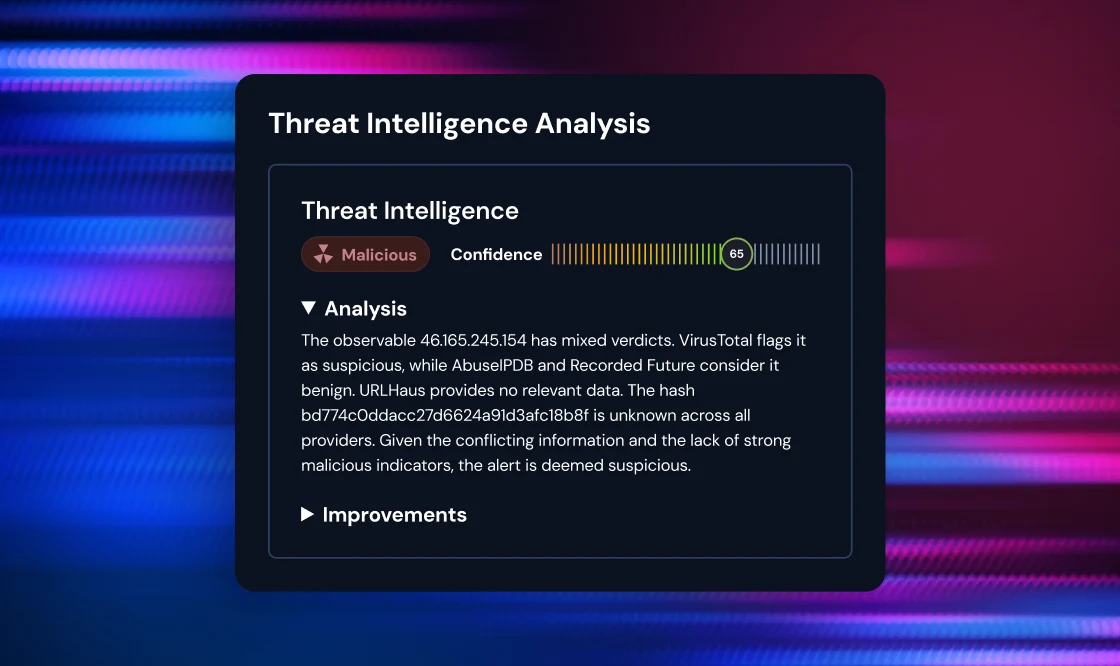
Here’s how it works in practice. When a case is created or an indicator needs enrichment, the TI Agent automatically queries every threat intelligence source your environment is connected to. It pulls reputation data, campaign associations, historical sightings, domain registration details, behavioral analysis, whatever each source provides. Then, instead of dumping six raw results into the case for the analyst to parse, it synthesizes them into a single, unified analysis.
That synthesis is what matters. The agent doesn’t just average scores or pick the highest one. It reasons across sources, weighing detection ratios, source reliability, indicator type, temporal context, and campaign associations, to produce an assessment that reflects what a well-informed analyst would conclude if they had the time to thoroughly review every source. The key difference: the agent does it in seconds, every single time, for every single indicator.
This feeds directly into the other Hero AI Agents. The Verdict Agent uses the TI Agent’s output, along with historical case context and knowledge base (KB) articles, to generate a disposition. The Investigation Agent uses it to build its end-to-end investigation plan. The MITRE Agent maps the attack techniques. Each agent does its job, feeds its output forward, and the result is a case file that’s richer and more consistent than what most SOCs produce manually, not because the AI is magic, but because it doesn’t skip steps.
One of the things I always push when I talk about AI in the SOC is explainability. It’s not enough for an agent to say, “This is malicious.” You need to know why it reached that conclusion, which sources contributed, how they were weighted, and where there was disagreement. Without that, you’re just swapping one black box (the analyst’s gut) for another (the model’s output).
The Hero AI agent’s confidence score addresses this directly. Rather than returning a binary good/bad verdict or a single opaque risk number, the TI Agent produces a confidence-weighted assessment that reflects the degree of agreement across sources, the quality and recency of the data, and the specific reasoning chain that led to the conclusion.
This matters operationally in a few ways. First, it gives analysts a quick way to triage how much attention an indicator needs.
Second, and this is the part that I think security leaders underestimate, confidence scoring creates a measurable baseline for your TI program’s effectiveness. Over time, you can track how often the agent’s high-confidence assessments align with actual outcomes. You can identify which TI sources consistently contribute signal versus noise. You can make data-driven decisions about which feeds are worth renewing and which ones are just adding volume without value. That’s TI program management backed by evidence, not vendor slide decks.
Let me zoom out for a second, because the TI Agent illustrates a broader point about how AI agents earn their place in the SOC.
The traditional approach to threat intelligence is additive: buy more feeds, integrate more sources, and hire more analysts to review the output. The problem is that each new source adds both signal and noise, and the burden of correlation falls entirely on humans. At some point, the marginal value of an additional feed turns negative because your team can’t process what they already have.
An AI agent inverts that equation. Instead of more inputs creating more work, more inputs create better synthesis. Every additional TI source you connect to the agent enhances correlation and makes confidence scoring more precise. The agent improves as your intelligence program grows, which is exactly the opposite of what happens when humans manually perform the correlation.
This is what I mean when I talk about building a symphony of agents that each earn the right to carry more weight over time. The TI Agent starts by showing you its unified analysis alongside what your analysts would have concluded. You benchmark, you compare, you build confidence. As it proves consistent, you start trusting it to enrich cases without an analyst having to review every indicator. Eventually, the high-confidence outputs feed directly into automated disposition via the Verdict Agent, and your team spends their time on the ambiguous cases that actually require human judgment.
That’s progressive trust applied to threat intelligence. And when you combine it with the MITRE agent standardizing the attack language and the D3FEND mapping showing what your tools already cover, you start to have a SOC that doesn’t just respond faster, it responds with a level of consistency and documentation that most teams can’t achieve manually.
In the next post, I’ll dig into the Verdict Agent and how explainable AI disposition works in practice. That’s where the progressive trust model really gets tested, because closing a case autonomously is a much bigger bet than enriching an indicator. Stay tuned.

Your analysts shouldn’t be the integration layer between six TI tools. Swimlane’s Hero AI Threat Intelligence Agent aggregates, synthesizes, and scores intelligence from every source in your environment, giving your team a single, explainable assessment instead of six tabs and a guess.
The Hero AI Threat Intelligence Agent uses purpose-built AI automation to eliminate the manual, time-consuming process of reconciling conflicting verdicts and scores from multiple TI sources. This agent aggregates and synthesizes data across all connected feeds to produce a unified, confidence-weighted assessment that provides a transparent reasoning chain for every conclusion. By applying consistent, explainable reasoning at machine speed, it moves intelligence synthesis from human-reliant judgment calls to data-driven certainty. As the second in a growing fleet of expert agents, the TI Agent delivers the high-confidence context required for autonomous case disposition via the Verdict Agent, scaling consistency and speeding up the entire SOC workflow.

 English English
  Français
 Deutsch
 日本語
日本語
 한국어
한국어
 Português
 Español