DemoVideo
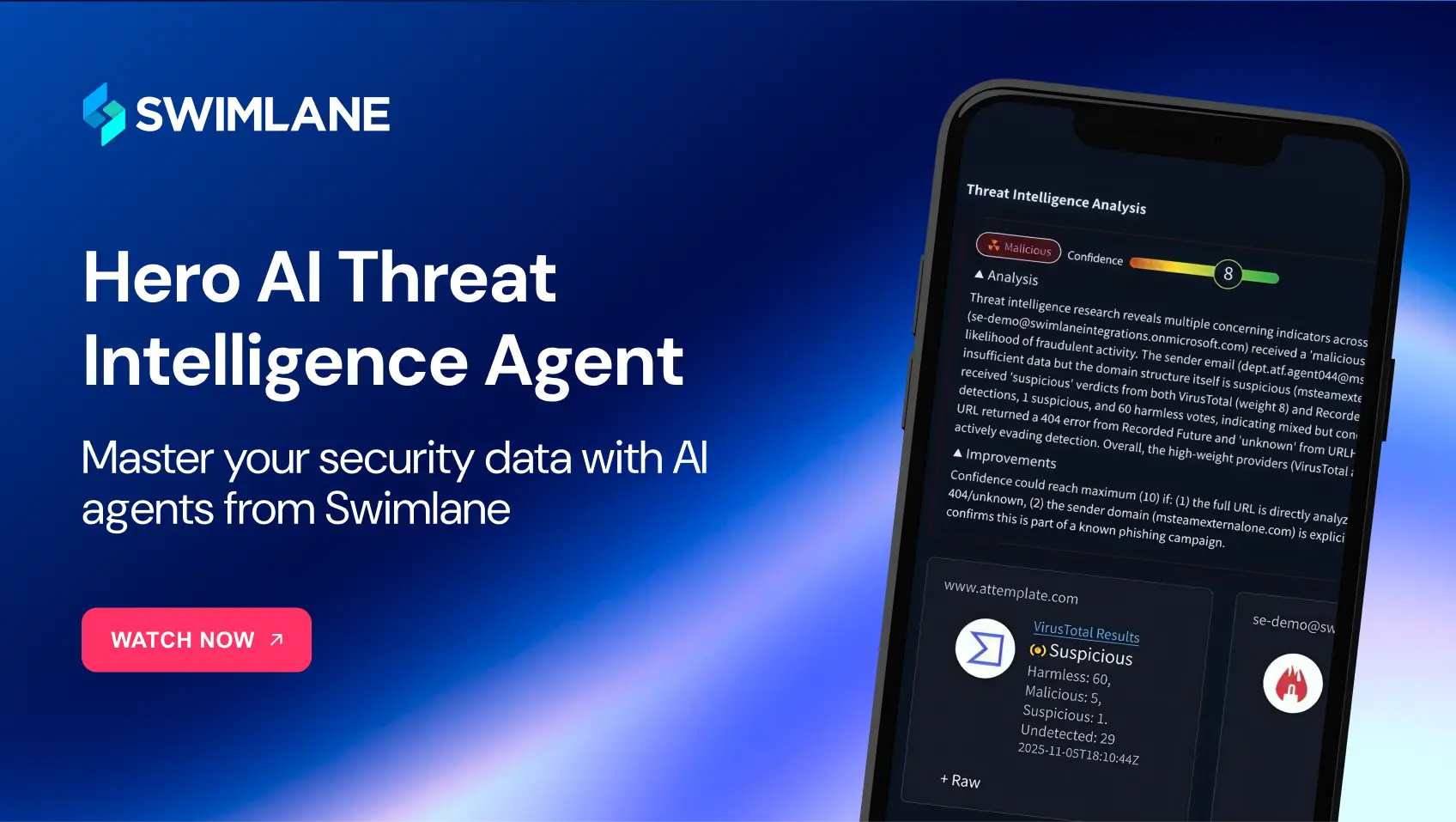
Master Your Security Data with the Threat Intelligence AI Agent
Read More


Proactively search cyber threats that are lurking undetected in the network. Real-time, AI-driven threat hunting correlates signals across your security stack to identify anomalies, prioritize risk, and accelerate response. AI agents and automated workflows turn threat hunting into a structured, continuous operation.

$
M
Connect SIEM, EDR, and XDR signals so teams can spot threats sooner, prioritize risk, confirm context, and act faster.
MITRE ATT&CK
Use Swimlane AI agents to prioritize risk, validate context, and trigger containment and remediation faster.
Situational
Swimlane automates analysis of vulnerabilities and external attack data to identify trending TTPs.
Continuously enrich, correlate, and assess threat signals as activity changes across the environment. Swimlane’s AI agents keep hunts moving by pulling context into connected cases, prioritizing emerging risks, and triggering response workflows when indicators are confirmed. Analysts spend less time rebuilding investigation context and more time moving threats toward containment, helping reduce dwell time and improve MTTD and MTTR across the threat hunting lifecycle.

Swimlane Turbine’s autonomous Integrations provide an ecosystem-agnostic orchestration solution without requiring developer resources. This improves hunting capabilities and response, while effectively protecting the organization from attacks. Connect SIEM, EDR, XDR, threat intelligence, and identity systems to unify visibility across your environment. Prioritize high-risk activity, contain threat indicators faster, trigger remediation workflows, and move investigations toward resolution.

Automate repetitive tasks to help continuously hunt for threats at machine speed, enabling your security team to focus on more complex threats quicker while also reducing mean time to detection (MTTD) and response (MTTR). Remove investigation friction, keep context attached to every signal, and move from detection to action without delay.

Align your processes and procedures with industry best practices with fully-customizable, automated playbooks and workflows. Use Swimlane’s adaptable low-code playbook builder to create the necessary automations to accelerate the hunt workflow and sift through the noise. Swimlane guides threat hunts from hypothesis to response, keeping evidence and decision history intact at every stage.

Swimlane handles the mundane and time-consuming tasks required for threat hunting, so that analysts can allocate their time to strategic work. Swimlane Turbine also helps SecOps standardize and scale critical security processes. Reduce repetitive Tier 1 work and manual context gathering so investigations move faster and analysts stay focused on active threat hunting.
Move confirmed activity from the hunt into a structured case without losing continuity from investigation through response. Swimlane keeps evidence, actions, decisions, and ownership connected across every stage, giving SOC teams a shared view of the investigation and maintaining a complete, audit-ready record from validation through response.


In order to mature our security operations, we knew it was necessary to advance how we monitor and respond to threat intelligence by taking a more proactive approach to security operations.
Tanajak Watanakij
Chief Information Security Officer

| Capability | Swimlane Threat Hunting | Traditional Threat Hunting |
| Hunting Approach | Automates and orchestrates threat hunting workflows | Relies on manual queries and analyst-driven investigation |
| Data Visibility | Unifies SIEM, EDR, XDR, identity, and cloud data in one workflow | Data remains siloed across multiple tools |
| Detection Style | Proactive hunting using correlated signals and behavioral context | Reactive, based on alerts and predefined rules |
| Investigation Speed | Accelerates validation and response by reducing manual correlation and handoffs | Slower investigations with manual correlation and handoffs |
| Signal Correlation | Applies AI-assisted correlation across multiple data sources | Limited correlation, often handled manually by analysts |
Automated threat hunting uses workflows and AI to continuously search for suspicious activity across security systems. Instead of relying on manual analysis, it enriches data, correlates signals, and surfaces potential threats faster, helping teams identify risks that traditional detection may miss.
AI helps security teams process large volumes of data, detect behavioral anomalies, and prioritize threats based on context and risk. It also accelerates investigations by summarizing findings, recommending next steps, and reducing the amount of manual analysis required from analysts.
Threat hunting workflows typically integrate with systems such as SIEM, EDR, XDR, threat intelligence platforms, and identity tools. Bringing these sources together allows teams to correlate signals, validate activity, and gain a unified view of their environment.
Swimlane reduces dwell time by correlating signals across tools, automating enrichment, and accelerating investigation workflows. Teams detect and validate threats earlier, allowing faster response before attackers can move deeper into the environment.
The world’s most capable security automation platform

 English English
  Français
 Deutsch
 日本語
日本語
 한국어
한국어
 Português
 Español