
Blog
Guide to Insider Threats: Definition, Detection, Best Practices & Tools
Read More


Only the most mature organizations can afford the human expertise needed to manually address insider threats, leaving the average organization with a blind spot. Automate the essential processes for detecting malicious behavior and ensuring water-tight employee offboarding.

%
Employees/ individuals with authorized access may leak data because they are oblivious, negligent, or malicious.
$
M
With security automation, SecOps teams can quickly act when alerted to malicious human behavior.
System of Record
SecOps teams have the integrations and information they need to better defend against potential insider threats.
Swimlane correlates user activity across identity, endpoint, and data systems to surface insider risk earlier and automate data exfiltration mitigation. It orchestrates follow-on response actions such as access review or account containment, triggers workflows, assigns cases, and drives each investigation through to resolution before incidents escalate. Unify insider risk data within security, identity, HR, and legal systems to give SecOps teams one trusted view of user activity, access changes, case ownership, and response status.
Swimlane connects investigation, enrichment, case routing, containment, and audit documentation so teams can move from suspicious activity to containment with speed and control.
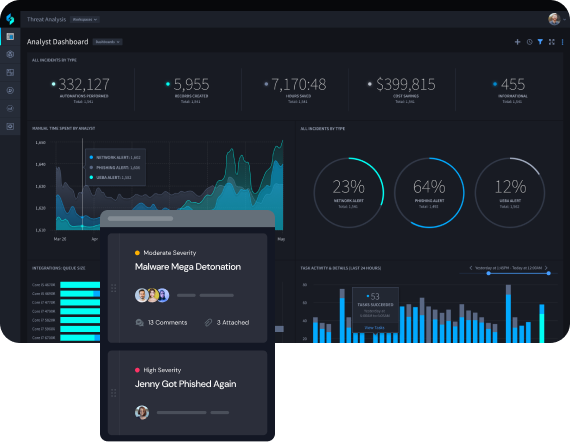
Insider threat investigations are nuanced and time-intensive. Bring humans in the loop of automation to speed manual information gathering, and collaborate on active insider threat cases.
Swimlane brings the right context into every case by enriching insider threat activity within SIEM, EDR, IAM, DLP, HR, and ITSM environments. Reconstruct user timelines faster, streamline sensitive handoffs, and maintain audit-ready records for every investigation.
Security teams who leverage low-code automation for insider threat use cases gain the scale and efficiencies to reduce insider risk holistically. This means that they address risks introduced by employees with elevated access, malicious insider threats, third-party risk, shadow IT use, and more.
Extend insider risk coverage by connecting user behavior, access patterns, and business context.
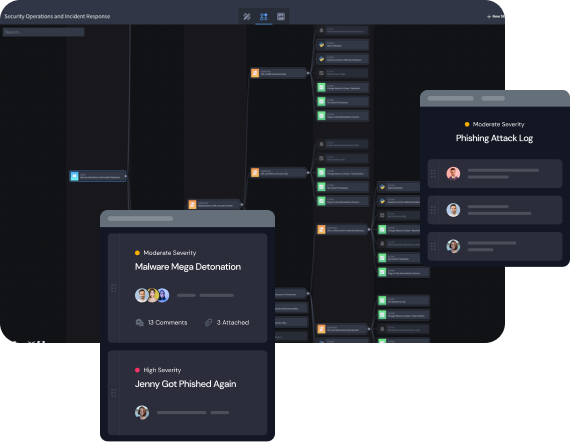
Nothing puts future profits in jeopardy like leaked source code, roadmaps, customer lists, vendor contracts, or regulated data. Establish a system or record for insider risk to validate that your security controls are effective at protecting valuable and regulated data.
Strengthen that protection by surfacing risky data movement and triggering response workflows that help teams investigate and contain potential data exfiltration before it impacts the business. Safeguard intellectual property and regulated data with policy-driven automated workflows and enforce response actions automatically to contain risk and maintain compliance.
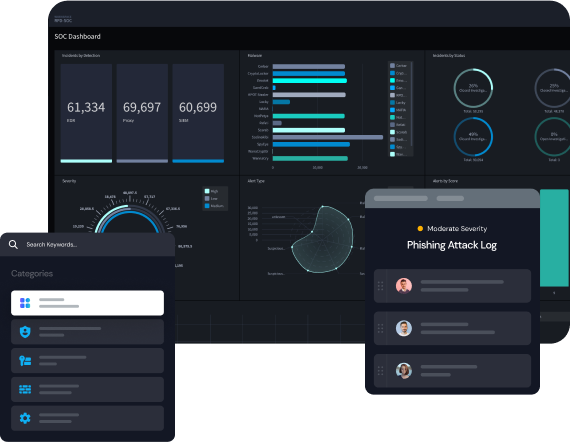
Insider threat programs require the right combination of people, processes, and technology. User-centric dashboards, reporting, and case management bring legal, HR, and compliance teams into the response process, with structured workflows for investigation, review, and escalation, backed by role-based access and secure case collaboration.


SOC teams validate security signals and initiate cases. HR teams provide employee context and manage internal actions.
Legal teams review evidence and guide sensitive investigations. Compliance teams ensure reporting, governance, and audit readiness.
Control risky data movement before it becomes a breach. Swimlane flags unusual file activity, investigates suspicious downloads, contains cloud storage misuse, and enforces response actions that protect source code, IP, and regulated data.


It’s one of the tools that actually allows us to buy time. And when you talk about the velocity of attacks that occur today, time is the most valuable asset that you have.
Jonathan Kennedy
Chief Information Security Officer



With Swimlane, we didn’t have to try and fit our outcome into a preconceived box that had already been developed. Swimlane allowed us to build something that worked for us and how we operate.
Matt Helling
Head of Cybersecurity
Swimlane connects insider threat detection, investigation, response, and reporting into a single workflow, orchestrating actions beyond security and business environments.
Support cloud and hybrid environments without disrupting existing tools.
Integrate SIEM, EDR, IAM, DLP, ITSM, HR platforms and cloud applications to bring relevant user, access, and activity data into each case.
Enable SOC, HR, legal, and compliance teams to act from the same case workflow.
Track cases, actions, and outcomes with real-time dashboards and reporting.
| Capability | Traditional Insider Threat Tools | Swimlane Insider Threat Automation |
| Insider risk visibility | Relies on siloed alerts spanning disconnected tools | Unifies alerts into a single case view with full user, data, and system context |
| Investigation approach | Requires manual data gathering from multiple environments | Automates enrichment across SIEM, EDR, IAM, DLP, HR, and ITSM systems |
| Workflow execution | Depends on static rules and predefined processes | Uses adaptive, AI-supported workflows that move cases forward based on risk |
| Cross-functional response | Limited to security teams with fragmented collaboration | Connects SOC, HR, legal, and compliance teams within one workflow |
| Documentation and audit | Requires manual documentation and reporting | Maintains audit-ready case history with full activity tracking |
| Response speed | Slower response with delayed actions and manual coordination | Enables real-time access control, containment, and policy enforcement |
Insider threat detection identifies risky or malicious activity from employees, contractors, or partners by monitoring user behavior, access patterns, and data movement over systems.
Swimlane connects investigation, enrichment, case management, and response actions into one workflow, helping teams validate risk, assign actions, and contain insider threats faster.
By monitoring unusual file access, large downloads, cloud storage activity, and data movement patterns, teams can identify and respond to potential data exfiltration early.
Yes, Swimlane enables secure collaboration among SOC, HR, legal, and compliance teams with role-based access, structured workflows, and shared case context.
Swimlane integrates with key environments covering identity, endpoint, data, and security stacks to unify signals and drive coordinated insider threat response.
The world’s most capable security automation platform

 English English
  Français
 Deutsch
 日本語
日本語
 한국어
한국어
 Português
 Español