
Mitigate SOC Alert Fatigue
Read More


AI and automation are already part of most SOCs, yet investigations continue to stall at familiar points. Alerts get enriched faster, summaries look cleaner, and context becomes easier to access, but cases still wait for someone to decide what happens next, move them forward, or connect the pieces across tools.
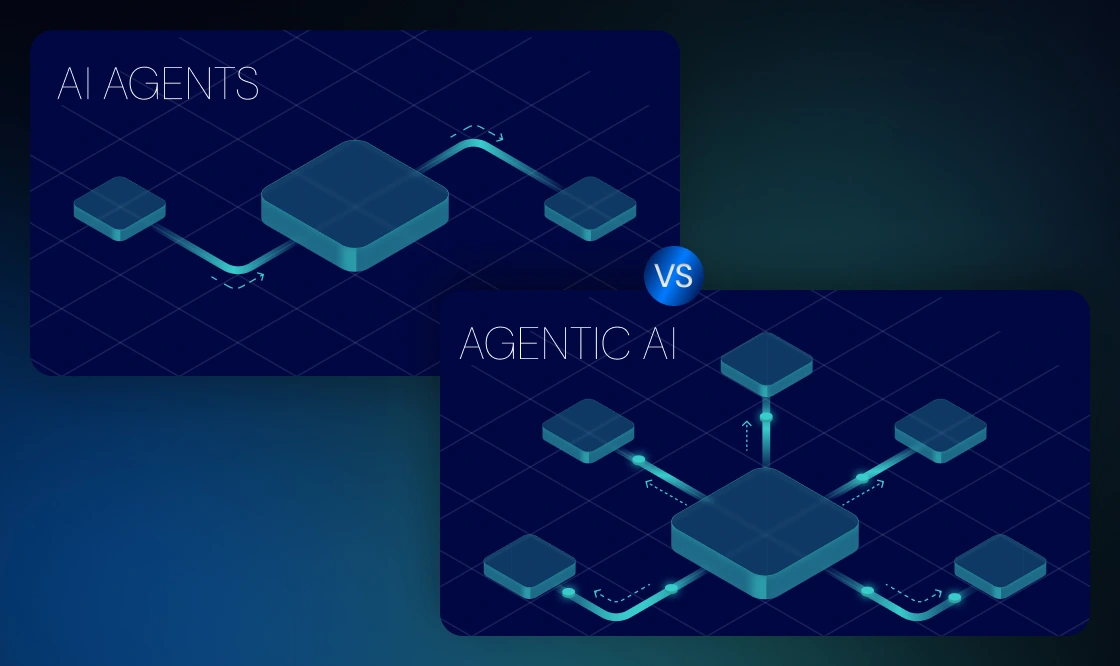
That gap comes from treating AI agents and agentic AI as the same thing. An AI agent is a task-specific system that acts on a defined input to complete a focused action, such as enrichment, summarization, threat intelligence checks, or data retrieval. Agentic AI is a broader operating approach where AI plans, sequences, and coordinates multiple actions toward a larger objective. AI agents improve how work gets done at each step. Agentic AI addresses a different problem. It connects those steps across triage, case creation, escalation, response, and reporting, so the investigation continues without breaking at every handoff.
For CISOs, SOC leaders, and MSSP operators, the difference shows up in execution, as they need AI to fit the way investigations actually move. Swimlane reflects that approach by combining Expert Agents for focused work, Deep Agents for coordinated case movement, low-code playbooks for governance, and orchestration across connected security tools. That makes the AI agents vs agentic AI distinction practical from the start. One improves specific actions, while the other keeps the broader security process moving with control and visibility.
AI agents perform defined tasks based on a goal, input, and set of instructions. In security operations, they can analyze alert details, retrieve telemetry, generate case summaries, classify activity, check threat intelligence, or recommend a next action. They work best when the task scope stays clear, controlled, and tied to an operational sequence.
In a SOC environment, an AI agent might review an alert and collect related context from a SIEM, EDR, identity platform, or threat intelligence source. Another agent may summarize alert history for an analyst. A different agent may map observed activity to a known framework or identify whether similar cases have appeared before.
Swimlane deploys AI agents through specialized Expert Agents that execute focused security tasks across the investigation and response lifecycle. An Expert Agent can support enrichment, evidence collection, case updates, summarization, or routing logic while working within the operations defined by the SOC team.
Deep Agents add value beyond task execution by coordinating multiple Expert Agents inside the workflows each SOC already uses. Rather than producing separate AI outputs that analysts still need to interpret, sequence, and route manually, Deep Agents keep case information and decision flow connected across enrichment, review, escalation, response, and reporting.
Expert Agents handle focused security work, while Deep Agents align those actions with the SOC’s tools, approval paths, and operating requirements. As every SOC runs differently, Swimlane’s Deep Agents follow guidance from approved knowledge base articles, while Expert Agents operate within the SOC’s tools, workflows, approval paths, and operating requirements.
By pairing Deep Agents and Expert Agents with low-code playbooks, SOC teams can design, govern, and adjust AI-driven processes as requirements change. AI outputs stay tied to the approved process, required approvals, audit trail, and operational rules that determine how each investigation should move.
Pro Tip: Map AI agents to the exact points where analysts lose time, such as enrichment, evidence gathering, routing, and case updates. Then check whether the platform can connect those outputs into the next workflow step instead of leaving analysts to stitch the work together manually.
In security operations, agentic AI connects actions across a case and changes the next step based on risk signals, asset criticality, user activity, alert history, and required approvals. Analysts remain in control of critical decisions, but the workflow no longer depends on manual handoffs at every step.
Agentic AI preserves flow across moving operational sequences, so investigations do not stall between processes.
Swimlane uses agentic AI in SOC operations through AI-driven process execution, low-code playbooks, and orchestration across connected security tools. SOC teams can define how alerts move through triage, investigation, escalation, and response, then adjust those workflows as processes change.
Governed automation keeps control in the hands of the security team. Leaders can define which actions run automatically, which require analyst review, and where approvals are needed. Swimlane also maintains case framework, timelines, and audit-ready records, giving teams clear visibility into what happened, what changed, and which actions were taken.
The combination of coordination, control, and visibility elevates SOC teams beyond isolated automation. Instead of speeding up individual tasks alone, Swimlane’s agentic AI approach keeps investigations progressing with connected context, consistent logic, and clear accountability.
Pro Tip: Before applying agentic AI, define which SOC decisions can be automated, which need analyst validation, and which require approval. Clear boundaries make agentic workflows faster without weakening control.
| Area of Comparison | AI Agents | Agentic AI |
| Primary Role | Complete a specific task | Coordinate multi-step work |
| Scope | Narrow and task-based | Broader and workflow-based |
| Decision-Making | Limited to the assigned task | Context-aware within defined guardrails |
| SOC Example | Enrich an alert with threat intelligence | Move an alert through triage, case creation, escalation, and response |
| Human Role | Review outputs and decide next steps | Supervise, validate, and approve higher-risk actions |
| Operational Value | Reduces manual effort in individual steps | Improves continuity across the investigation lifecycle |
AI agents move processes faster by reducing manual work in defined tasks. Agentic AI maintains continuity by connecting those tasks across the investigation and response lifecycle.
Many SOC teams already use automation for enrichment, routing, ticket creation, or notifications. The real challenge begins when systems need to adapt to changing risk and threat intelligence. Activity involving a critical asset may need faster escalation, while a known false positive may only need documented closure. A risky user action may call for identity review, and confirmed malicious activity may require containment through endpoint or network controls.
Agentic AI supports these decisions within boundaries set by the security team. It carries telemetry and case state forward as the case progresses, without asking analysts to rebuild context at every step. It reduces repeated work, improves handoffs, and keeps investigations moving with more consistency.
For SOC leaders, the AI agents vs agentic AI distinction shapes how they evaluate tools, design operational sequences, and measure improvement:
SOC outcomes improve when individual task execution connects to a larger operating model. AI agents accelerate focused work, while agentic AI turns that work into coordinated, governed action.
Pro Tip: Build your AI roadmap around workflow breakpoints. Wherever cases slow down because situation, ownership, risk level, or approval requirements change, agentic AI has a stronger role than a standalone AI agent.
The easiest way to understand AI agents vs agentic AI is to look at where each one shows up in daily SOC work.
AI agents can pull in threat intelligence, asset details, user activity, and related events so that the triage speed becomes clearer. The real shift comes when those findings drive the next step, guiding whether the case moves to closure, escalation, or deeper investigation based on risk instead of waiting for manual review. That reduces time spent gathering basic details and lets analysts focus on deciding whether the alert requires action.
A phishing case shows where the difference becomes more important. An AI agent can summarize an email, extract indicators, and check sender reputation, but it only solves the first part of the problem. The SOC still needs to know who received the message, whether anyone clicked, whether similar emails reached other inboxes, and which actions require approval.
Agentic AI can guide that process from email analysis to mailbox search, user impact review, case creation, approval tracking, and permitted response actions such as message removal. That prevents phishing investigations from turning into a chain of disconnected manual checks. Instead of chasing each step, analysts can review a connected investigation path and focus on validating the right actions.
An AI agent can surface the first layer of endpoint evidence, such as process activity, device telemetry, and suspicious behavior. From there, agentic AI brings the case together by linking that evidence with identity activity, related alerts, and approved containment rules, so analysts can move toward response without rebuilding the investigation in separate tools.
An AI agent can generate structured summaries of investigation activity and capture key findings as the case progresses. Agentic AI keeps records updated in real time, ensuring actions, decisions, and timelines stay complete and audit-ready without requiring analysts to reconstruct the case later. Reporting shifts from an end-of-case task to something that stays current throughout the investigation.
These examples show why task-level intelligence and workflow-level coordination need to work together. SOC performance improves when every action adds intelligence, reduces uncertainty, and moves the case closer to resolution.
Swimlane Turbine brings AI agents and agentic AI together into their operating model. Expert Agents handle focused work such as enrichment, alert analysis, case summaries, routing support, and evidence collection. Deep Agents coordinate those actions across the broader pipeline, so the case can move from triage to investigation, response, and reporting with less manual coordination.
The platform combines AI-driven execution, low-code playbooks, and orchestration across connected security tools. An Expert Agent may gather background telemetry from SIEM, EDR, identity, or threat intelligence systems. Agentic AI then carries that context into the next step, whether the action calls for analyst review, escalation, containment, or documentation.
That balance matters in large SOCs and MSSPs, where alert volume, shift handoffs, tool sprawl, and approval paths can slow down mature teams. Swimlane helps security teams define how work should move, adjust workflows as requirements change, and keep analysts focused on decisions that require judgment.
When tasks, decisions, timelines, and outcomes stay connected, leaders gain clearer visibility into bottlenecks, workload patterns, and process consistency.
AI agents and agentic AI solve different parts of the SOC automation challenge. AI agents complete specific tasks that slow analysts down. Agentic AI links those tasks so investigations and response actions progress without interruption.
Security teams need both capabilities as they mature. AI agents take on focused work such as enrichment, summarization, evidence collection, and case updates. Agentic AI gives the SOC a more consistent operating model for triage, investigation, response, and reporting.
Swimlane’s approach reflects that operational need. By combining agentic AI, low-code playbooks, and orchestration across tools, Swimlane Turbine helps SOC teams move beyond isolated automation and build coordinated security operations at enterprise scale. Book a SOC automation walkthrough to see how.

Explore how Swimlane Turbine brings AI agents, agentic AI, and low-code automation together to move SOC work from alert to action with greater control and consistency.
AI agents perform specific tasks such as enrichment, summarization, or data retrieval. Agentic AI coordinates multiple actions across a broader workflow. In a SOC, AI agents help complete steps faster, while agentic AI helps move the entire case forward.
Agentic AI helps an AI SOC by connecting enrichment, correlation, case management, escalation, and response actions. The system keeps the investigation and its findings moving forward, instead of leaving analysts to rebuild it manually. That improves consistency and reduces operational friction.
Swimlane Turbine uses agentic AI, low-code playbooks, and orchestration to help SOC teams automate and coordinate security operations. The platform helps execute routine work, connect tools, and keep cases moving with governed automation.
AI agents handle focused tasks, while agentic AI coordinates the larger process. SOC teams need task execution and workflow continuity to reduce delays. The strongest approach combines both under clear governance.

 English English
  Français
 Deutsch
 日本語
日本語
 한국어
한국어
 Português
 Español