Inside Our AI SOC: How Swimlane Cut MTTR in Half
Read More


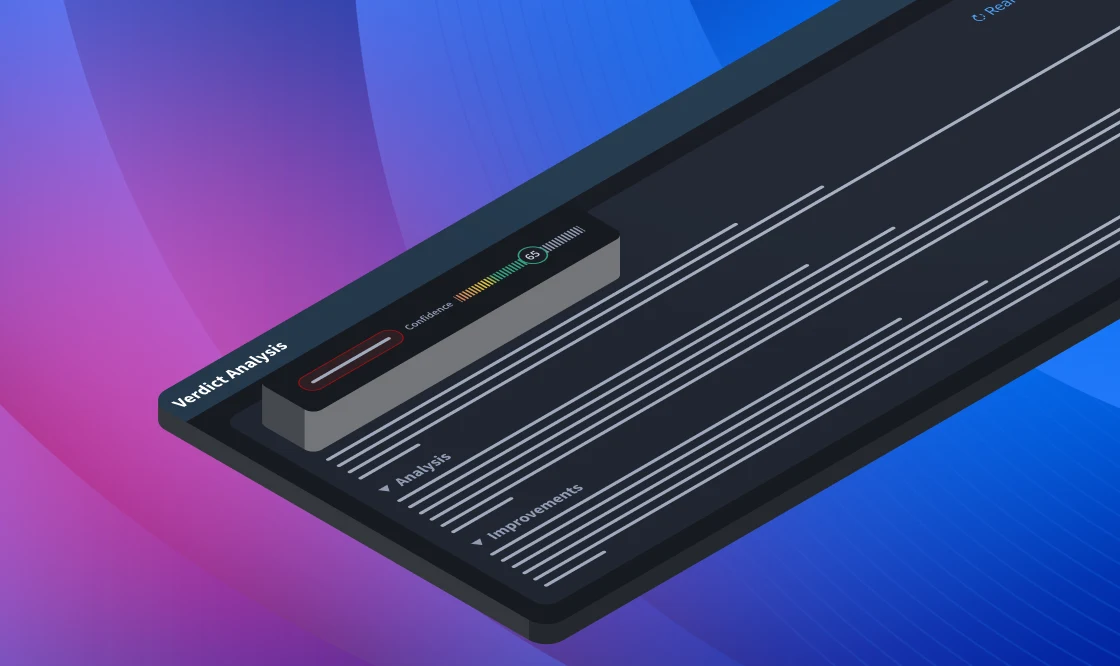
This blog post, the fourth and final in the series on Swimlane’s Hero AI agents, tackles the ultimate question in security operations: the alert verdict. Previous agents provided context and investigation plans, but the Verdict Agent is where that interconnected reasoning converges. It eliminates the SOC bottleneck—the unsustainable ask for analysts to consistently make and document good disposition calls at volume—by generating explainable, defensible verdicts that replicate an expert’s chain of reasoning, not just a binary “malicious” or “benign” outcome. Discover how this agent frees your senior analysts from routine cases to focus on novel threats, making autonomous closure safe, auditable, and real.
This is the fourth and final post in this series on Swimlane’s fleet of Hero AI agents. We’ve covered the MITRE ATT&CK & D3FEND Agent, which standardizes attack and defense language; the Threat Intelligence Agent, which synthesizes multi-source intel into a single assessment; and the Investigation Agent, which orchestrates end-to-end investigations and unlocks the path to auto-closure. Each of those agents produces context, enrichment, and analysis. But none of them answer the question that every alert ultimately comes down to…
So what do we do with this?
That’s the verdict. Malicious, benign, escalate, close. It’s the moment of decision, and in most SOCs, it’s the bottleneck. Not because analysts can’t make the call, but because consistently making good calls at volume, with documentation, while the queue keeps growing is an unsustainable ask at the scale most teams operate at.
The Verdict Agent is where the interconnected AI reasoning converges. It takes everything the other agents produce, the TI synthesis, the MITRE mappings, the investigation plan, layers in historical case context, knowledge base articles, and analyst notes, and generates an explainable disposition that mirrors what a well-informed analyst would conclude. The verdict is where trust is earned or lost. It’s where the AI SOC becomes real, or stays theoretical.
Let me push back on something I see in a lot of AI security marketing: the idea that a verdict is a binary classification. Malicious or benign. Thumbs up or thumbs down. That framing might work for a spam filter, but it doesn’t reflect how experienced analysts actually think about cases.
A real verdict is a chain of reasoning. It’s the analyst saying: “I’ve looked at the alert data, the enrichment shows this indicator has a mixed reputation across sources, we’ve seen this same pattern three times in the last month from this user and closed it as benign each time, the MITRE mapping shows T1566.002 but the D3FEND countermeasures confirm our email gateway already blocks this technique, and the linked case history shows this detection rule has a 94% false positive rate for this alert type. Verdict: benign, close it, no action required.”
That’s not a binary call. That’s synthesis. It weighs multiple inputs, applies institutional context, references precedent, and produces a judgment that’s explainable and defensible. The whole point of the Verdict Agent is to replicate that reasoning chain, not just the outcome, but the why.
This matters for two reasons.
Here’s the paradox that most SOC leaders live with: the cases that need the most analyst attention are the ones that get the least, because the volume of routine cases consumes all the available bandwidth.
Think about what a typical SOC’s queue looks like. Maybe 60-70% of cases are straightforward, known false positives, benign patterns, repeat alerts from noisy rules, and phishing simulations.
An experienced analyst can look at these and make a call in under five minutes, but they still have to open the case, review the enrichment, check the history, document the decision, and close the ticket. Multiply that by hundreds of cases a day, and your senior analysts are spending most of their time on work that doesn’t require their expertise.
Meanwhile, the cases that actually need deep investigation, the novel patterns, the ambiguous indicators, the alerts that might be the early stages of something real, sit in the queue getting older while the team works through the routine stuff. MTTD and MTTR suffer not because the team is slow, but because the team is buried.
The Verdict Agent breaks this cycle by handling the routine verdicts at machine speed with human-level reasoning. When AI agents enrich a case and the Verdict Agent assesses it against historical context, knowledge base (KB) articles, and analyst precedent, it can confidently disposition the obvious stuff, and it does it with full documentation, every time, without fatigue or shortcuts. That frees your analysts to spend their time where it matters: the ambiguous cases, the emerging patterns, the investigations that actually need a human brain.
This is the scalability unlock that most AI marketing promises but rarely delivers, because most approaches try to solve it with a single model that does everything. Swimlane Turbine’s agentic AI architecture is what makes it work. The TI Agent has already synthesized the intel. The MITRE Agent has already mapped the techniques and countermeasures. The Investigation Agent has already built the plan. By the time the Verdict Agent makes its call, it’s working with pre-processed, high-fidelity context from three specialized agents, rather than trying to do all that reasoning in a single pass.
I want to address governance directly, because I know this is where the conversation gets real for CISOs and compliance teams. Letting an AI agent close cases without human review sounds great for efficiency metrics, but the governance implications are non-trivial. What if the agent gets it wrong? What if an auditor questions the methodology? What if a regulator wants to understand the decision-making process?
Here’s how I think about it, and this is the framework I’ve used across multiple AI implementations.
First, you don’t start with autonomous closure. You start with the agent generating verdicts alongside your analysts, in shadow mode. The agent makes its call, the analyst makes their call independently, and you compare. This is the benchmarking phase I’ve been talking about throughout this series. Swimlane benchmarked its agents against approximately 35,000 human investigations before agents began to trust autonomous outcomes. That’s not a shortcut you can skip.
Second, autonomous closure isn’t an all-or-nothing proposition. You define tiers. The cases where the agent matches analyst judgment 98%+ of the time for a specific case type become auto-close candidates. For cases where agreement is 90%, the verdict is presented to the analyst for one-click confirmation. The cases where the agent flags low confidence or where the case type hasn’t been sufficiently benchmarked, those go to full human investigation. It’s a spectrum, not a switch.
Third, every autonomous verdict gets the full reasoning chain documented in the case record. The enrichment data, the TI synthesis, the MITRE mappings, the historical precedent, the referenced KB articles, and the specific logic that led to the disposition. If the case needs to be reopened or reviewed, the investigation record is complete. If an auditor asks questions, the answer is traceable. This is what makes AI-driven verdicts more defensible than the status quo, not less. Because right now, in most SOCs, the “documentation” for a closed case is a one-line analyst note that says “FP – closed” and that’s it. The Verdict Agent produces a more thorough record than most humans do under time pressure.
Fourth, and this is critical, you build the feedback loop. When an auto-closed case gets reopened, when an analyst overrides a verdict, or when a pattern changes, that data feeds back into the system. The agents get better over time because your institutional knowledge is continuously being captured and refined, not locked in analysts’ heads, where it walks out the door when they leave.
This series started with a simple thesis: the AI SOC isn’t one giant magic model. It’s a fleet of AI agents that each map to a step in the analyst workflow and collectively earn the right to carry more weight over time.
The four agents that I covered in this series are part of a much larger ecosystem of agents assembled in Swimlane Marketplace, plus the ability to build your own agents with Turbine Canvas. If you take nothing else from this series, the AI SOC isn’t about replacing your team. It’s about building a network of interconnected AI agents that earn the right to take the routine off their plate so they can do the work that actually matters.

Swimlane’s Hero AI Verdict Agent delivers explainable, defensible verdicts built on the full context of your security operations, so your team can focus on the work that actually needs them.
The Verdict Agent eliminates the SOC bottleneck of high-volume disposition calls by replicating an expert analyst’s full, defensible chain of reasoning, moving beyond simple binary classifications. It achieves safe, autonomous closure for routine alerts by synthesizing high-fidelity context from the entire fleet of specialized AI agents and institutional knowledge. Trust and governance for autonomous closure are built on a framework of incremental steps: Shadow Mode Benchmarking against human investigations, defining Progressive Autonomy Tiers, Documenting the Full Reasoning Chain for auditability, and implementing a Continuous Feedback Loop. This collective agent work enables the SOC to shift from reactive triage to strategic autonomy, ensuring senior analysts focus exclusively on ambiguous, novel threats.

 English English
  Français
 Deutsch
 日本語
日本語
 한국어
한국어
 Português
 Español