Swimlane Turbine
Read More



100+ customers with 450,000+ endpoints managed
Victrix is a Quebec-based IT consulting and managed security services firm founded in 2003. The company operates a managed security operations center (SOC) covering more than 100 customers across Canada, with over 450,000 endpoints under active management. Victrix delivers the full range of SOC services, including threat intelligence, vulnerability management, and continuous surveillance, and holds a proactive stance on emerging threats, including the latest MITRE framework developments.
When Victrix won a competitive RFP that added 45 new customers in the parapublic sector, covering more than 200,000 endpoints, the team needed a way to scale without a proportional increase in analyst headcount. That challenge launched a search for an automation solution that could absorb the volume and grow with them. They initially selected a security orchestration automation and response (SOAR) platform to scale their services, but ultimately that solution failed to meet expectations, so Victrix turned to Swimlane Turbine, the agentic AI automation platform.

Victrix invested in a SOAR platform expecting to automate at least 20% of incoming tickets within the first year. By the end of that year, they had not come close. Persistent bugs, integration failures, and gaps in core functionality meant the platform never delivered on its promises. “It was a fail,” said Patrick Côté, Manager of Cybersecurity at Victrix. “Each time we did a go-live, it always brought new problems.”

The previous SOAR had such a poor user experience that analysts routed around it entirely. Rather than working inside the platform, they continued using the old manual processes they had always relied on. Victrix found itself paying for a SOAR that its own team refused to use, leaving alert triage and incident response as manual as ever.

Built-in AI was a firm requirement for Victrix. The previous vendor had talked about it, but it never materialized in the platform. To continue to drive efficiency and stay on the cutting-edge of service innovation, Victrix knew they needed a modern alternative to SOAR.
Adding 45 new customers at once while operating with a lean analyst team demanded a platform backed by a strong implementation team. Victrix needed a partner that understood the specific demands of MSSPs, not just enterprise security buyers. The previous vendor’s support structure did not meet that bar.
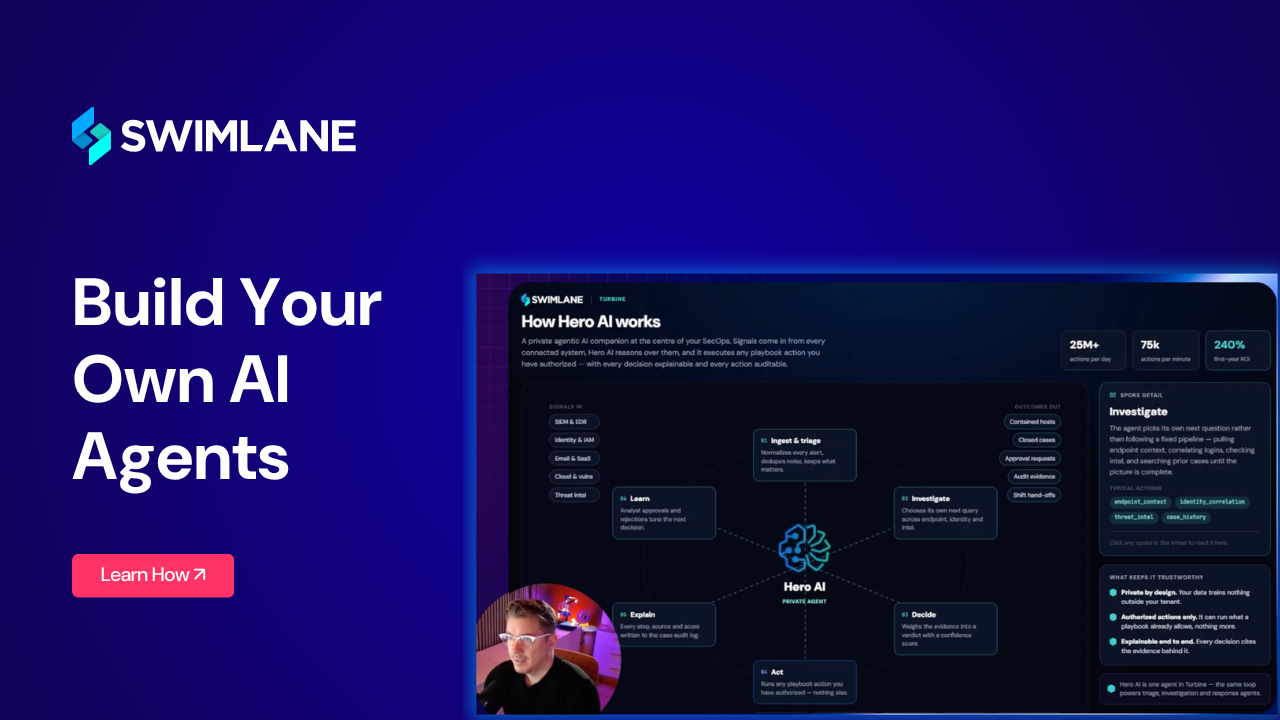
Unlike its predecessor, Swimlane Turbine delivers AI as a native capability inside the platform, not a roadmap promise. Victrix uses Hero AI, the platform’s native AI capabilities, to build playbooks in natural language and to run investigation and correlation within live workflows. The AI analyzes alerts, surfaces context, and presents conclusions to analysts who then make the final call. “The AI does the job of an analyst, totally,” said Côté. “It explains the tickets and alerts, and the analyst just has to decide if it’s okay or not.”
Since deploying AI-assisted playbooks, Victrix has recorded a 100% accuracy rate: every time Turbine recommends a resolution, the analyst reaches the same conclusion independently. As that track record extends over the coming months with further testing and validation, Victrix plans to allow the AI to take automated action on high-confidence case types without analyst sign-off.

Where the previous SOAR required separate, product-by-product integrations for each customer’s tools, Turbine takes a different approach. A single playbook and connector handles multiple EDR vendors simultaneously. Whether a customer runs Microsoft Defender, CrowdStrike, or SentinelOne, the same playbook logic applies with only the connector swapped behind the scenes. Victrix further streamlined onboarding by building an Azure enterprise application that centralizes permission management across all customer environments. The result: connecting a new customer no longer requires custom engineering work.
Victrix had originally selected Swimlane a year prior but moved elsewhere because Swimlane could not host data in Canada at the time. When Swimlane returned with a Canadian-tenancy option, Côté moved quickly to make the switch. “When Swimlane contacted me to say they could build a Canadian tenant for us, that idea stayed in my head,” he said. “I had to convince management, but I don’t regret that move.”
The Swimlane team matched Victrix’s urgency during deployment, working in parallel streams: rebuilding integrations and playbooks on one side while training Victrix analysts on the other. It was a compressed, high-pressure timeline, and it worked.
The Swimlane team helped Victrix reproduce everything built during a year on their previous SOAR in just three weeks. The migration ran in parallel with analyst training and went live without service disruption. “Even my boss doesn’t believe me when I say that,” said Côté. “But we did it.”

Every AI recommendation Turbine has produced in production has matched the analyst’s own conclusion. Victrix plans to use this track record as the basis for enabling fully automated resolution on proven case types within the next several months.

After months of analysts bypassing the previous platform entirely, the switch to Turbine produced immediate adoption. Every analyst working in the SOC now uses Turbine as their primary interface. No workarounds, no manual fallbacks.
With AI handling triage and investigation on routine cases, Victrix plans to redeploy half its analyst team from Level 1 tasks to higher-value Level 2 and Level 3 work, including security projects and proactive threat hunting, within six months.
Turbine’s Canadian tenant satisfied Victrix’s compliance requirement for in-country data residency, a non-negotiable constraint that had delayed the partnership by a year.
“Swimlane is a game-changer for us. The product is really great, but the team, wow. I love that team, really. We did in three weeks exactly the same that we did in one year with the previous one.”
— Patrick Côté
Manager of Cybersecurity, Victrix


Manager of Cybersecurity, Victrix
Patrick Côté leads cybersecurity operations at Victrix, including the company’s managed SOC. He oversees security services for more than 100 Canadian customers and is driving Victrix’s strategy to address emerging threats through agentic AI automation. Patrick was the driving force behind Victrix’s adoption of Swimlane Turbine and continues to lead the platform’s expansion into vulnerability management, reporting, and advanced threat detection.


Realize 240% ROI in year one through agentic AI with automated guardrails.
 English English
  Français
 Deutsch
 日本語
日本語
 한국어
한국어
 Português
 Español