
Incident Response
Read More


AI-enabled incident triage reduces false positives by using agentic AI automation to analyze alert context, severity, and patterns in real time. This approach filters out low-value alerts and enriches high-priority ones with relevant context, allowing security teams to focus on genuine threats and improve response accuracy.
AI-enabled incident triage uses artificial intelligence to automatically analyze, prioritize, and route security alerts. Instead of relying solely on manual processes or fixed rule sets, agentic AI automation evaluates alert context, severity, and patterns in real time. This helps security teams quickly identify what matters, while suppressing the false positives that often overwhelm analysts.
Manual alert triage slows response times and introduces risk. AI-enabled triage changes that by dynamically prioritizing alerts the moment they occur. This enables faster threat identification, streamlined workflows, and reduced time to resolution, all of which are critical for minimizing the impact of incidents.
False positives continue to be a top contributor to analyst burnout. With agentic AI, repetitive and low-value alerts are filtered out automatically based on historical data, behavioral patterns, and contextual insights. The result is a more focused, manageable alert queue that allows analysts to work more efficiently.
AI doesn’t just prioritize alerts, it enhances them with real-time context. Automated enrichment adds data points, such as asset details, user behavior, and threat intelligence, to help analysts make informed decisions faster. This accelerates incident resolution and reduces the time spent hunting for information.
With alert noise reduced and decisions backed by enriched context, analysts can redirect their focus to high-priority investigations and proactive threat hunting. AI-enabled triage allows organizations to maximize the impact of limited resources while reducing stress and fatigue among SOC teams.
AI triage automates repetitive tasks in incident response and ensures a consistent workflow for every alert type. This leads to faster detection and resolution, driving down key performance metrics like mean time to respond (MTTR) and mean time to detect (MTTD).
By offloading time-consuming triage tasks to AI, SOC leaders can better allocate human resources toward areas that require expert analysis or strategic oversight. This boosts efficiency, improves job satisfaction, and helps teams do more with less.
AI-driven triage can scale across hybrid, cloud, and edge environments, offering consistent performance without custom scripting or heavy engineering support. This scalability is crucial for organizations that operate across diverse environments or have growing security needs.
For organizations looking to operationalize agentic AI automation in a scalable, flexible way, Swimlane provides a platform purpose-built for this challenge. At the heart of Swimlane’s approach is a centralized case management system that unifies alerts, automation, and context within a single interface. This allows analysts to act more quickly and with greater confidence, without getting buried in noise.
Swimlane Turbine captures hard-to-reach telemetry and acts on it at the point of inception. By eliminating alert delays and reducing false positives, Turbine delivers real-time prioritization and contextual enrichment directly into analyst workflows. With adaptable playbooks and autonomous integrations powered by AI automation, security teams can triage and respond faster while extending automation across every part of their environment.
By embedding AI agents within a flexible, scalable automation framework, Swimlane enables teams to overcome alert fatigue and achieve efficient, reliable incident response across the enterprise.
Learn how Swimlane helps security teams triage high volumes of EDR alerts with precision and speed using agentic AI automation.
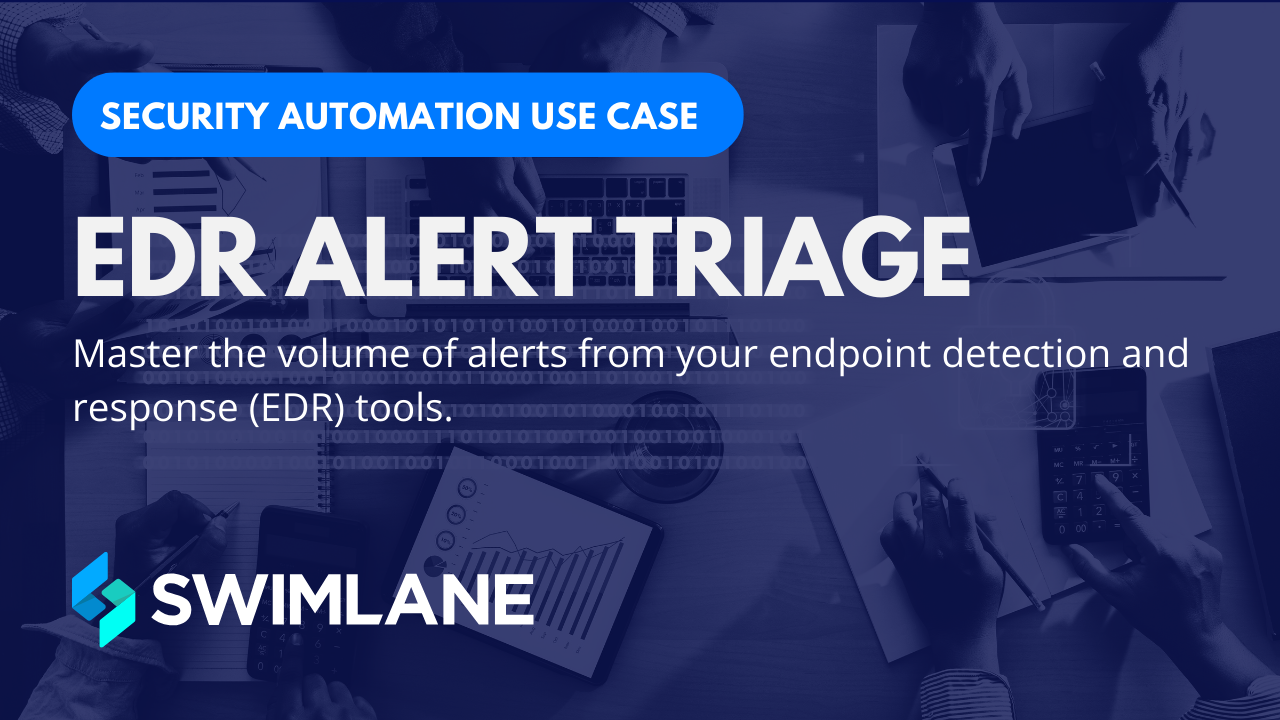
Learn how Swimlane helps security teams triage high volumes of EDR alerts with precision and speed using agentic AI automation.
AI-enabled incident triage uses agentic AI automation to evaluate security alerts in real time, filtering out false positives and enriching relevant alerts with contextual data. This reduces response times, minimizes alert fatigue, and allows analysts to focus on real threats. Unique to this approach is the ability to scale consistent triage across complex environments without custom engineering. Swimlane enables this by combining AI agents, autonomous integrations, and centralized case management to deliver accurate, real-time incident response at scale.

 English English
  Français
 Deutsch
 日本語
日本語
 한국어
한국어
 Português
 Español