
Your AI Automation Platform Decision is Missing Someone
Read More


An AI SOC analyst combines human security expertise with AI agents that can research alerts, analyze related activity, prepare investigation plans, complete defined tasks, and document the work. Agentic AI augments security analysts by expanding how much they can review, understand, and act on without reducing human control.
Agentic AI, in this context, means AI agents that can plan multi-step investigation work, take defined actions, and adjust the plan as new evidence appears.
For security teams, that means less time spent moving between consoles, transferring data into cases, and repeating routine steps. Agents can bring identity, endpoint, cloud, email, threat intelligence, and case context together around the specific question the analyst needs to resolve.
Even as AI adds speed and structure to the work, human judgment remains central to conclusions and decisions involving intent, business impact, conflicting evidence, or disruptive action.
AI SOC analysts use AI-enabled tools and agents to investigate alerts, assess recommendations, and guide response. Their work centers on directing automated tasks, validating the supporting evidence, identifying conclusions that lack enough evidence or overlook important context, and deciding when human intervention is required.
Compared with a traditional SOC role, they spend less time carrying out routine steps manually and more time shaping investigation paths, setting action limits, reviewing exceptions, and improving how agents apply SOC procedures. The role shifts from executing every step to supervising the quality and direction of the response actions.
Pro Tip: Evaluate the role by the quality of decisions and oversight it enables, not by how many manual steps disappear.
AI makes the biggest difference in the time-consuming early stages of an investigation: gathering and verifying evidence, reasoning through competing explanations, and shaping the investigation plan.
Analysts often have to piece together and verify information from several disconnected sources before they can begin the analysis. AI handles much of that preparation by collecting relevant context, removing duplicates, updating the case, and highlighting gaps or contradictions.
The investigator starts with a clearer account of what happened, what remains unknown, and where the assessment should go next. From there, AI can support research, reasoning, and planning as the investigation develops.
AI gives analysts more time to examine how the evidence fits together instead of spending it collecting records. It identifies relevant activity and helps establish whether separate events belong to the same sequence.
The AI agent may surface:
The AI assistant can align timestamps, link activity to the same identity or session, flag contradictions, and identify missing records. It can also distinguish between a source that shows no suspicious activity and one that could not be checked successfully.
Investigators usually consider several possible explanations and compare each one against the evidence.
The activity could have several explanations:
An AI agent can organize those possibilities and show which findings support or weaken each one. The analyst can then test competing explanations before deciding what the activity means.
Once the evidence supports deeper review, agentic AI can propose a plan based on the alert type, current context, SOC procedures, organizational policies, and previous outcomes.
The investigation plan might include:
The analyst can revise the sequence as new evidence changes the direction of the security assessment. This keeps the work responsive to the evidence while following established procedures.
Enterprise SOCs and MSSP teams need a clear operating boundary between execution and judgment. Routine steps such as running approved queries, creating tickets, updating case records, or preparing handoff notes can often move forward automatically.
Response actions that could disrupt users, systems, or business operations need tighter controls. Account suspension, session revocation, endpoint isolation, email removal, or access changes may require approval before execution. Cases that involve legal, privacy, HR, fraud, or other business functions also need input from the relevant stakeholders before the response moves forward.
Teams should define these limits by use case, customer, asset criticality, and potential impact. That prevents automation from moving forward on assumptions and creates a clear point for human intervention. The process should make it clear when the AI assistant can proceed, when it must pause, and who must authorize the next step.
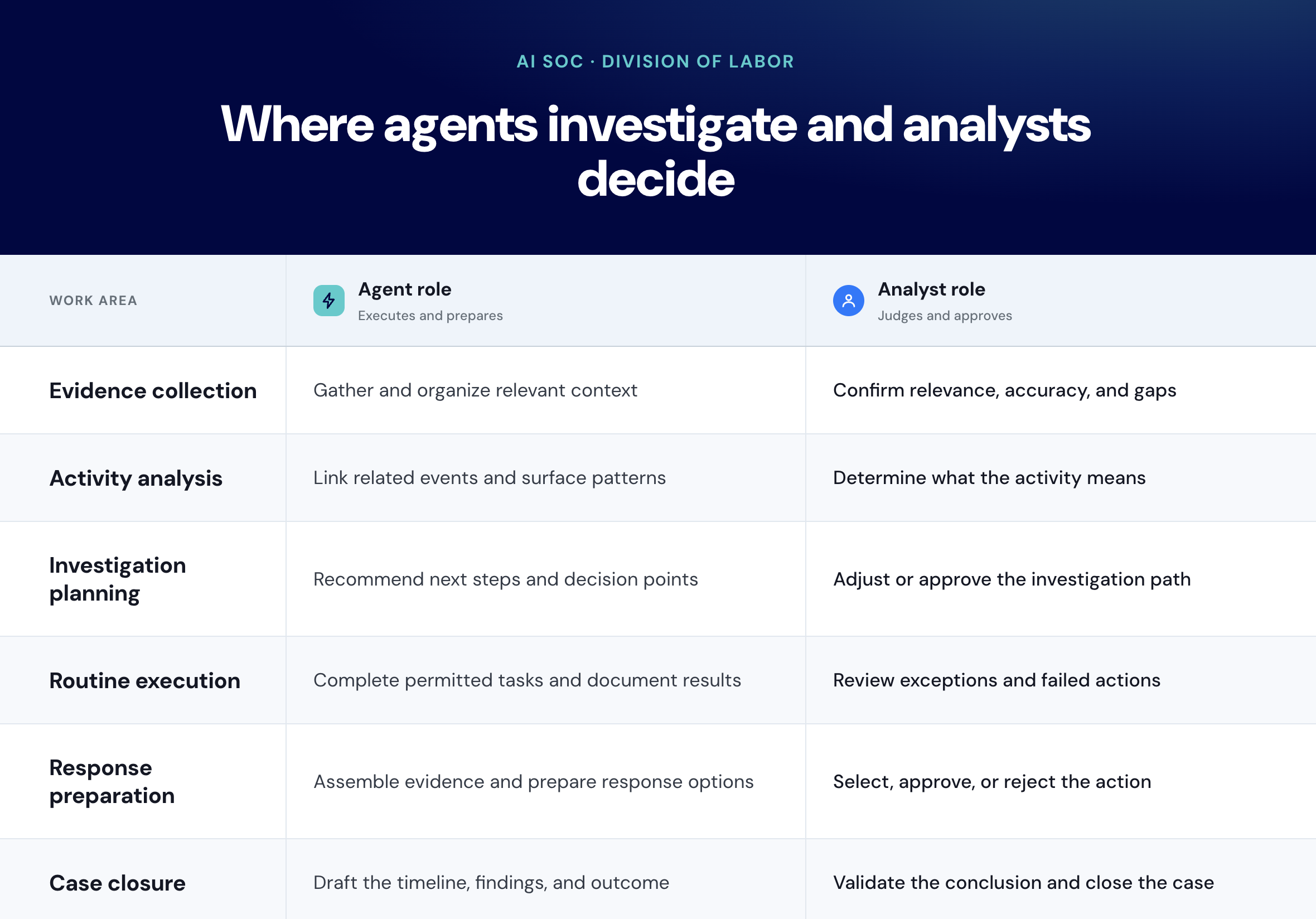
AI contributes differently depending on the volume of work, the complexity of the assessment, and the impact of the response.
For recurring alerts, AI agents can collect standard context, verify required sources, and apply approved criteria before routing the case for closure or escalation. The SOC team can focus on alerts that fall outside the expected pattern or require closer review.
Investigations that span identity, endpoint, cloud, email, and other systems require more than routine enrichment. AI assistants can align activity across sources, build timelines, and surface relationships that would take longer to trace manually. The SOC team can spend more time assessing scope, intent, and likely impact.
Cases involving privileged users, critical systems, sensitive data, or customer operations require greater human involvement. Agentic AI can prepare response options, assemble supporting evidence, and route the required approvals. The reviewer then determines whether the proposed action fits the facts and the operational risk.
SOC leaders need to understand where work slows down, which tasks remain manual, and where analysts override agent recommendations. Structured records can reveal procedural gaps, training needs, approval bottlenecks, and automation paths that need adjustment.
A pilot can show how an agent performs in one investigation. Wider adoption requires that support remain reliable across different teams, tools, and use cases.
Before expanding AI across the SOC, teams should confirm that analysts can see:
The investigation record should reflect the work as it happens, including completed actions, exceptions, and changes in direction. Analysts can then review the full history without rebuilding it from separate tools.
Pro Tip: Test the failure path before the success path. Confirm that the AI clearly shows missing data, stopped actions, approval requirements, and ownership when the process cannot continue as expected.
Swimlane Turbine gives AI SOC analysts one operational layer for investigation, decision-making, response, and reporting. It combines agentic AI, low-code playbooks, case management, dashboards, and broad integrations so teams can apply AI within established SOC operations.
Turbine uses a glass box approach and lets analysts see which sources informed the work, what the agent completed, where information remains unavailable, and when the response process requires human input. It helps teams review AI-supported decisions without separating them from the underlying evidence.
AI agents work inside defined playbooks. They can gather and compare evidence, prepare assessment paths, request human input, complete permitted tasks, and record the work in the case as it happens.
Low-code playbooks give teams the flexibility to adjust investigation and response paths as policies, tools, and use cases change. Case management keeps the evidence, decisions, actions, and outcomes connected in one record.
Turbine coordinates work between SIEM, EDR, XDR, identity, cloud, email security, ITSM, threat intelligence, vulnerability management, and other systems. It complements the systems that generate alerts by helping the SOC investigate them, determine the next step, and carry approved actions through to remediation.
Dashboards and reporting then give leaders visibility into workload, delays, exceptions, approval timing, and operational outcomes. The result is an AI-enabled SOC where agents extend analyst capacity without separating automation from the investigation process.
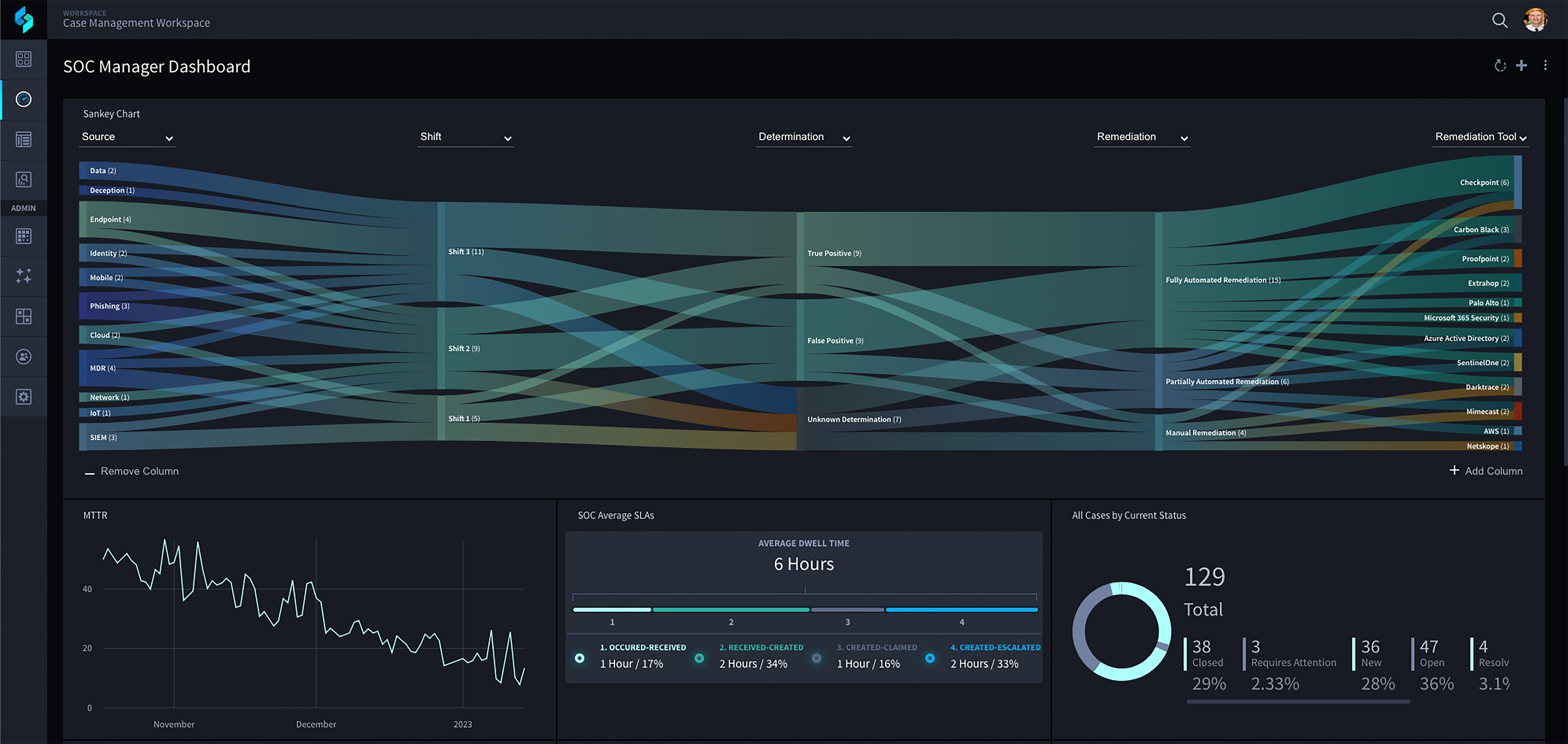
Turbine brings agentic AI, low-code playbooks, case management, and integrations into one operational layer so analysts can direct AI-supported investigations, control what gets automated, and keep every decision connected to the evidence. Built for enterprise SOCs and MSSPs.
Effective AI augmentation gives analysts more time for investigation, supports stronger decisions, and brings greater consistency to SOC operations.
Measure reductions in time spent collecting evidence, updating cases, managing handoffs, and completing repetitive administrative work.
Review whether analysts have more complete evidence, reach consistent escalation decisions, and resolve cases with fewer unanswered questions.
Assess how reliably approvals, exceptions, overrides, and automated actions follow the intended process.
Examine whether teams apply the same investigation standards across shifts, regions, use cases, and customer environments.
The clearest measure is whether the SOC can reach well-supported decisions faster and with less operational friction.
As AI becomes part of daily security work, its impact will be seen in how teams handle pressure, uncertainty, and complex decisions. Analysts will have more support around them, while the quality of the outcome will continue to depend on how well the SOC applies context and judgment.
The AI SOC analyst represents a more capable way of working, giving security teams the support to investigate thoroughly and respond without unnecessary delay.
See how Swimlane Turbine helps analysts investigate alerts, coordinate response across the security stack, and keep every critical action connected to the evidence. Request a demo.
Yes, they can use data and actions from the tools already in place, provided those systems can share the required context through supported integrations, APIs, or workflows. The main consideration is whether the connected sources provide enough reliable information for the task.
Good starting points include phishing review, suspicious login analysis, vulnerability coordination, alert enrichment, and other repeatable processes with clear data sources and escalation criteria. Teams can expand into more complex cases as they gain confidence in the results and operating controls.
Strong security fundamentals remain essential, even while working with agentic AI. Analysts also need to know how to validate AI output, question unsupported conclusions, adjust investigation paths, and define when automated work should stop for human review.
MSSPs can apply customer-specific playbooks, approval paths, access limits, and reporting requirements while using a common automation platform. This helps maintain consistent service delivery without treating every customer environment the same.
No. Human judgment stays central to decisions involving intent, business impact, conflicting evidence, and disruptive action. Swimlane Turbine automates evidence gathering, research, and routine execution, so analysts spend their time on the decisions that need a person, not on approving every step.

 English English
  Français
 Deutsch
 日本語
日本語
 한국어
한국어
 Português
 Español