
AI SOC: How Artificial Intelligence Is Transforming Security Operations
Read More


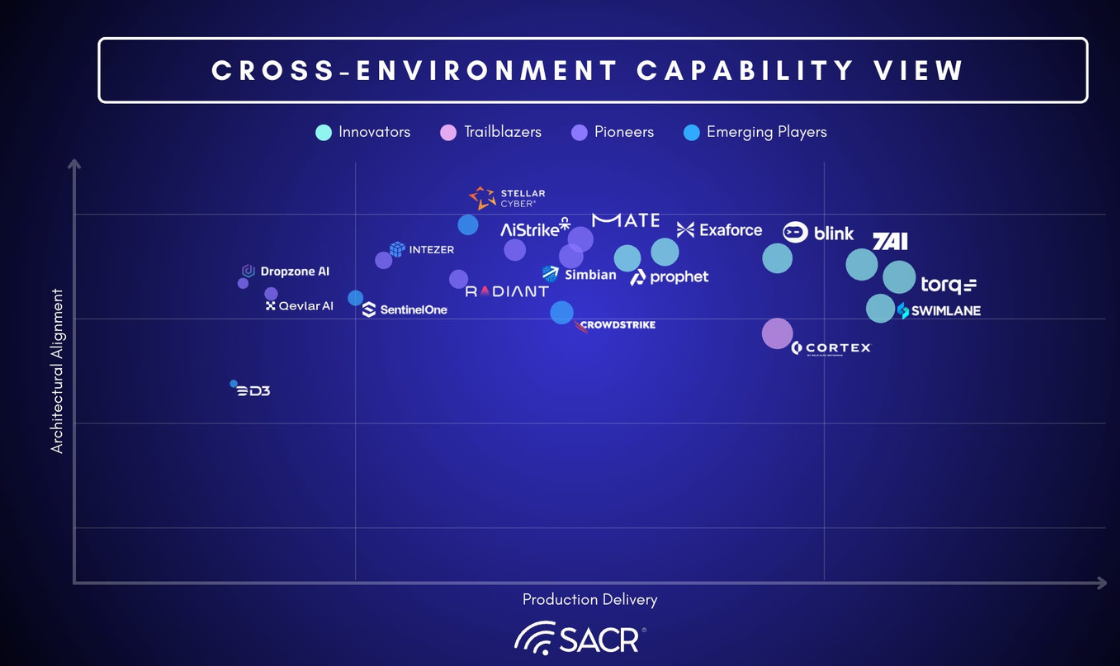
Software Analyst Cyber Research (SACR) just published Part 2 of its AI SOC Technoscope Series, an independent evaluation of 18 vendors across regulated enterprise, hybrid mid-market, and cloud native SOC environments. Swimlane landed in the Innovator category, the top tier reserved for vendors that combine deep architectural alignment with credible production delivery. That placement is worth unpacking, both for what the report got right and for a few places where we can dig deeper on Swimlane.
Software Analyst Cyber Research placed Swimlane in the Innovator category, the top tier, in Part 2 of its 2026 AI SOC Technoscope Series evaluating 18 vendors. In production, Swimlane’s Hero AI cuts one customer’s daily case queue from 180 cases to 36 requiring human review, while Turbine still executes roughly 26,800 automated actions a day.
SACR’s central argument in this report is that architecture alone doesn’t determine leadership. AI-native platforms, automation-derived platforms, and consolidated security suites can all reach the Trusted SOC destination, just by different roads. Swimlane’s story began with automation, and the report treats that as an advantage rather than a limitation. It credits Swimlane with combining federated evidence access, production AI reasoning, mature governance, and dependable execution across a customer’s existing stack, the same combination that earns AI-native challengers a seat at the same table.
That distinction matters because it recognizes this capability set as an architectural advantage rather than a market category with its own perception attached. SACR recognizes automation platforms, like our own, but separates them on one basis: whether the AI layer is portable and provable, or bolted on.
Portable vs. Proven AI SOC: The report is explicit that Swimlane clears the bar of proven AI SOC rather than a bolt-on or marketing-claimed feature. The difference comes down to an experience centered on a chatbot added on to an old workflow engine versus a solution built from the ground up as an AI-native product to derive the maximum value from AI and automation.
The report’s read on Swimlane Turbine centers on case management, which carries evidence from intake through enrichment, investigation, recommendation, approval, execution, verification, and closure. Every one of those phases is transparent to the analyst, including what Hero AI recommended, what a human approved or overrode, what was executed, what failed, and what got rolled back.
SACR also calls out the breadth of the action surface, spanning endpoint, identity, cloud and runtime, email and collaboration, ITSM, network, and custom APIs, and the governance wrapped around it: role-based agent identities, policy decisions that weigh confidence, asset criticality, blast radius, and incident severity, and analyst authority to edit, pause, reject, or escalate any AI-generated action plan. That’s why Turbine is trusted in the most demanding environments of the Fortune 500, Managed Services, and Government.
The SACR report takes customer experience into account, but doesn’t state it explicitly. SACR’s evaluation describes the architecture well but doesn’t show how that plays out in customer environments against real alert volume.
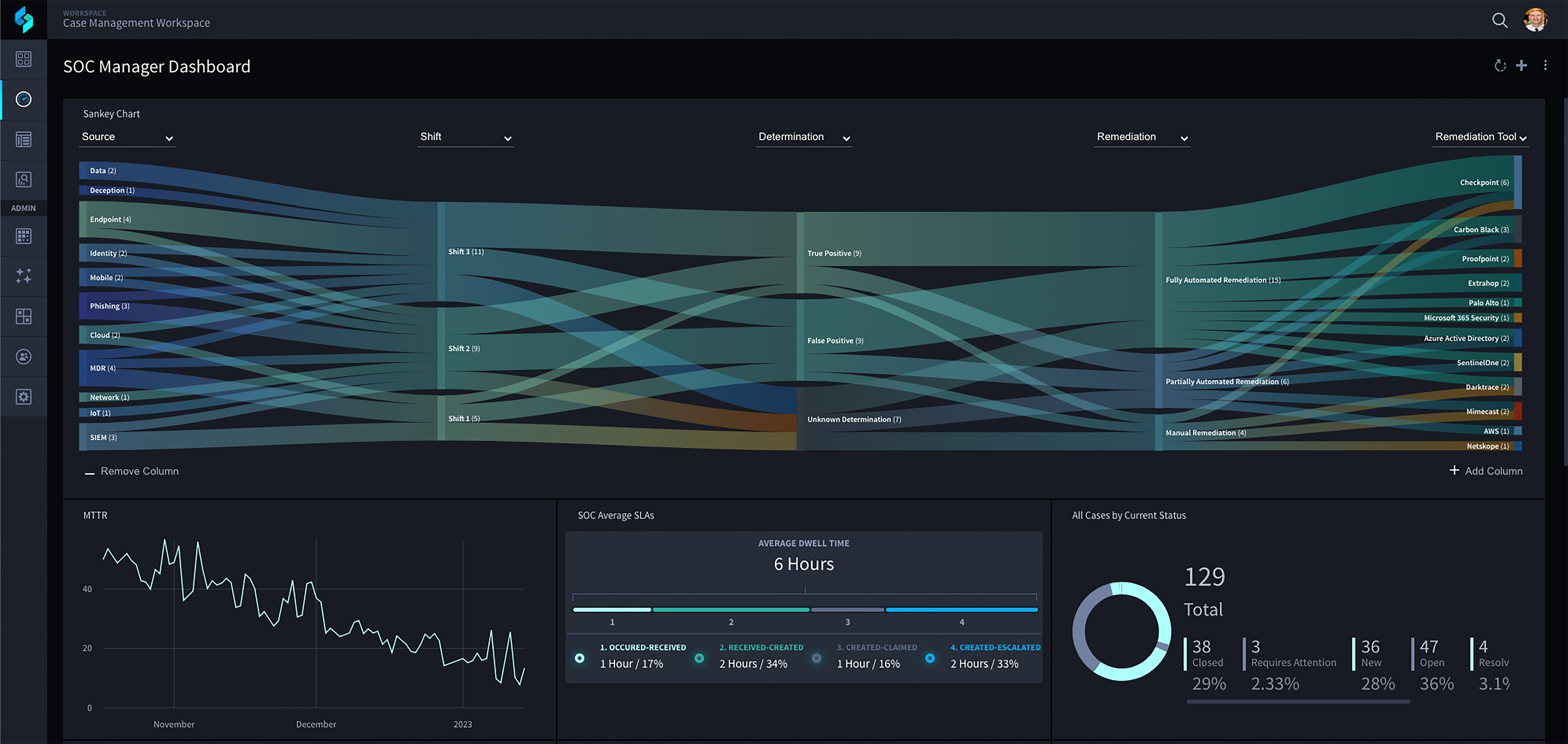
A Swimlane Turbine customer, a health research organization, runs roughly 26,800 automated actions and 180 new cases on a typical day.
Intelligent routing within Swimlane AI SOC decides, per case, whether AI is warranted. Cases with a deterministic answer go to automation. Only cases requiring reasoning consume AI. That distinction is what makes the funnel below economically different from a platform that runs every case through a model.
Of the 180 cases, 128 close automatically as informational, requiring no further action but are retained for audit and compliance. For the vast majority, no AI is spent, no analyst time is taken, and there is no gap in the record. That leaves 52.
Sixteen of the 52 are Microsoft Defender alerts. Turbine links each alert to its parent Defender incident, so the analyst works the incident once and the child alerts close with it. No separate triage of alert and incident.
That leaves about 36 cases carrying Hero AI case analysis and human judgment. Those 36 consume roughly 1250 Hero AI credits combined, about 35 credits per case.
The funnel: 180 cases in, 36 to an analyst, at a prompt volume many vendors would call light for a single case, let alone an entire day’s queue. The savings are not from doing less work. Turbine still executed 26,800 actions that day. They come from not paying a model to decide things that do not require a model.
In both hybrid and cloud native (multi-cloud) environment breakdowns, SACR credits Swimlane with clearing the leadership threshold, then adds a caveat about administrative weight.
That framing deserves a closer look, because “administrative weight” and “time to value” are two different measurements, and the report only addresses the first. On the second, the evidence tells a different story. One customer went from 0% to 100% automation of Level 1 triage tasks in five months running on Swimlane. That’s not the adoption curve of a platform that fights its operator at every step. It’s the adoption curve of a platform where governance and automation maturity front-load the work so the automation compounds instead of requiring constant babysitting.
The report is right that Swimlane is not a chat-first point solution. In practice, it shows up in product with true scaled automation, not manual triage via a chat interface, and the initial investment is paid back in scaled work reduction.
There’s a second data point worth adding to the governance conversation, since SACR spends real space on whether AI SOC vendors can be trusted to reason correctly before they act. In production evaluations at Victrix, a Canadian MSSP, Hero AI’s investigation conclusions matched human analyst judgment 100% of the time. That’s the kind of evidence the report’s own Decision Assurance and Governance Axis is built to reward.
The report goes to great lengths to cover and summarize a crowded market, so understandably not all details made the cut. Here are a few important facts about Swimlane that we want you to know.
Hero AI doesn’t bet a SOC’s operations on a single model or even a single framework to manage workloads. Core reasoning runs on a fallback chain of models available in discrete and data-sovereign deployments globally, so a rate limit or an outage on one model doesn’t take down triage; it just steps down to the next model in line.
Certain capabilities, like Hero AI’s playbook generation agent, run on a different model entirely, picked because it’s the right tool for that specific job. Administrators can also override default routing and assign specific models to individual actions or across the whole tenant, so a team can match model performance to the task instead of accepting one-size-fits-all reasoning and can also bring-their-own-model (BYOM).
Most AI SOC tools reason over whatever the current alert hands them. Hero AI pulls in an individual customer’s, or in the case of an MSSP, an end customer’s prior case history, analyst comments and decisions, integrations, intelligence sources, runbooks, regulatory compliance, and history directly from the platform, and Model Context Protocol (MCP) support extends that reach into other connected tools and data sources. That means a verdict reflects what actually happened in this environment before, not just what a model assumes based on the alert in front of it.
The Swimlane AI SOC doesn’t reach a conclusion and stop. It runs through shadow mode benchmarking against real human investigations, moves through progressive autonomy tiers as it earns trust, documents its full reasoning chain for auditability, and feeds every outcome back through a continuous feedback loop. That loop is what separates a system that automates a fixed set of decisions from one that keeps refining its own judgment as it sees more cases.
None of this shows up in a bubble chart. All of it is why the funnel numbers above hold up at scale instead of falling apart the moment the alert volume gets messy.
SACR’s own framing is the right one to close on: the Trusted SOC isn’t purchased as a platform; it’s built by granting AI agents authority only when the evidence, governance, reliability, and verified outcomes support it. Swimlane’s Innovator placement reflects a platform that earns that authority through a federated data fabric, a governed case record, and cross-stack execution most automation-derived products can’t match.
What the report doesn’t fully capture is what that architecture looks like once it’s running against real volume: a queue that shrinks from 180 cases to 36 before Hero AI or a human ever has to dig in, an automation curve that goes from 0 to 100% in months rather than years, and investigation judgment that’s held up against human analysts at 100% accuracy. Architecture explains why that’s possible. The numbers are the proof it’s actually happening.
The SACR 2026 AI SOC Report proves that architecture determines the ceiling for your SOC’s performance. Don’t settle for bolt-on automation that creates more administrative weight.
See how Swimlane’s proven AI SOC product drives down case volume, and delivers unmatched accuracy.
Innovator category, the top tier.
SACR credits it with combining federated evidence access, production AI reasoning, mature governance, and cross-stack execution, not a chatbot layered on an old workflow engine.
100% match with human analyst judgment in production evaluations at Victrix, a Canadian MSSP.
One customer went from 0% to 100% automation of Level 1 triage in five months.

 English English
  Français
 Deutsch
 日本語
日本語
 한국어
한국어
 Português
 Español