
Autonomous SOC: The Evolution of Self-Driving Security Operations
Read More


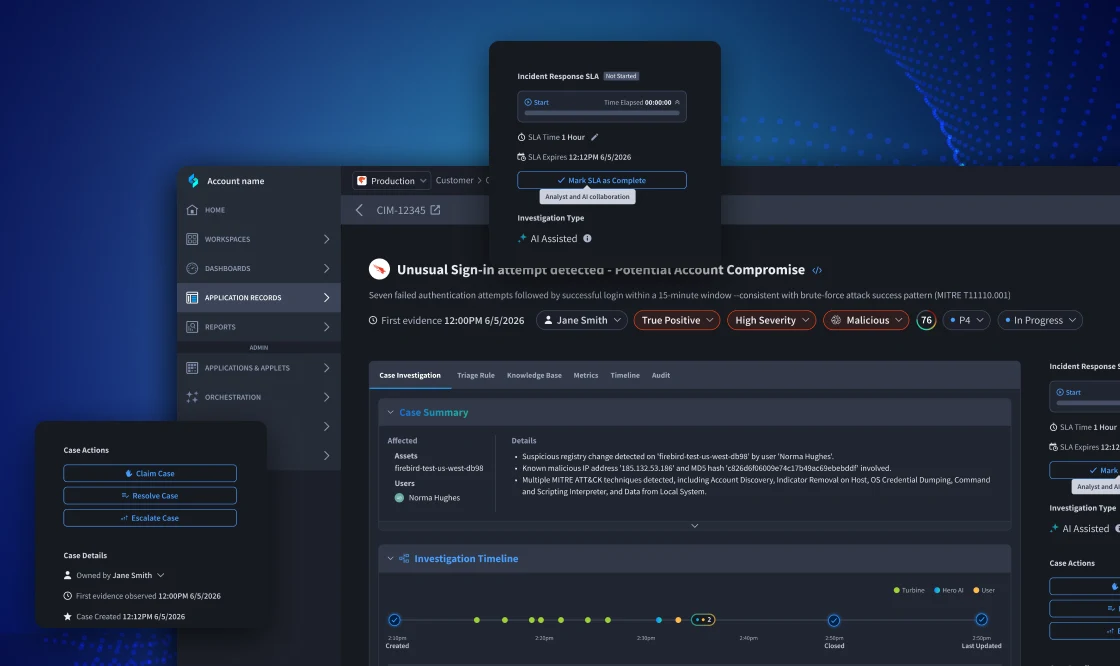
Adding an AI model to a security environment does not create an AI-driven SOC. A model can summarize an alert, suggest a next step, or interpret a set of findings. Those capabilities may help an analyst, but they do not explain how an investigation moves from an initial alert to a defensible decision and coordinated response.
Access to a capable model offers little differentiation. The harder problem is giving AI enough understanding of the customer’s environment to interpret an event correctly. An unusual action may point to a threat, an approved business process, or a gap that requires deeper investigation. General security knowledge alone cannot resolve that difference.
AI SOC architecture turns that understanding into an operating model for investigation and response.
AI SOC architecture brings security evidence, organizational context, decision logic, response actions, and human oversight into one operating framework.
Its purpose is to help the SOC understand what an event means inside the customer’s environment and carry that understanding into the appropriate response. Security telemetry establishes the initial facts, but organizational and operational context determines what those facts mean inside the organization’s operating context.
The same architecture must also connect the investigation to a supported verdict and an appropriate response. Some use cases allow remediation to proceed automatically, while others keep the decision with an analyst. The investigation may also reveal related activity, a root cause, or changes needed to strengthen the environment.
A practical way to view the architecture is:
| Collect → Contextualize → Investigate → Decide → Respond → Improve |
AI supports this operating flow through contextual analysis, investigation planning, and decision support. Integrations, orchestration, scalable data processing, customer-defined controls, and analyst expertise make that intelligence operational.
Early AI SOC designs focus on alert-centric architectures instead of investigation-centric architectures that reason across independent events and time. These designs also lacked continuous learning. An alert and a small set of related findings could support initial interpretation, but they don’t show how the activity fits into the organization’s wider environment.
Without access to broader organizational knowledge or past learnings, the resulting verdict remains incomplete or misses a legitimate explanation for the activity.
Enterprise scale exposes another weakness. Security teams work with data volumes that are impractical to send directly to an LLM, while many routine investigations already follow well-established procedures. Running all of that work through an agentic process adds cost and processing time where bulk analysis or deterministic playbooks are better suited.
Recommendations also have limited operational value when they remain separate from the systems used to investigate, respond, and manage the case. First-generation designs could assist with interpretation, but they often lacked the connected operating structure needed to carry security work from initial evidence through resolution. Addressing those limitations requires an architecture built to support the full investigation.
A production-ready AI SOC connects evidence, context, investigation, response, and post-incident improvement. Each component builds on the last, while data processing, AI agents, orchestration, and analyst expertise each perform a defined role across that flow.
Every investigation starts with access to the right evidence. Security alerts, identity records, asset data, cloud activity, endpoint telemetry, internal approvals, and operational records all contribute to the final assessment.
A federated approach leaves data in its existing source and retrieves only what the investigation requires. Relevant organizational relationships remain available for repeated use, while live queries bring current information into the case.
Large datasets require preparation before an agent examines them. Authentication activity and vulnerability findings often reach millions of records.
General security knowledge helps an agent recognize suspicious activity, but the quality of the investigation depends on how well it understands the customer’s environment.
That understanding includes identities, permissions, assets, internal approvals, previous case decisions, and activity occurring during the incident. AI SOC architecture brings that information into the investigation through real-time source queries and maintained knowledge and context graphs.
The same investigation may also involve service accounts or machine identities running scripts, background services, or automated processes. To judge whether the activity is expected, the investigation must understand the identity and if it is authorized.
These relationships change as permissions are added or removed, so the architecture must maintain them over time rather than rely on a single log query or API response.
The impact of a compromise depends on the systems and information the asset can access. Access to a routine internal resource carries a different level of risk from access to financial data, sensitive cloud storage, critical infrastructure, or high-value endpoints. Connecting identity relationships with asset importance gives the investigation a clear view of potential impact.
The explanation for unusual activity often exists outside the security stack. Internal tickets, collaboration channels, and documentation systems establish whether unusual activity was planned or approved. Connecting those records with security evidence gives the business explanation behind the event.
Employee context also shapes the verdict. Role and department, travel, leave status, employment status, and expected activity during the incident window help establish whether the behavior fits the situation.
Analysts add organization-specific knowledge whenever they review a case. Their comments, documented exceptions, and final decisions capture details that were not present in the original evidence.
Retaining that information gives future investigations access to the organization’s history. Agents use earlier outcomes as context, while experienced analysts continue to guide complex cases.
A knowledge base holds the established information an investigation depends on: identities, permissions, assets, business roles, approvals, and previous cases. Storing those records together, along with their relationships, lets the investigation retrieve connected context rather than isolated facts.
Maintaining these relationships in advance prevents the platform from rebuilding the environment for every investigation. The agent retrieves relevant context in real time and reasons accurately against information the security team owns and can edit. Every entry remains visible, so an analyst reviewing a determination can trace it back to the evidence that produced it.
Once the evidence and organization context are available, the investigation determines whether the activity is benign, suspicious, or malicious.
AI connects findings across sources, identifies gaps in the available information, and directs the next line of inquiry. Deterministic playbooks complete checks with established logic, while agents handle evidence that requires interpretation within the organization’s operating context.
The verdict must account for both the technical evidence and the circumstances surrounding the activity. Organizational context can confirm a legitimate explanation, reveal unresolved inconsistencies, or strengthen the case for a malicious classification.
Analysts step in when evidence remains incomplete, the surrounding context is unclear, or the potential impact demands expert judgment. A defensible verdict gives the response process enough evidence and context to act without restarting the investigation.
No single level of automation suits every organization or every incident. Some organizations want AI to propose an investigation plan and wait for a person to decide what happens next. Others allow an agent to carry more of the investigation forward. A routine, low-impact action may run automatically, while a response involving a sensitive account or critical system stays with the analyst.
Customer-defined settings determine:
The orchestration layer connects the verdict to the systems where action must occur. It coordinates tasks, applies workflow conditions, updates the case, and carries out approved response steps across connected tools.
Faster attacks demand faster containment. The architecture supports automatic remediation where the customer authorizes it and preserves human judgment where the organization requires it.
The work continues after the immediate response. Post-incident activity identifies how the exposure occurred, assesses the incident’s impact, addresses weaknesses in access and controls, and strengthens the environment to prevent similar incidents in the future.
The investigation also produces knowledge that supports later investigations. Final verdicts, analyst observations, and documented exceptions become part of the organization’s case history, alongside the hunting and hardening work completed after containment.
The incident closes, but its evidence and analyst input continue to improve the SOC’s understanding of the environment.
The five components operate as one investigation path rather than separate layers. Consider an alert involving a copy of data from a sensitive S3 bucket.
A confirmed threat would continue into remediation, where hunting, hardening, and retained case knowledge complete the investigation cycle.
AI SOC architecture depends on access to information and actions across many systems. Traditional integrations require connectors, authentication, and supporting content for each source. MCP introduces a more flexible way to make those systems available to AI-driven workflows.
A polished summary or convincing recommendation does not reveal how well an AI SOC will perform inside a live security environment. Evaluation should focus on the information available to the system, how investigations move across tools, and where the organization retains control.
Swimlane Turbine connects agentic investigation with the orchestration required to move security work across the environment. Agents do not operate as a separate recommendation layer. They work with the automation platform that connects investigation decisions to established procedures and security tools.
Turbine preserves different operating models within the same platform. Predictable work remains in deterministic automation, while agents take on investigations that require greater interpretation. Customers decide how much of the investigation and remediation proceeds automatically for each use case.
Agentic reasoning and security execution stay connected within the same AI SOC architecture. Analysts gain more support without losing control over the procedures and actions that shape the outcome.
With MCP client support, Swimlane connects to supported customer systems from within Turbine Canvas or the AI SOC experience. Agents gain another way to retrieve the information needed for an investigation, while natural-language interaction reduces the work of defining how the platform reaches those sources. This expands the data collection layer without requiring every interaction to be built as a separate integration flow.
As an MCP server, Swimlane allows external AI and development tools like Claude Code, Cursor, ChatGPT, Microsoft Copilot, Gemini CLI to call its automation capabilities. Customers can create automations in the tools they already use, then call Turbine to execute those automations across their security environment.
This separates where the automation is created from where it runs. External tools could support the authoring experience, while Swimlane provides the orchestration and execution foundation behind the action.
The pressure on security teams will continue to increase as attack activity becomes faster and more automated. The answer is not to remove people from the SOC, but to build an architecture that gives them more control over where speed, automation, and judgment belong.
Controlled autonomy provides that middle ground. It allows routine investigations and approved response actions to move faster, while analysts remain responsible for exceptions, high-impact decisions, and the business consequences of a response.
The organizations that get this right will not be those that automate the most. They will be the ones that define the boundaries most clearly and build an architecture capable of operating within them.

See how Swimlane Turbine turns AI-led investigation into coordinated security action while keeping teams in control.
Traditional SOAR architecture centers on deterministic playbooks that execute predefined security procedures. AI SOC architecture extends that foundation with agents that interpret customer-specific context, investigate activity that does not follow a fixed path, and contribute to verdict decisions. Victrix replaced its SOAR with Swimlane Turbine, migrating a year of work in three weeks.
No. An AI SOC does not need to send every security record to an LLM or copy every source into a new repository. High-volume data can be processed before AI examines it, while relevant information can be retrieved from source systems when an investigation requires it.
An AI SOC can take on more of the investigation and response process, but fully removing human oversight is not the objective. The stronger model is controlled autonomy, where automation expands within defined operating boundaries and analysts retain authority over decisions that require expert judgment or carry greater operational impact.

 English English
 Français
 Deutsch
 日本語
 한국어
 Português
 Español