
AI SOC with Intelligent Deep Agents
Read More


Security teams are being asked to do more without getting simpler environments to defend. At the same time, SOC leaders are expected to improve response consistency, reduce analyst fatigue, and show that operations are becoming more disciplined, not just busier.
That is why interest in AI SOC use cases has grown so quickly. The purpose is not to remove analysts from the loop. The purpose is to help them spend less time on repetitive investigation steps and more time on judgment, prioritization, and decision-making.
The most useful AI SOC applications are not abstract. They show up in routine operational work. They help analysts determine which alerts deserve attention, connect evidence across tools, move investigations forward, and standardize how the SOC handles common tasks. It becomes part of how security work is actually executed at scale.
This article examines the real-world use cases that matter most, how they work in practice, and why they are becoming foundational to modern SOC operations.
An AI SOC is a security operations model in which artificial intelligence assists analysts and automated workflows by helping interpret alerts, collect context, identify patterns, and support operational actions across the incident lifecycle.
This matters because most SOC work is not a single dramatic incident. It is a steady stream of repeated activities:
AI can support each of these steps, but only when it is grounded in operational processes. A useful AI SOC is one that fits into the existing SOC workflow and helps teams move through their workload with more consistency.
“AI supercharges cyber defenses and helps anticipate, track, and thwart cyber-attacks.”
Source – U.S. Congressional Hearing on Artificial Intelligence and Cybersecurity
The most practical AI SOC use cases are those that reduce manual effort while maintaining analyst oversight. The following applications reflect how AI is being applied inside SOC environments today.
Alert triage is one of the clearest and most immediate AI SOC use cases because it touches the highest-volume part of SOC operations.
AI in alert triage uses artificial intelligence to review incoming alerts, collect surrounding context, and help analysts determine whether an alert is benign, suspicious, duplicated, or in need of escalation.
AI can improve this process by helping the SOC do the following:
An AI-assisted triage workflow can gather all of that context automatically and present it in a structured form. The analyst still makes the decision, but the work required to get to that decision is materially reduced.
Another major area where AI SOC applications are gaining traction is threat detection support, especially in environments where meaningful activity is spread across many different tools.
AI for threat detection uses machine learning, pattern recognition, and signal correlation to help identify suspicious behavior that may not be obvious from a single alert source.
AI-assisted detection can support the SOC by:
This is especially useful when attacks unfold through a series of small signals rather than one obvious event.
When an alert becomes an incident, the pressure changes. The question is no longer whether the alert is valid. The question becomes how quickly and consistently the team can investigate, contain, coordinate, and document the response.
This is where AI plays a different role.
AI in incident response uses artificial intelligence to support investigation steps, guide response actions, and coordinate workflows across people and security systems.
These are some common incident response tasks where AI helps:
AI can help gather the evidence needed for a responder to understand scope and severity. That may include device activity, user history, recent detections, threat intelligence context, and relevant ticketing or case data.
For recurring incident types, AI can support analysts by suggesting the next step in the workflow based on established playbooks.
AI can help assemble and summarize the sequence of known events from multiple sources.
Incidents often require handoffs to IT, cloud, identity, or legal teams. AI can assist by updating records, routing requests, and ensuring the right stakeholders are brought into the workflow.
Here, AI does not replace the incident responder. It reduces the time spent coordinating known tasks and helps the team move through the response with more structure.
Case management often receives less attention in conversations about AI, but it is one of the most important places where operational quality is either reinforced or lost.
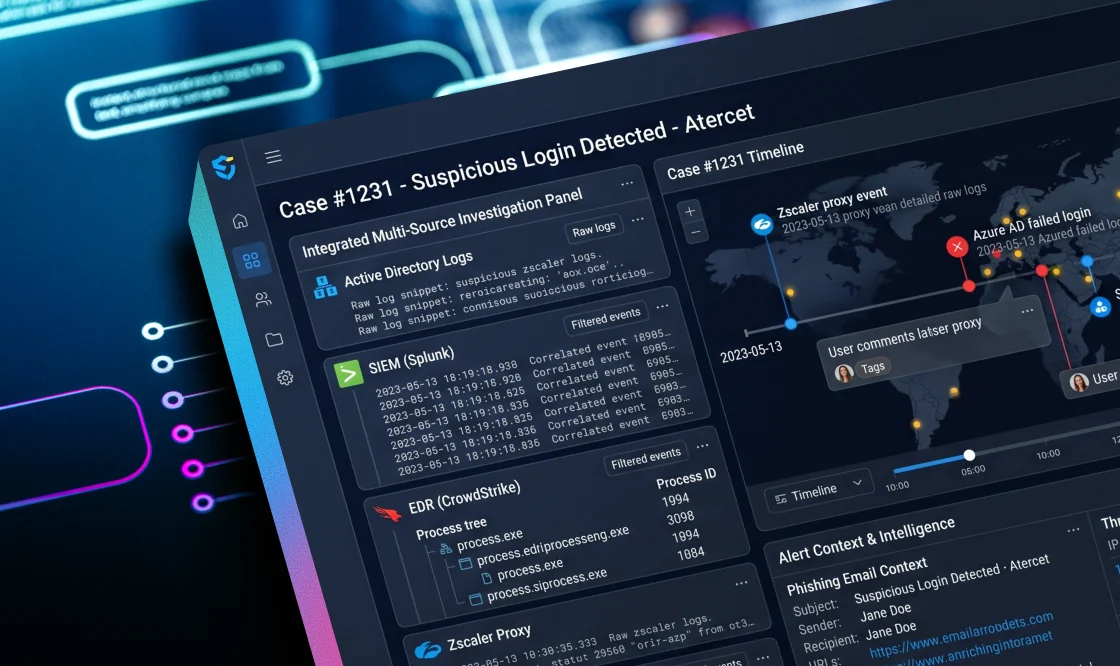
AI in security case management uses artificial intelligence to help organize investigations, summarize case activity, maintain timelines, and support consistent documentation throughout the lifecycle of a security event.
Without strong case management, even a technically sound investigation can become difficult to review, transfer, or justify later. This creates problems for:
AI can support case management by:
This helps the SOC preserve not just activity, but decision quality.
“Artificial intelligence has the potential to be widely used to manage operations for systems such as infrastructure and cybersecurity.”
Source – U.S. Department of Energy research publication on AI and risk management
One of the most important developments in this space is the move from passive AI assistance to agentic AI SOC workflows.
Agentic AI can execute multi-step operational tasks inside defined guardrails rather than only providing analysis or recommendations.
This is an important shift. Traditional AI in the SOC often stops at classification, summarization, or prioritization. Agentic AI goes further by participating in work execution. It can initiate queries, gather data, update cases, trigger playbooks, and move investigations through predefined steps.
An agentic AI workflow might:
The value here is not autonomy for its own sake. The value is operational throughput with structure.
Pro tip: Treat agentic AI as a workflow executor, not a free-form decision-maker. Start with repeatable, low-risk SOC tasks such as enrichment, case updates, and evidence gathering, then add approval gates for higher-impact actions so speed improves without weakening control.
AI brings clear potential, but adoption is not frictionless. Security leaders should expect several operational challenges.
If the SOC has not defined how common investigations should run, AI will have little structure to support. Good automation starts with clear process design.
AI is less useful when the systems holding the needed context are not integrated into the workflow.
The team needs clear rules around which tasks can be automated, how escalation works, and what requires analyst review.
If investigation records are inconsistent or incomplete, AI has less reliable context to work from and less ability to support future decisions.
These are reminders that operational maturity still matters. AI improves disciplined workflows more effectively than it compensates for missing ones.
The real significance of AI in the SOC is that the operating model of security work is changing.
For years, many SOCs have relied on analyst effort as the glue that holds workflows together. Analysts were expected to interpret alerts, gather context, coordinate tools, manage documentation, and keep the process moving.
That model works up to a point, but it becomes increasingly fragile as environments grow.
AI, especially when paired with orchestration and low-code automation, changes that equation. It gives security teams a way to move routine operational work into structured workflows that can be executed with more consistency.
Analysts still matter deeply, but their role becomes less about manually carrying the process and more about directing, reviewing, and improving it.
That is the shift many modern SOCs are moving toward.
Pro tip: If you want AI to improve the SOC operating model, start by mapping where analysts are acting as process glue today. Those repeated handoffs, manual context pulls, and documentation steps are usually the best places to introduce structured automation first.
This is the point where strategy has to meet operational reality. It is easy to identify the potential use cases. The harder question is how to make them work consistently across a complex environment.
That is where a platform such as Swimlane Turbine becomes relevant.
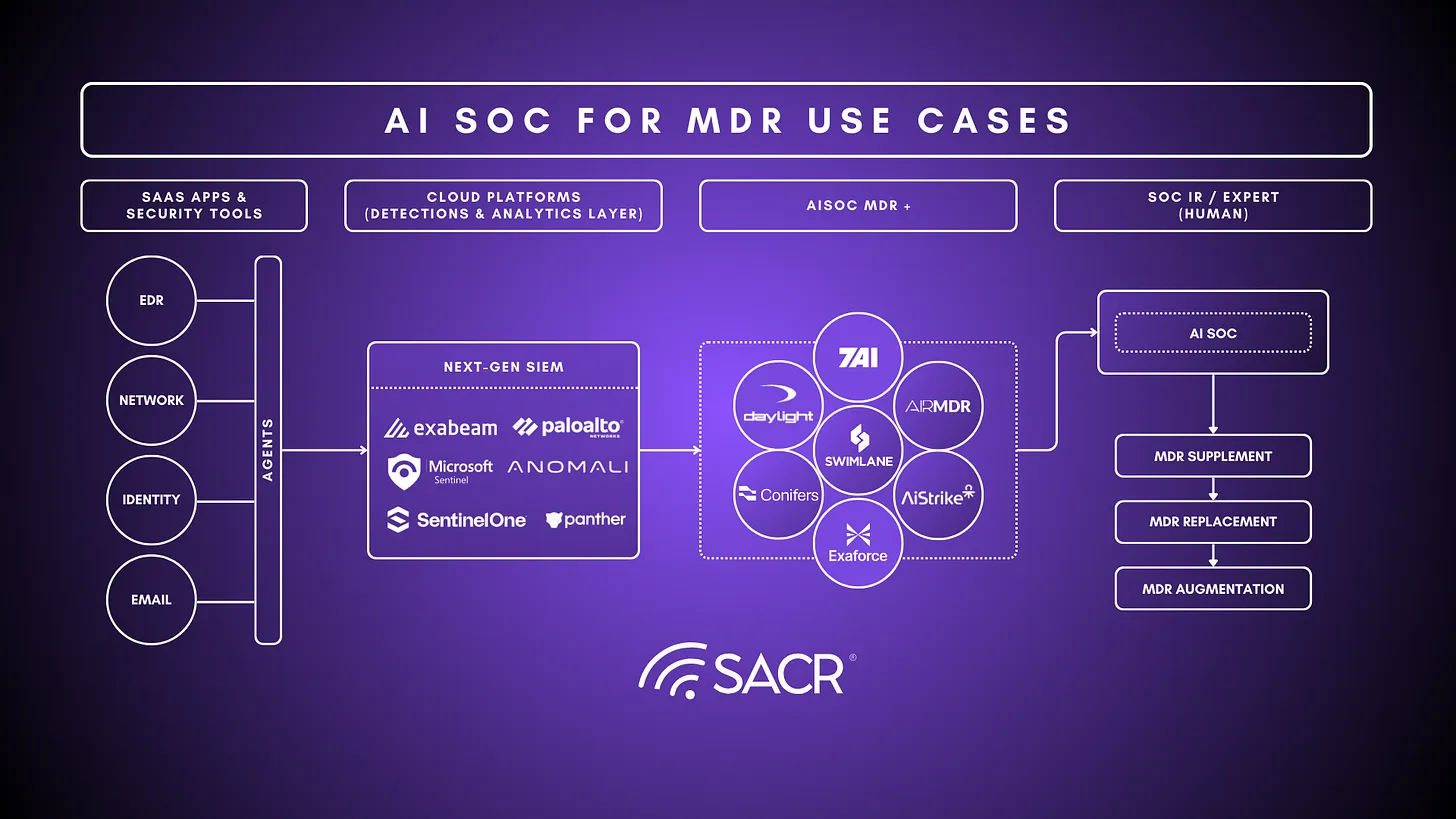
In enterprise SOCs, AI only becomes durable when it is tied to execution. Swimlane supports this by combining AI-driven security automation, agentic AI, orchestration, and low-code playbooks that help security teams build workflows around real operating needs.
In practical terms, teams can structure how alerts are triaged, how investigations are enriched, how cases are updated, and how response actions are coordinated across tools. The SOC can create a repeatable operating model that reduces manual load while preserving analyst control.
This matters because scale in security operations is not just about processing more alerts. It is about keeping decisions and workflows consistent as demand increases.
The most important AI SOC use cases are not theoretical. They are already visible in the parts of the SOC that consume the most time, like alert triage, threat detection support, incident response coordination, and security case management.
What makes these use cases effective is the combination of AI with orchestration, workflow discipline, and automation that turns assistance into operational progress.
Teams that approach AI this way are more likely to improve consistency, reduce repetitive analyst workload, and build a SOC model that can scale with less friction.
For organizations looking at where this is headed, the direction is becoming clearer.
AI in the SOC is moving from isolated support to workflow participation. Agentic AI, governed execution, and low-code automation are becoming part of how modern security teams structure routine work.
That is also why Swimlane fits naturally into this conversation. As enterprises push toward more mature SOC automation, the need is not just for intelligence, but for a platform that can operationalize that intelligence across tools, teams, and security workflows at scale.
Learn how Swimlane helps security teams turn AI SOC use cases into repeatable workflows.
AI SOC use cases are the practical ways artificial intelligence supports security operations. Common examples include alert triage, investigation enrichment, threat detection support, incident response coordination, and security case management.
An AI SOC is a security operations environment where artificial intelligence assists with operational tasks such as analyzing alerts, gathering context, identifying patterns, and supporting workflow execution.
Agentic AI in the SOC is AI systems that can execute multi-step tasks within defined workflows and guardrails. Instead of only making observations, these systems can actively perform actions such as querying tools, collecting evidence, and moving the workflow forward.
Swimlane supports AI SOC applications by combining agentic AI, low-code playbooks, orchestration, and enterprise-scale security automation. This allows security teams to build and refine workflows for triage, investigation, response, and case handling while maintaining visibility and control.

 English English
  Français
 Deutsch
 日本語
日本語
 한국어
한국어
 Português
 Español