
Best AI SOC Platform Guide for Enterprise Security Teams
Read More



If every alert looks urgent, how does your SOC decide what actually deserves attention first?
That is exactly where AI can help improve and prioritize detection signals to help address alert overload, weak prioritization, and the growing burden of manual review in the SOC. While AI is often embedded in threat detection tools themselves, it is also critical to pair it with AI-driven alert triage to fully remediate the threats that matter.
AI threat detection and analysis identify suspicious activity by analyzing patterns, behavior, and context across large volumes of data. Instead of relying solely on known threat signatures, it can surface unusual activity that may indicate compromise, misuse, or emerging threats.
For SOC teams, that means more time spent on high-value alerts, faster triage on incidents that need action, and less analyst effort wasted on noisy or low-priority detections.
AI threat detection uses machine learning and behavioral analytics to identify potential threats, but its real value comes when those insights are connected to structured workflows that help SOC teams investigate and act on them consistently.
Traditional detection methods often depend on predefined rules, threat signatures, and known indicators of compromise. They prove less effective when dealing with novel attack techniques, subtle misuse, or suspicious behavior that does not yet have a known signature.
AI threat detection paired with advanced alert correlation, business intelligence, and automation expands that view. It looks at how users, endpoints, applications, and systems behave over time, then prioritizes activity that appears abnormal or risky.
This helps SOC teams spot low-noise activity earlier and respond with more confidence when attackers are moving carefully enough to blend into normal operations.
“Effective cybersecurity monitoring requires contextual awareness to distinguish between normal and malicious activity.”
Source – SANS Institute (.org)
Most SOCs still rely heavily on signature-based tools, rules, and correlation logic.
However, attackers now move across cloud platforms, identity systems, endpoints, email, and third-party applications. They often use legitimate credentials, built-in tools, and low-noise techniques that blend into normal activity.
In those cases, a signature alone may not tell the full story. A few common problems stand out.
Signature detection works only when the threat has already been seen before and codified into a detection rule or signature. If the activity does not match an existing signature or rule, it may go unnoticed.
Many SOC teams are flooded with alerts that require review but do not lead to meaningful action. This increases analyst fatigue and slows response.
Traditional detections may flag an event, but they often do not explain whether the event is actually unusual in context.
A login is not always suspicious. A login from a new location, at an unusual time, followed by privileged access attempts may be.
Rules can be updated, but that process often takes time. Threats move faster than many manual rule-writing cycles.
This is where AI-driven approaches improve detection signals and analysis. They can add context, identify patterns earlier, and help separate routine noise from real security concerns.
Pro tip: Do not frame AI threat detection as a replacement for traditional detections. Frame it as an operational layer that adds behavioral context, improves prioritization, and closes the gaps left by static rules.
Machine learning threat detection uses models trained on historical and real-time data to identify patterns associated with risk.
These models are not simply looking for a static match. They evaluate relationships across data points and can identify behavior that appears inconsistent with established baselines.
Machine learning-based threat detection uses statistical models and pattern recognition to identify anomalies, suspicious behavior, or likely threats from data, rather than relying solely on fixed rules.
In practice, this can help with:
The benefit for the SOC is not just detection breadth. It is the ability to identify potential problems earlier and reduce the manual effort required to assess them.
“Machine learning techniques can enhance intrusion detection by identifying patterns and anomalies in large datasets.”
Source: NIST
Behavioral analytics plays a central role in AI threat detection because it focuses on what is normal before identifying what is not.
This is especially valuable in environments where attackers use legitimate credentials or operate carefully enough to avoid obvious rule-based triggers. In those cases, behavioral deviation may be one of the strongest signals available.
Agnetic AI automation can help perform behavioral analytics to identify risk by establishing normal patterns for users, devices, or systems and then surfacing activity that deviates from those patterns in potentially meaningful ways.
Examples might include:
Automation helps unify these signals across disparate detection sources, presenting analysts with comprehensive context from a single system of record. That context is often the difference between a noisy alert and a meaningful security signal.
This is not an either-or conversation. AI and signature detection serve different purposes, and most SOC teams need both.
Signature-based detection remains effective for known malware, established indicators, and repeatable attack patterns. It provides clear logic and often offers a strong level of confidence when a known condition is met.
AI-based detection is better suited for situations where the signal is less obvious. It identifies unknown threats, suspicious sequences, and subtle anomalies that would be difficult to capture in static rules alone.
The strongest SOC programs do not throw out traditional detection. They use AI automation to improve depth, context, and prioritization.
Pro tip: Treat AI and signature detection as a layered strategy rather than competing approaches. Use signatures for high-confidence, known threats, and apply AI where context, behavior, and pattern recognition are needed to surface what rules alone would miss.
Operationalizing AI threat detection across multiple detection sources improves both signal quality and response speed. It helps SOC teams focus on the threats that actually matter, spend less time on low-value alerts, and move through triage and investigation more efficiently.
It improves accuracy by analyzing signals in context rather than in isolation. This helps teams:
It improves speed by reducing manual effort in the early stages of response. Agentic AI automation can help:
What AI threat detection and response gives SOC teams is better signal quality and faster operational follow-through, which is exactly what most teams need.
Pro tip: The strongest way to position AI threat detection is around signal quality and workflow speed, not just detection volume. SOC leaders are far more interested in whether AI helps analysts focus faster, investigate with better context, and move incidents forward with less manual effort.
AI Threat detection is a single, albeit important, piece of the puzzle. The larger operational issue is what happens next. If every alert still depends on enrichment, disconnected tools, and human decision-making, even strong detections lose value.
Swimlane takes on the last mile of AI threat detection by connecting alerts, detections, and AI-driven insights with agentic AI workflows and automation to deliver unified security operations. For teams building an AI SOC strategy, this ensures that detection supports execution rather than adding to the queue.
Swimlane Turbine supports this model through:
Agentic AI can support structured investigation and documentation tasks, helping teams reduce repetitive analyst effort while staying inside governed workflows.
Low-code and AI-generated playbooks let SOC teams modify workflows without rebuilding them from scratch, making it easier to keep triage, investigation, and response processes aligned as threats, tools, and operating requirements shift. That matters in real SOC environments where rigid workflows often fall out of date.
SOC workflows span multiple systems, which makes consistent execution harder when teams still have to move between steps manually. Orchestration connects the systems involved in triage, enrichment, investigation, and response so analysts are not forced to manually bridge the gaps.
As alert volume grows, consistency becomes just as important as speed. Enterprise-scale automation helps teams handle routine work more reliably and with less variation between analysts or shifts.
This is where the value becomes practical. AI threat detection identifies what may need attention.
Swimlane moves teams from signal to structured action by triggering defined workflows that rely on agentic AI as well as traditional automation that handles enrichment, investigative steps, and response actions consistently and repeatably.
AI threat detection reduces time spent on low-value alerts, improves prioritization, and enables faster response to incidents that actually require action. It improves accuracy by incorporating behavioral context and machine-learning-based pattern recognition. Speed improves as teams can prioritize more effectively, investigate with clearer context, and move faster on alerts that require action.
But detection alone is not the full answer.
The real operational gain comes when AI-based insights are connected to automation, orchestration, and structured workflows. That is what turns a better alert into a better SOC process.
For organizations building toward an AI SOC, the path forward is not just smarter detection. It is smarter execution.
Swimlane supports that shift by helping teams operationalize AI-driven security work with agentic AI, low-code playbooks, orchestration, enterprise-grade case management and business intelligence tools. It reduces manual load and improves consistency where it matters most.
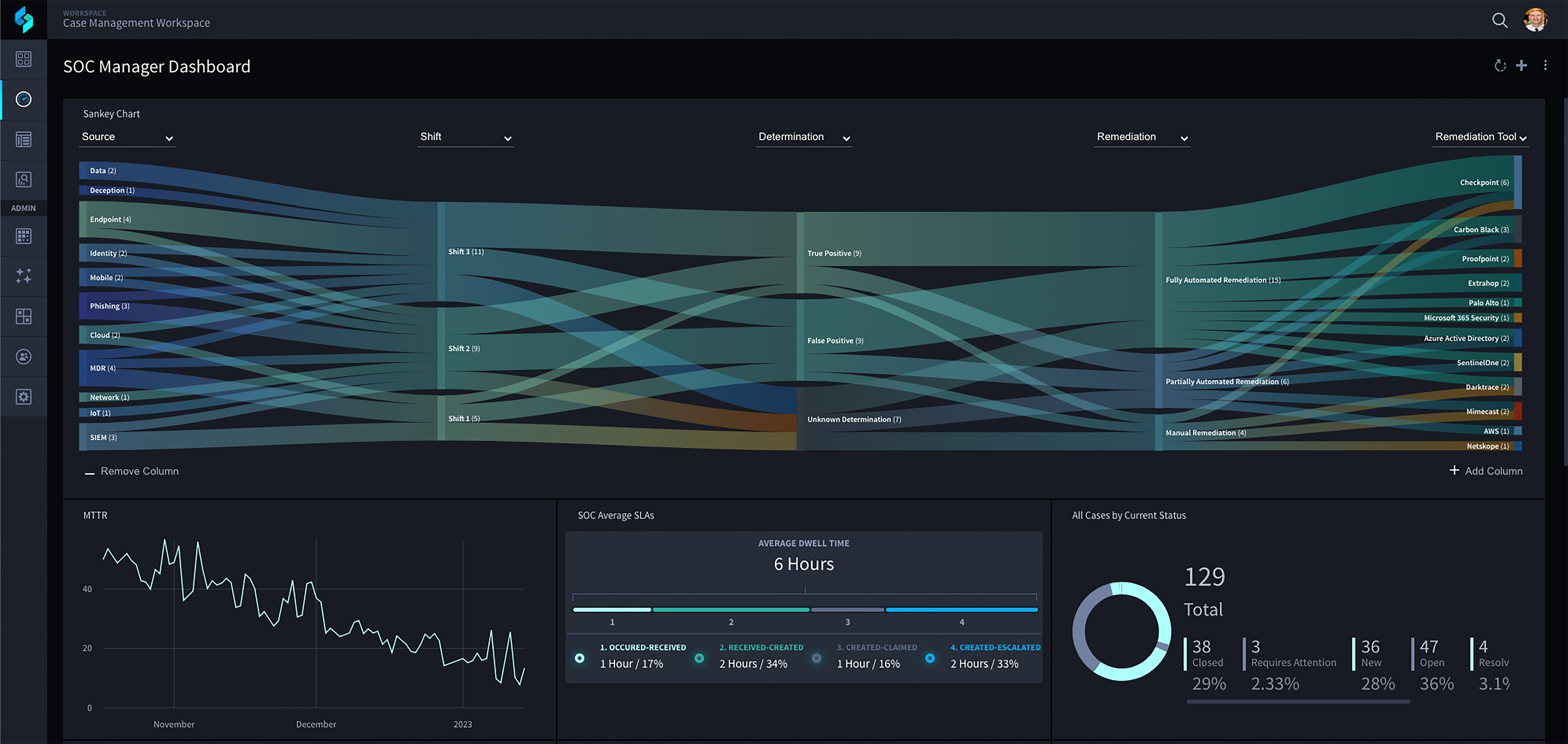
See how Swimlane helps SOC teams connect better detection to faster triage, investigation, and response.
AI threat detection uses machine learning, behavioral analytics, and data models to identify suspicious activity and possible threats. It helps security teams find patterns and anomalies that traditional rule-based methods may miss.
Signature-based detection looks for known patterns and indicators. AI threat detection analyzes behavior and context, which makes it more useful for spotting unknown threats or subtle misuse.
No. Most SOC teams still need traditional detection tools. Agentic AI automation adds another layer by improving context, prioritization, and anomaly detection rather than replacing existing controls outright.
Behavioral analytics defines normal activity for users, devices, and systems. It then identifies unusual deviations that may signal compromise, misuse, or early-stage attacks.
Swimlane supports AI threat detection, traditional signature based threat detection, and SOC operations by helping teams operationalize AI-driven security work with agentic AI, low-code playbooks, orchestration, enterprise-grade case management and business intelligence tools. It integrates with the tools you already have, reduces manual load and improves consistency and reliability of analyst work.

 English English
  Français
 Deutsch
 日本語
日本語
 한국어
한국어
 Português
 Español