
What is an Autonomous SOC? The Future of Security Operations Centers
Read More



The journey to an Autonomous SOC (Security Operations Center) is an incremental evolution, not a sudden transformation. It shifts the SOC operating model from reactive, manual processes to a proactive, AI-enabled orchestration framework. This transition is crucial for combating increasingly complex, AI-enabled offensive attacks. The autonomous SOC leverages intelligent automation to handle repetitive Tier-1 tasks, reserving human analysts for higher-value functions that require judgment and business context. In partnership with TAG Cyber, Swimlane outlines five practical pillars for autonomous SOC enablement, ranging from autonomous analysts to platform-orchestrated Architecture. The ultimate goal of this framework is to guide security leaders in achieving AI SOC maturity, ensuring a balance between AI efficiency and indispensable human oversight.
The conversation surrounding the modern security operations center (SOC) has undergone significant changes. For the past decade, we’ve watched a steady shift toward increased automation in security operations (SecOps). Functions such as detection, response, and reporting, which were once purely manual, are now supported by intelligent platforms.
At Swimlane, we believe the evolution has reached a tipping point: practical, AI-driven automation in the SOC is fully scalable, highly reliable, and ready for widespread adoption.
However, the vision of an “autonomous SOC” is often misunderstood. It is not about eliminating human involvement; it’s about changing the nature of human involvement. It’s a continual journey of improvement, not a final destination. The goal is to establish a balance where automation and AI handle the relentless, repetitive tasks, allowing analysts to focus their strategic judgment and business context on the most complex cases.
For security leaders facing tight budgets and chronic shortages of skilled analysts, embracing this AI SOC evolution is no longer optional; it’s a requirement for resilience.
Most SOCs have already adopted some form of automation, having progressed beyond experimental projects to an expected baseline capability. Early tactical automation focused on simple tasks such as alert triage and ticket generation, providing relief from alert fatigue but not fundamentally altering the operating model.
The next phase requires moving beyond tactical automation to AI-enabled orchestration. This is crucial for defending against continuous, adaptive, and AI-enabled attacks.
To guide this progression, we partnered with TAG Cyber to develop the report “Analyst Report: Your Guidebook for Autonomous SOC Enablement,” which outlines five practical pillars of autonomous SOC maturity that frame how security operations will evolve.
These pillars represent a progressive journey, with overall SOC autonomy successively increasing at each step.
The starting point is automating Tier-1 support. Intelligent agents can now handle nearly all basic tasks, triaging alerts, initiating investigations, and escalating incidents, ultimately freeing human analysts to focus on higher-value functions. Human oversight remains essential for complex cases, ensuring that actions do not disrupt business operations.
The traditional model of reactive, alert-by-alert handling is unsustainable against modern threats. This pillar introduces an adaptive investigation model where telemetry is organized into ongoing narratives across time and systems. The AI-driven SOC tracks evolving evidence, moving from chasing isolated alerts to proactively recognizing attack progression, leveraging platforms like Swimlane Turbine to integrate inputs from SIEMs, XDRs, and threat intelligence.
AI fundamentally changes incident response by guiding playbooks in real time. Rather than relying on static, often outdated instructions, AI adjusts workflows based on business rules, operational priorities, and the evolving nature of an incident. While AI accelerates responses, validation checkpoints can be implemented for sensitive or high-impact actions, ensuring human review where needed.
This pillar embeds compliance and risk oversight into the operational fabric of the SOC, moving away from retrospective, manual reporting. Automation enables near-real-time alignment with frameworks such as NIST and ISO, simplifying the audit process and providing risk officers with immediate visibility through live dashboards.
The highest level of maturity sees orchestration become the central “mission control” for the entire security stack. This approach coordinates detection, response, reporting, and compliance, unifying security teams, tools, and telemetry. The result is reduced tool sprawl, streamlined workflows, and a measurable return on investment through consolidation and faster, automated coordination.
The Swimlane Turbine platform is designed to enable this journey towards an AI SOC today. Its agentic AI architecture enables organizations to adopt AI and automation together, starting with automating Tier-1 tasks and expanding to adaptive detection and AI-executed playbooks.
Turbine serves as the orchestration layer, connecting diverse systems into a coherent, future-state AI SOC architecture. Looking ahead, Turbine’s AI capabilities will rapidly expand, supporting fully autonomous AI agents across every SOC function and adjacent IT security domains, delivering intelligence, automation, and orchestration at scale.
The trajectory toward increased AI SOC capabilities is unmistakable, and forward-leaning organizations are already realizing the benefits. The time to begin, or accelerate, your path toward AI adoption is now. The longer you wait, the harder it will be to close the gap.
To learn more about how Swimlane can help you develop your own AI SOC, visit swimlane.com/demo
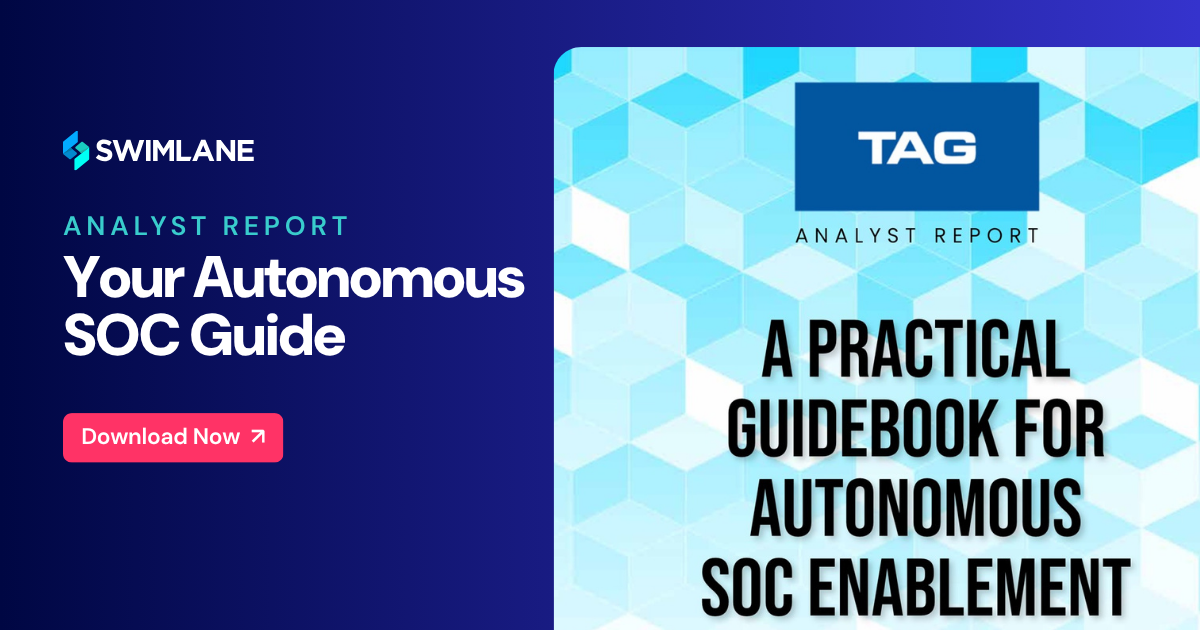
Security leaders are under pressure to reduce costs, address skilled analyst shortages, and defend against continuous, adaptive AI-enabled attacks. This report provides the roadmap you need to advance your SOC maturity without compromising your human capital.