
What SACR’s 2026 AI SOC Market Report Says About Swimlane
Read More


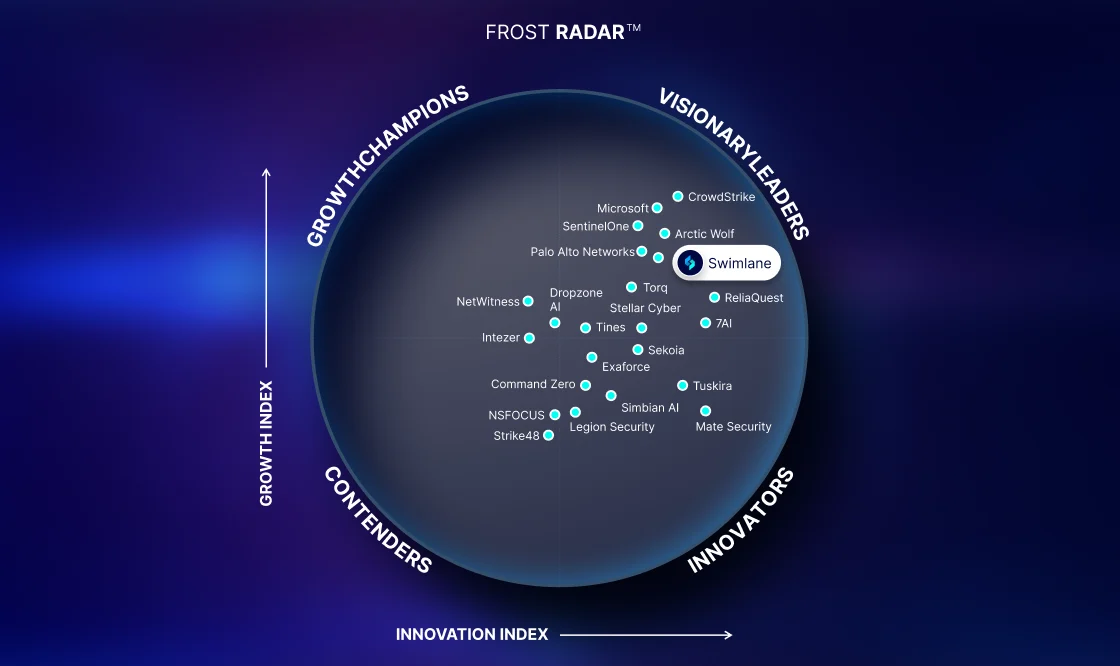
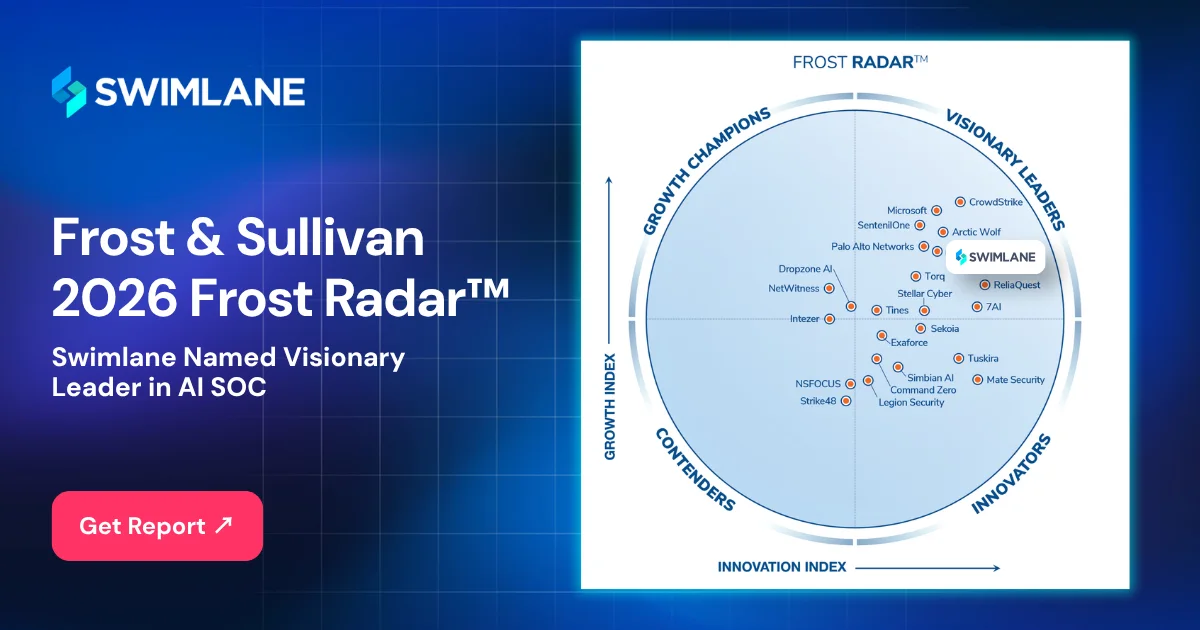
Frost & Sullivan has named Swimlane a Visionary Leader in its 2026 Frost Radar for AI SOC.
“Most AI SOC conversations start with the model; they should start with the environment. Security teams run dozens of tools across cloud, identity, OT, and everything in between, and an AI SOC that reaches only part of that estate only sees part of the attack. We built Swimlane AI SOC to work across all of it, with the customer’s data, the customer’s model choice and the customer’s rules.”
— Cody Cornell, Co-Founder and CEO, Swimlane
Most vendors in the AI SOC market reach for the same pitch: our model is smarter, our agents are more autonomous, our triage is faster. That pitch assumes the hard part is the reasoning. In practice, the hard part is reach. A brilliant model looking at a third of your environment is still looking at a third of your environment.
When Swimlane started in 2014, the hard problem was connecting tools that were never designed to talk to each other. AI didn’t make that problem go away; it made it matter more, because an agent can only reason about the evidence it can reach.
Frost & Sullivan evaluated more than 60 AI SOC companies and selected 23 growth and innovation leaders for its 2026 Frost Radar. Swimlane was named a Visionary Leader, a category for companies that combine innovation, growth and industry influence, with an Innovation Score of 4.45 and a Growth Score of 4.30.
“Swimlane has built a vendor-neutral, governed AI SOC that pairs agents for complex investigations with automation for reliable execution. That hybrid approach, combined with coverage that ranks amongst the broadest in the market and auditability across every agent action, places Swimlane among the Visionary Leaders in AI SOC.”
— Lucas Ferreyra, Industry Principal, Frost & Sullivan
The report sets three best practices for AI SOC providers: deliver full-lifecycle security operations, embed governance and human oversight, and support open integration and measurable outcomes. Notice what isn’t on that list. Nothing about the biggest model or the most autonomous agent, everything about reach, control and fit with what you already run.
Frost credits our automation foundation, mature orchestration, agentic reasoning, deterministic execution, governance and integrations, and calls our coverage among the broadest in the market. You’ll find the full report alongside our other analyst coverage in the Swimlane reports library. This recognition belongs to the team that built the platform and the customers who run it in production every day.

Expanding threats, skills shortages and alert fatigue are pushing buyers past triage toward platforms that connect detection, investigation and response. That’s where most AI SOC products start to strain, and they strain in three predictable places.
Many AI SOC products cover the alert sources that are easy to integrate, usually SIEM and EDR, and stop there. Attacks don’t respect that boundary. An intrusion that starts with a phished identity, moves through a SaaS app and lands on an OT network crosses domains the AI never sees, so the investigation ends exactly where the attacker’s path gets interesting.
Sending every alert through an LLM looks impressive and scales badly. You pay reasoning prices for work a playbook already does reliably, outcomes get harder to predict, and costs climb with alert volume instead of with risk.
Some platforms want to own your data, your detections and your workflows before they deliver value. Frost & Sullivan is direct on this point: vendors that complement existing investments through open APIs, integrations and partnerships will be better positioned than those requiring wholesale platform replacement. Software Analyst Cyber Research made a similar distinction in its own evaluation, which we covered in what SACR’s AI SOC report says about Swimlane.
The difference here is where you start. Start with the model and you inherit all three problems, start with the environment and you design around them.
Frost & Sullivan found that Swimlane AI SOC can autonomously investigate and resolve known and novel incidents across 16 security and IT domains, subject to approval gates each customer configures: endpoint, cloud, network, identity, email, AI, case management, communications, threat intelligence, DevOps, forensics, governance, infrastructure, OT/IoT, SIEM and vulnerability management.
That list isn’t there to look long. Each domain is a place where an investigation either continues or dead-ends. When an agent can pivot from an EDR alert to the identity provider, to the cloud control plane, to the ticketing system, it builds a picture of the attack instead of a summary of one alert.
Reach also has to be practical. Swimlane agents search data where it already lives, in SIEMs, cloud services, on-premises data lakes and operational stores, and pull only the relevant evidence into the investigation record. You don’t duplicate your data into another platform, and you decide what Swimlane stores and for how long. The Hero AI Ingestion Agent connects and maps those sources, then enriches alerts with MITRE ATT&CK, D3FEND, threat intelligence, organizational context and investigation history.
And reach has to cover threats your vendors haven’t written rules for yet. Customer-defined detections let teams send alerts for risks like prompt injection and unsanctioned AI use straight into agentic investigation and response.
Frost & Sullivan highlights the hybrid at the center of our approach: agents for complex investigations, deterministic playbooks for reliable, cost-efficient execution. People treat that as a compromise between old and new. It’s not, it’s the only design that holds up at production volume.
Under the hood, deep agents handle complex reasoning and expert agents handle specialized tasks, with models matched to each job’s complexity and cost. You choose which model providers you use and where those models run. The Investigation & Response Agent builds a plan an analyst can review or override, and Hero AI either executes that plan directly or converts it into a deterministic playbook.
That conversion is the part most buyers underrate. Novel threats get adaptive reasoning, repeatable work gets reliable, lower-cost execution, and anything the AI figures out once doesn’t need to be figured out again. One healthcare customer handling about 180 threats a day cut investigation costs by up to 90% this way, which we covered when we introduced intelligent automation routing.
Frost & Sullivan states that human oversight, governance and transparency should remain fundamental as AI SOC platforms become more autonomous. I’d go further: autonomy without governance doesn’t get deployed, it gets piloted and shelved.
In Swimlane, every LLM interaction and agent action is auditable. Agents carry governed identities, role-based access controls and lifecycle controls, with tenant-isolated data and connectors. Customers set the boundaries for models, deployment, autonomy, knowledge and deterministic execution:
Openness is the other half. Frost notes that third-party integration is central to Swimlane, and it’s built into the Swimlane Turbine platform through customer-built agents, natural-language automation, multitenancy, GitOps, flexible deployment and global regions. That’s the same reason roughly half our business runs through channel partners and a third through MSSPs. Our AI SOC for MSSPs leaves the end-customer relationship, the data and the service delivery with the provider, an approach Frost singled out as serving providers rather than competing with them.
The outcomes follow from that design. Swimlane customers report 240% ROI in the first year and a 75% reduction in mean time to respond.
Analyst research is a good map, it isn’t the territory. Whatever platform you’re evaluating, ours included, these questions will tell you more than any score.
If you’re mapping the longer road, our five-pillar blueprint for the autonomous SOC lays out how teams move from tactical automation to AI-driven operations in stages.

Models will keep getting better, and they’ll keep getting cheaper. Whatever model looks best this quarter will be replaced by something better soon after. Your environment won’t change that fast. The tools, the data stores, the identities, the OT networks and the approval chains you run today are the ground every AI SOC has to stand on.
That’s why we built Swimlane AI SOC to work across all of it, with the customer’s data, the customer’s model choice and the customer’s rules. A crowded market will keep arguing about whose AI is smartest. The better question is whose AI can see the whole attack, and whether you can prove what it did about it.
Start with the environment, and the model becomes a choice instead of a constraint.

Watch Swimlane AI SOC investigate across 16 security and IT domains, with your data, your model choice and your rules.

 English English
 Français
 Deutsch
 日本語
 한국어
 Português
 Español