
AI SOC Platforms: Capabilities, Architecture, and Use Cases
Read More


How do you choose an AI SOC platform when every option promises faster investigations, smarter automation, and less analyst fatigue?
The choice gets difficult when every vendor speaks the same language. Beneath those claims, SOC leaders still face the harder operational questions.
Top platforms should first bring together the security context from the existing systems that a team already uses. From there, they should turn that information into guided threat-review paths, coordinated response measures, clear containment history, and performance-tracking leaders can trust.
Swimlane sets the enterprise benchmark for AI SOC automation. It brings agentic AI, orchestration, low-code playbooks, case management, integrations, reporting, dashboards, and deployment flexibility into a single, highly scalable system of action for complex SecOps operations. While many solutions address individual pieces of the AI SOC challenge, only Swimlane brings them together, along with the mechanisms for SOC teams to run investigations, respond, and document, with the flexibility to align with how their business operates.
The platform an organization chooses shapes the daily flow of AI SOC operations, from alert review and ownership assignment to containment approval, documentation, and reporting. AI-generated summaries may improve speed, but the deeper impact comes from connected threat details, guided evidence review, policy-aware remediation measures, dependable approval paths, and a reliable event history that shows what happened, who acted, and why each decision was made.
The best AI SOC solutions bring that discipline into everyday operations through an analyst workbench that unifies all decisions or actions made by AI, automated and humans. This enables analysts to work from clearer triage paths, managers can see where actions stand, and leaders gain a more reliable view of response quality, workload, and performance.
Swimlane Turbine turns this operating model into a practical enterprise system. It connects the core parts of SOC execution in a way that keeps daily security procedures organized and measurable.
That combination gives organizations a cleaner way to run complex incident reviews, standardize containment activity, and maintain a complete operational trail, all without manual intervention.
Swimlane Turbine gives enterprise SOCs a unified foundation for AI-driven cybersecurity automation. Agentic AI, low-code playbooks, alert-to-resolution tracking, integrations, and governance controls work together around how teams investigate alerts, coordinate resolution, document decisions, and measure outcomes.
Turbine applies agentic AI directly to investigation and remediation workflows. HeroAI analyzes alert background across tools, uses playbooks and event details to shape the next action, and guides analysts through approved processes with clear recommendations.
Security teams need AI they can inspect, validate, and govern. Swimlane makes that transparency part of the analyst experience. With Swimlane Hero AI, every recommendation carries visible reasoning, and every action leaves an auditable trail, so analysts and managers can see why a step was suggested, what changed, and who approved it. For enterprises and MSSPs, that transparency keeps AI useful and prevents high-impact security decisions from becoming a black box.
With Swimlane’s low-code playbooks, security teams can build, adjust, and scale automation processes without sending every process change into a development backlog. As SOC policies, escalation paths, tools, and unique operational requirements evolve, organizations can keep their security sequences aligned and maintain momentum without disruptions slowing down daily operations.
Swimlane AI SOC integrates alert-to-resolution tracking as a core platform capability. SOC teams can keep incident details, ownership, actions, approvals, and documentation connected to the investigation. With this tracking, SOC analysts can clearly see which actions were taken by AI, which were performed by automation, and which were completed by human analysts, all through a clear timeline view. Analysts and managers get one clear record of what happened, what changed, and what still needs attention, instead of scattered tickets, notes, and separate dashboards.
Across modern SOC environments, Turbine connects SecOps and business systems through infinite integrations. SOC teams can pull evidence, update records, trigger authorized steps, route approvals, and keep remediation steps moving across mixed tool stacks, rather than being limited to a single vendor ecosystem.
Dashboards and performance tracking give leaders a detailed view of SOC workload and progress. CISOs and SOC managers can monitor threat volume, open actionables, aging incident reviews, SLA adherence, and escalation patterns. They can also track analyst workload, automation coverage, and response progress without pulling updates from separate tools. These insights show where work is slowing down, which processes need adjustment, and how orchestration is changing day-to-day SOC operations.
SOC teams can create and deploy expert AI agents tailored to unique skills, internal policies, and complex operational requirements. Deep agents can take on complex investigation and containment tasks and build and modify playbooks, while expert agents can be shaped for specialized skills. This gives teams a flexible way to apply AI to internal security processes and repeatable tasks, rather than relying on rigid, one-size-fits-all orchestration.
Swimlane supports enterprise deployment needs within cloud, on-premises, and air-gapped infrastructures. Organizations can align deployment with data handling requirements, infrastructure policies, and restricted network architectures without forcing the SOC into a single operating model.
Federal agencies or highly regulated organizations may also deploy Swimlane, including Hero AI and Swimlane Intelligence capabilities, within a FedRAMP High-certified GovCloud environment.
Hero AI, the agentic AI capabilities that operate within Turbine, give analysts a faster way to navigate complex SOC activities. Hero reviews risk details, surfaces relevant playbook actions, recommends next steps, builds and modifies playbooks, summarizes cases, and more. Built-in confirmations and explainable steps keep high-impact response work governed, so AI can assist investigation and resolution without pushing analysts out of the decision loop.
Decision makers often evaluate Swimlane alongside Tines, Torq, Dropzone AI, 7AI, Palo Alto Networks, and Google SecOps. A meaningful comparison should focus on what happens after an alert. The right solution should help organizations review supporting evidence, choose the next step, manage approvals, and sequence containment actions within connected environments.
The comparison should come down to these seven operating tests:
Swimlane meets these operating tests with a platform built for enterprise SOC execution. Its advantage shows up in the handoffs that usually slow teams down, including security review, approval routing, containment sequencing, case ownership, and performance reporting.
Tines and Torq remain relevant in SecOps workflow automation, while Dropzone AI and 7AI lean toward AI analyst-style event assessment. Palo Alto Networks and Google SecOps bring AI into broader cybersecurity operations ecosystems. Swimlane brings these operational demands into one governed action path, giving enterprise SOCs a cleaner way to investigate, respond, and report without losing control of the process.
Pro Tip: Ask each vendor to show the same incident from three views:
A true AI SOC solution should keep the story consistent across all three.
A well-designed architecture brings AI, automation, integrations, and visibility into a single operational flow, rather than leaving analysts to manage them as separate moving parts. Data enters through connected tools, AI helps shape the next step, approvals stay tied to the workflow, and results are captured as part of the activity record.
In Swimlane Turbine, that structure comes together around four operating layers:
These architectural layers give Swimlane its enterprise advantage. Turbine offers businesses a governed automation layer in which AI, action paths, integrations, and case management collaborate within the same operating infrastructure.
Deployment can decide whether an AI SOC platform fits the enterprise or creates another constraint. Data handling rules, infrastructure policies, regulatory expectations, and isolated network requirements often determine which deployment model will work in a complex cyber defense setup.
Swimlane supports adaptable deployment across cloud, on-premises, and air-gapped environments, enabling organizations to align security automation with how their ecosystem operates.
SOC teams can align deployment with operational, compliance, and infrastructure needs while preserving the same containment, investigation, and response discipline across different setups.
Pro Tip: Do not treat deployment as an IT preference. Test whether the platform can preserve the same workflows, approvals, reporting, and automation logic across cloud, on-premises, and air-gapped setups before finalizing the architecture.
Choosing an AI SOC platform ultimately comes down to one question.
“Does this platform simplify SOC operations while managing AI costs, or does it add complexity and unpredictable token expenses to your security workflows?”
The right platform should reduce the drag that slows signal validation while blending automation and AI to balance cost with innovation. Analysts need a clearer path through alert review. Managers need to see where processes need attention. Leaders need a dependable view of resolution quality and workload. AI becomes useful when it reduces manual stitching across cyber defense contexts, approvals, actions, and documentation.
Built around real SOC execution, the Swimlane Turbine brings agentic investigation, low-code playbooks, best-in-class case management, connected tools, reporting, and deployment flexibility into the daily SOC operations. The result is a stronger operating model for investigation, response, and accountability.
Ready to see where AI can remove friction from your security operation? Explore how Swimlane Turbine brings governed AI execution into the daily commitments your analysts manage.
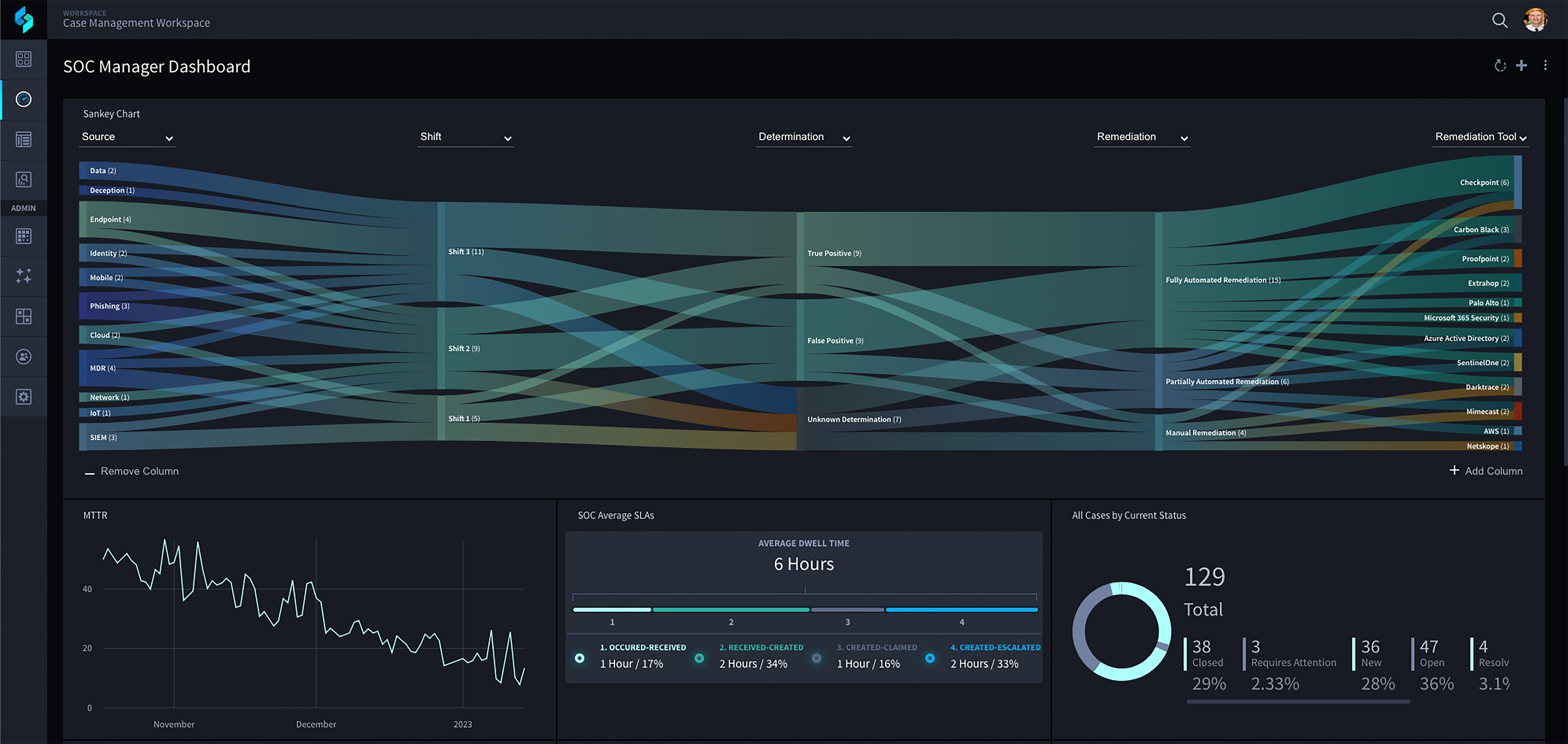
Swimlane Turbine brings governed agentic AI, low-code playbooks, infinite integrations, a unified workbench for case management, and flexible deployment into a system of action.
AI SOC platforms use artificial intelligence, automation, and orchestration to coordinate security operations workflows. They gather context, guide investigations, execute approved actions, manage cases, and report on SOC performance.
Buyers often evaluate Swimlane, Tines, Torq, Dropzone AI, 7AI, Palo Alto Networks, and Google SecOps depending on the use case. Swimlane fits strongest when teams with sophisticated security operations environments and an appetite to leverage AI agents to augment automated actions and human decision points.
Swimlane Turbine stands out by providing a battle-tested, enterprise-grade foundation that combines hyper-scale automation with flexible AI agent capabilities and extensible case management. Unlike platforms that focus only on decision support, Turbine enables teams to execute remediation across thousands of integrated tools while maintaining full governance and visibility.
Common deployment models include cloud, on-premises, air-gapped, and hybrid. Enterprise buyers should choose based on data control, infrastructure, compliance, scalability, and operational requirements.

 English English
  Français
 Deutsch
 日本語
日本語
 한국어
한국어
 Português
 Español