Report
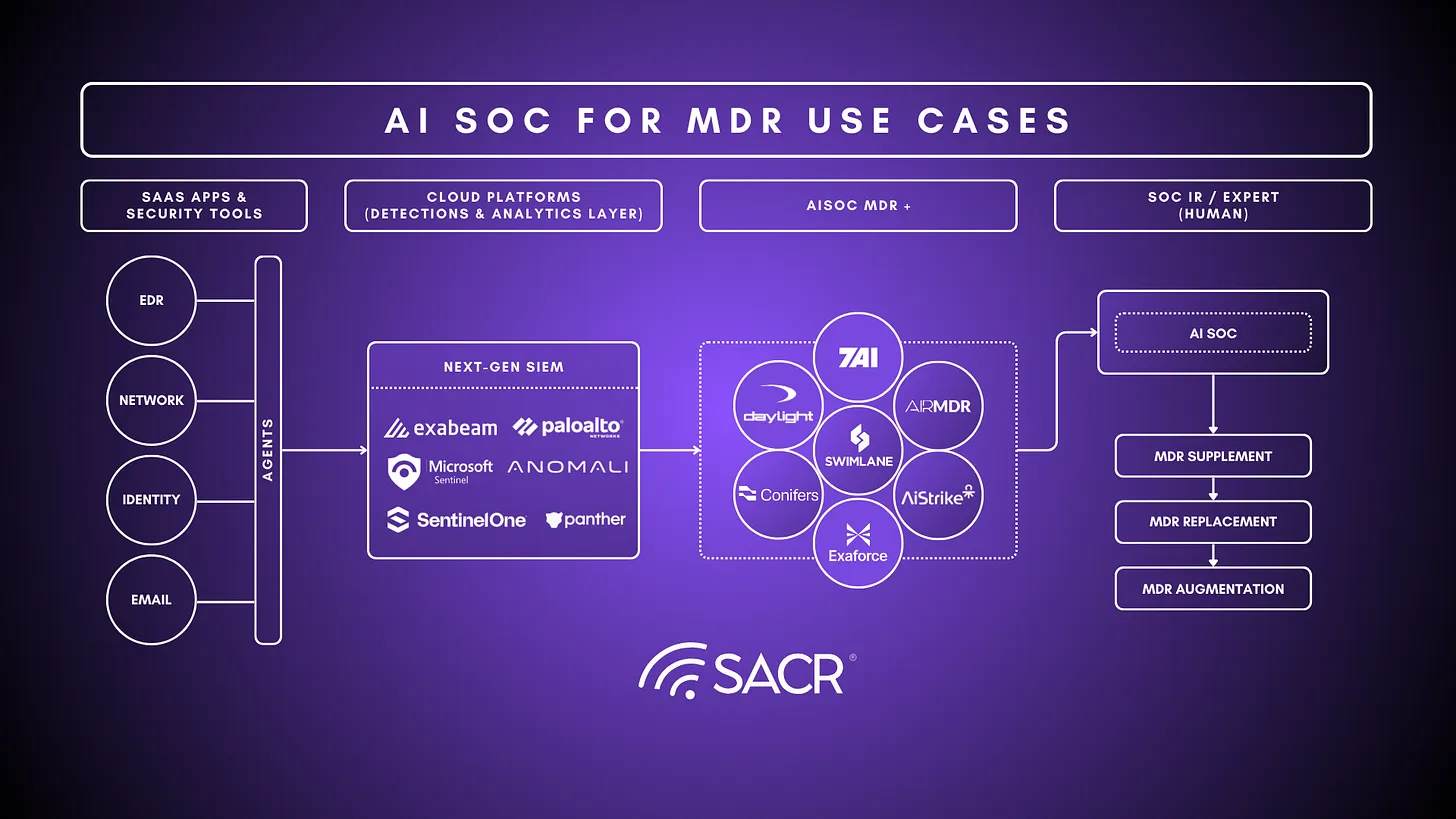
Analyst Report: AI SOC for MDR
Read More


Accelerate alert resolution and improve efficiency while ensuring that every decision is explainable and every action is auditable. Feed it alerts from your SIEM, EDR, and cloud tools, plus your own detection logic for the threats those tools miss.
is delivered across the Swimlane customer base through agentic AI automation efficiency gains.
%
Achieved in a customer’s production environment with AI SOC.
CUSTOMER-DEFINED DETECTIONS
Swimlane AI SOC routes each alert, whether it comes from your security tools or your own detection logic, to the level of investigation it needs. Analysts spend their time where judgment matters.

Run organization-specific detection logic against large volumes of data in Turbine. A single action evaluates tens of thousands of records across parallel compute nodes, and resulting alerts go directly into agentic investigation and response.

Detect AI risks that vendor tools may not alert on: local AI model use, unsanctioned AI accounts, sensitive data submitted to AI services, prompt injection, and disabled or bypassed guardrails.

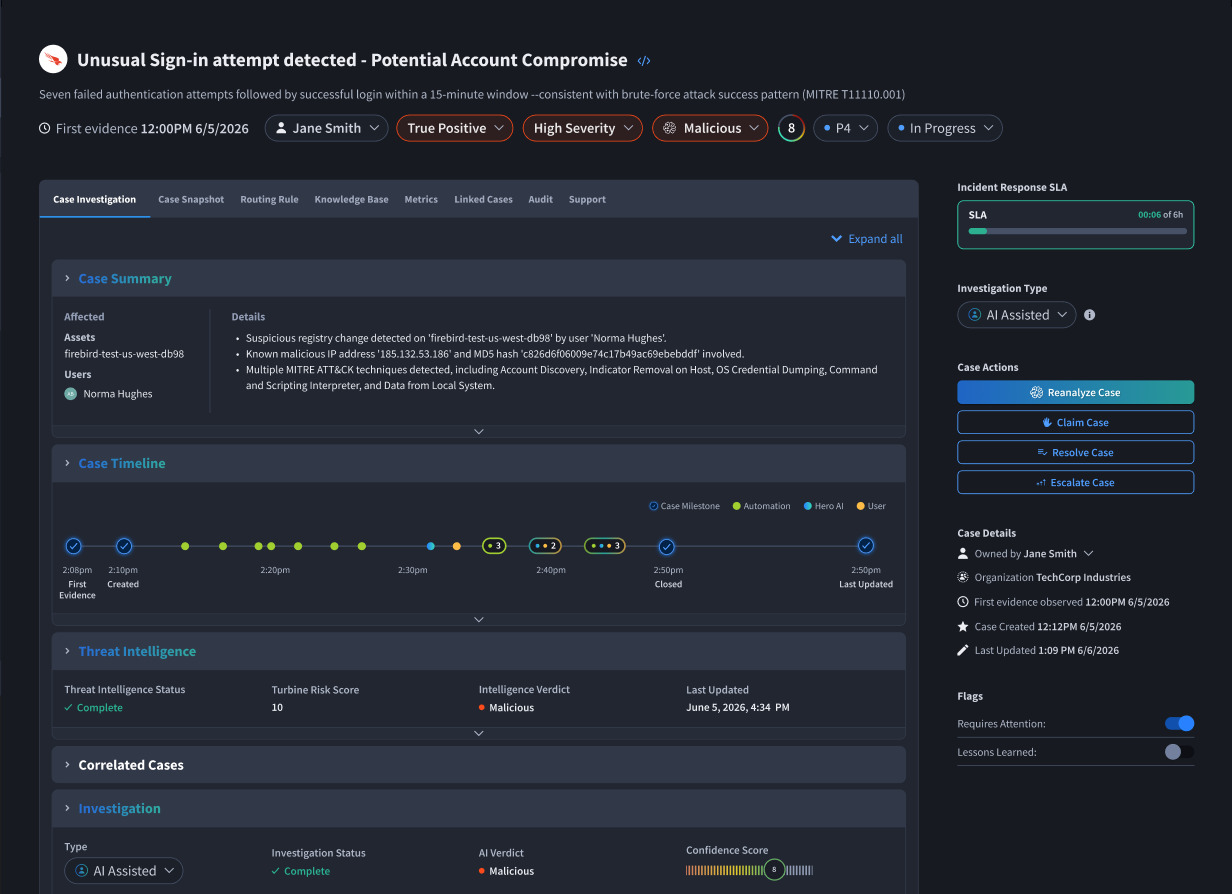
Intelligent routing sends each alert to automation, AI-assisted or fully agentic investigation. Agents pull threat data, past cases, and knowledge base articles into each investigation, adding capacity to work on tasks your team never had time for.

Simplifies playbook creation and lowers the barrier to entry by enabling users of all skill levels to create or modify playbooks with natural-language prompts. Hero asks clarifying questions and shares real-time progress updates while building to improve first-pass accuracy and mitigate rework.

Describe the report or visualization you need in plain language, and Hero AI will instantly generate a live preview that can be applied directly to dashboards or case views.

Integrate with any ingestion source on the fly to ensure your AI SOC implementation is ecosystem-agnostic without the burden of building or maintaining integrations.

Two-way MCP support allows you to connect Cursor, Cloud Code, or another AI coding tool to Swimlane AI SOC and build playbooks, connectors, applications, and widgets in your building tool of choice, which can later be tested and validated in Swimlane Turbine.


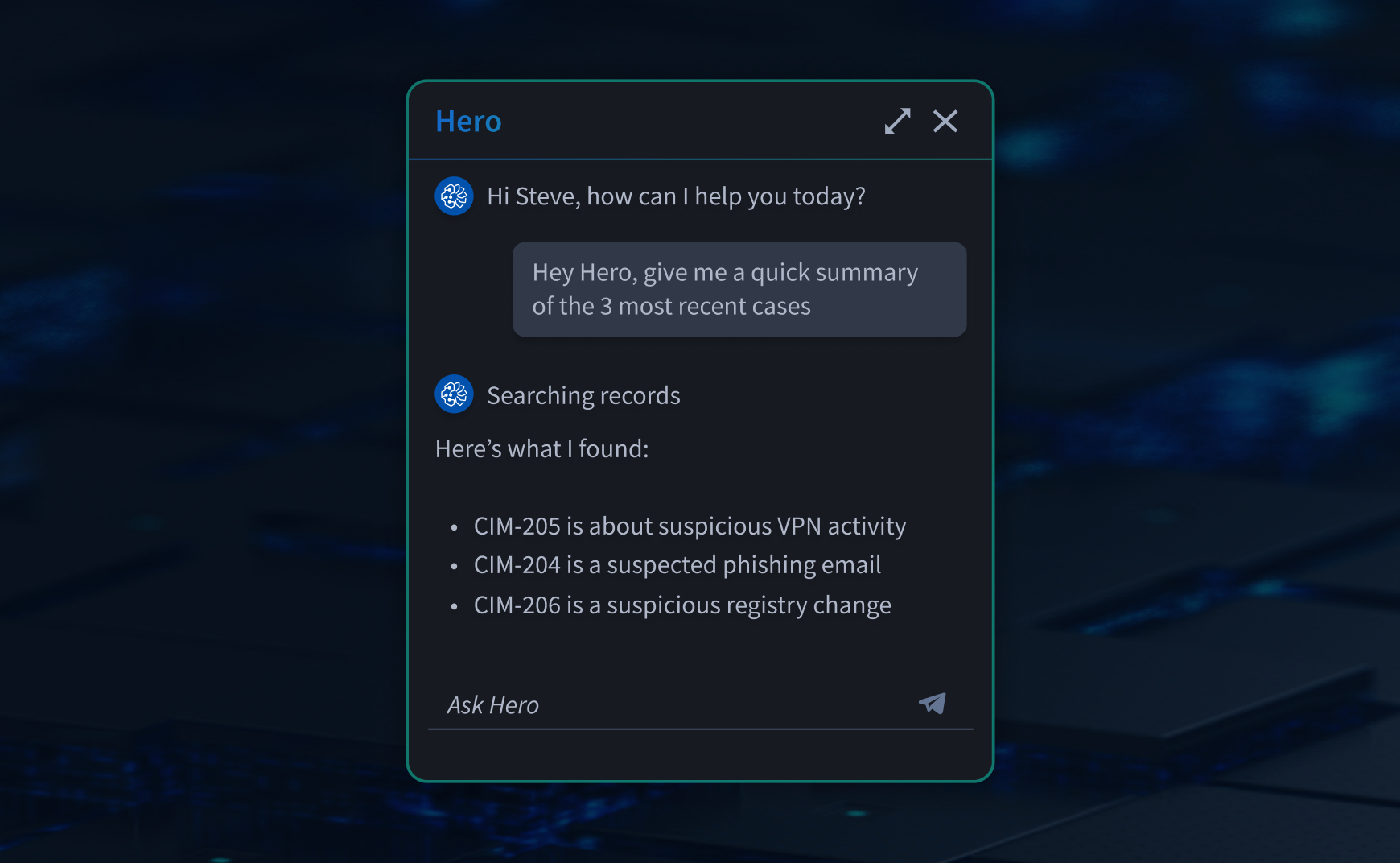


An AI SOC platform combines AI agents with security automation to investigate, triage, and respond to alerts, rather than relying on analysts to handle every case by hand. Swimlane AI SOC applies this model with agentic AI that plans, executes, and documents each investigation, keeping every decision explainable and every action auditable.
A traditional SOAR platform executes only pre-built, deterministic playbooks and can't reason through cases outside its rules. Swimlane AI SOC pairs that same deterministic automation with agentic AI that handles novel or ambiguous alerts, then routes each alert automatically to deterministic automation, AI-assisted investigation, or a fully agentic investigation based on how much judgment the case requires. Security teams get the speed of SOAR and the reasoning of AI on one platform, not two.
Swimlane AI SOC generates a human-readable reasoning chain for every investigation: what data it collected, what logic it applied, and what conclusion it reached, exportable for audit. Analysts can review, modify or rebuild any AI-generated plan before it executes. Software Analyst Cyber Research named Swimlane an “Innovator,” the top classification in its 2026 AI SOC Technoscope report, citing the platform's federated evidence access and mature governance controls, in contrast to vendors that bolt a chatbot onto an old workflow engine.
No. Swimlane AI SOC hands well-understood, low-risk alerts to automation and reserves human review for the alerts that need judgment. At one healthcare customer, Swimlane independently closes about 128 of roughly 180 daily cases and routes the remaining 36 to analysts for review, so the team spends its time on the work that actually requires a person. Analysts keep the authority to edit, pause, reject or escalate any AI decision.
Yes. Swimlane AI SOC requires explicit human approval before any state-changing action an organization hasn't already trusted to automation, and analysts can pause, reject or roll back an AI recommendation at any point in an investigation. When Hero AI is uncertain, it escalates the case to a person instead of guessing, and every step of the investigation, not just the final status, for review.
When done right, AI SOC lowers costs rather than adding a new one. Swimlane's intelligent automation routing sends each alert to the cheapest path that can handle it: deterministic automation for well-understood alerts, AI assistance for ambiguous ones, and fully agentic investigation only for the alerts that truly need it. One Swimlane healthcare customer investigating about 180 threats a day cut investigation costs by 90% by reserving agentic AI for only the most complex 10% of its workload.
Swimlane doesn't force every alert through a model. Many AI SOC platforms rely on model-driven processing for every case, which becomes expensive at scale; Swimlane combines deterministic automation and agentic AI in a single governed platform and, alert by alert, determines which one a case actually needs. Software Analyst Cyber Research's 2026 AI SOC Technoscope report drew the same distinction, ranking Swimlane an “Innovator” for combining production AI reasoning with dependable execution rather than a chat interface layered on legacy tooling. At MSSP Victrix, Hero AI's investigation conclusions matched human analyst judgment 100% of the time.
Swimlane also lets teams define their own detections, so investigation doesn't depend only on what commercial tools flag.
Yes. In June 2026, Swimlane became the first AI SOC provider to earn FedRAMP High certification, covering the Swimlane Turbine agentic AI platform, including Hero AI and Swimlane Intelligence. The certification allows federal agencies to deploy Swimlane for their most sensitive unclassified workloads, and existing government customers report a 240% ROI in year one.
Swimlane AI SOC's no-code automation studio and pre-built integration library are designed to get teams up and running without a custom engineering project. One Swimlane customer went from 0% to 100% automation of Level 1 triage in five months. Another replaced a year's worth of SOAR automations within three weeks. The Ingestion Agent connects new data sources on the fly, so teams don't have to build or maintain integrations before they see value.
Swimlane AI SOC lets customers select a specific AWS Bedrock model, as well as BYOM support for Anthropic and select Bedrock models, for each Hero AI agent, aligning cost, performance, and availability with the task at hand instead of locking teams into a single model or provider.
Ready to see it for yourself? Request a demo above, and Swimlane will walk you through an AI SOC investigating a real alert end-to-end, using your environment's alert volume and cost profile.
Yes. Teams can run organization-specific detection logic against the data available to Turbine, processed in parallel at enterprise scale, and send resulting alerts directly into Swimlane AI SOC. Intelligent routing then sends each alert to deterministic automation, AI-assisted investigation or fully agentic investigation.
No. Swimlane continues to consume alerts from SIEM, EDR, cloud security and other technologies. Customer-defined detection adds another way to raise alerts for risks those tools may not cover, such as prompt injection or unsanctioned AI use, without replacing the security tools you already rely on.
 English English
 Français
 Deutsch
 日本語
 한국어
 Português
 Español