

White Paper
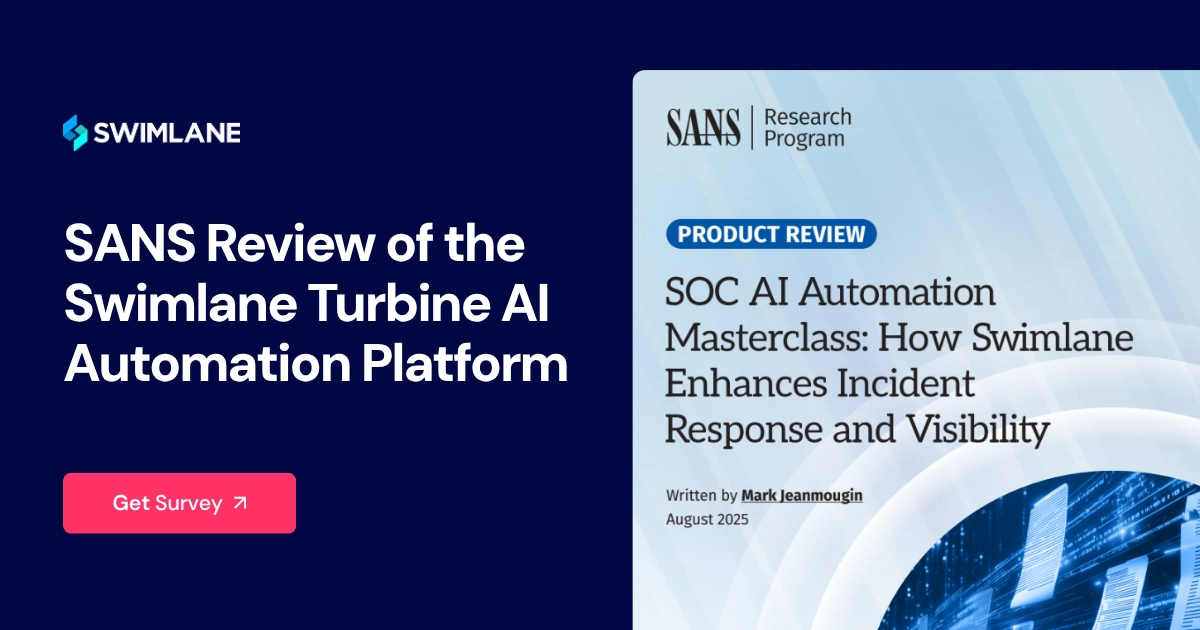
SANS Product Review: Swimlane for Incident Response and Visibility
Read More


For teams building an AI SOC, case management brings the structure needed to cut through false positives, focus on high-risk incidents, and keep investigations moving.
+
Optimize case management with custom fields like verdict, severity, classification, and timestamps.
Proven ability to save 8 hours daily for in-production SOC workloads.
K Cases
Swimlane customers achieved milestones that had never been reached with their previous SOAR vendor.

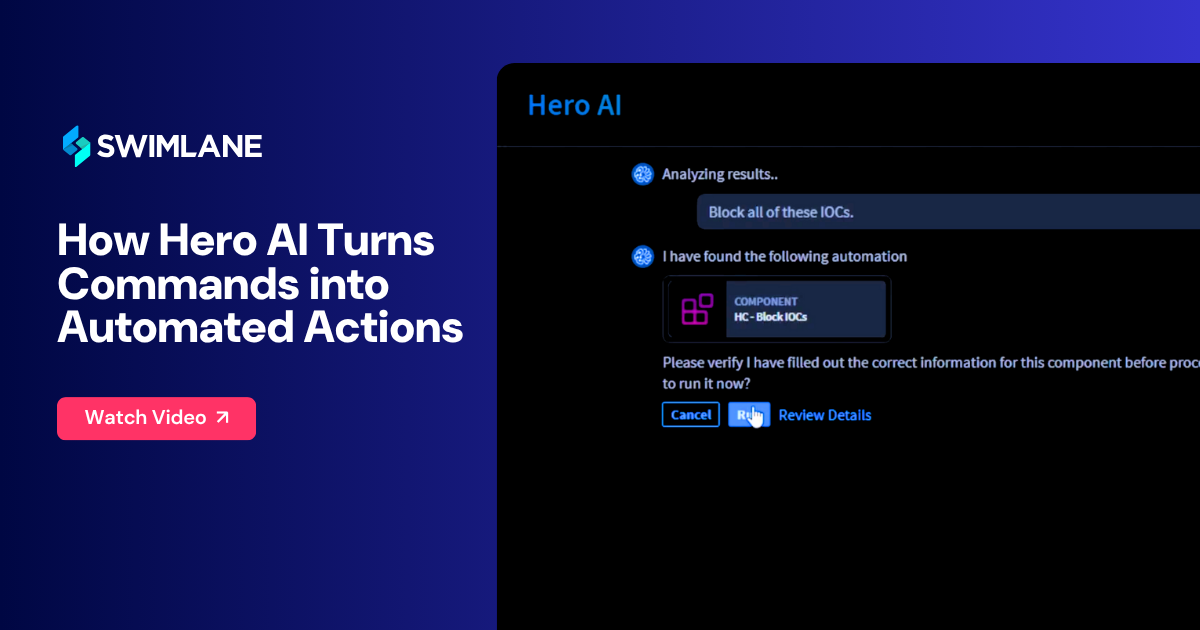
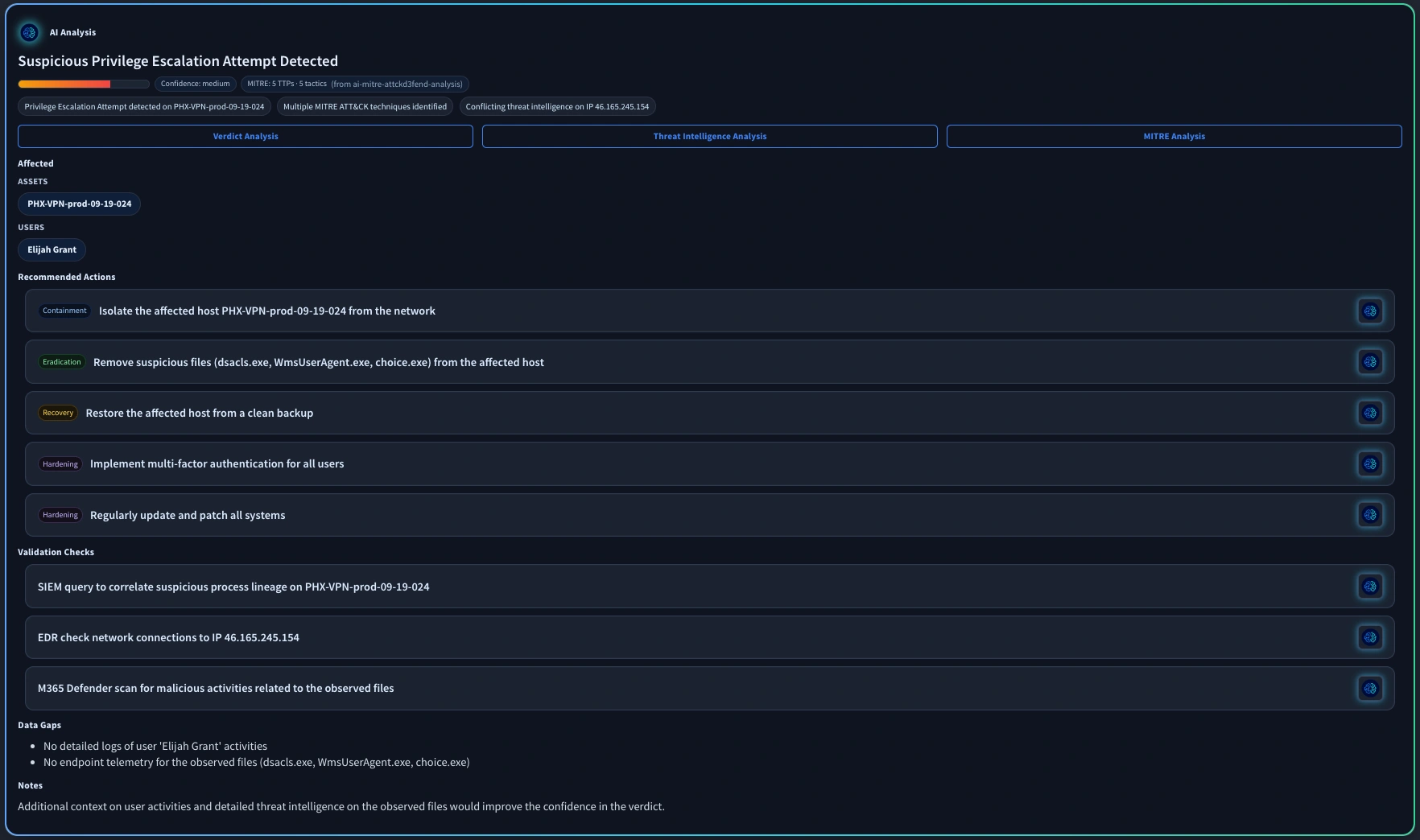
In this video, you’ll see how Swimlane Turbine uses AI agents to analyze case context, validation checks and ticket history to generate recommendations that can be executed in a single click.
Move beyond severity-based triage by incorporating risk scoring directly into case management workflows. Evaluate incidents based on regulatory impact and business criticality, not just technical indicators, so escalation decisions reflect real organizational risk.
Streamline SOC communication and handoffs to improve threat detection and response across SIEM, EDR, SOAR, XDR, and ITSM environments, while supporting ITIL-aligned case workflows so teams can work from shared context instead of disconnected systems.

Use predefined templates to send bi-directional messages directly between Turbine and messaging applications, such as email, Slack, and Microsoft Teams.
Tighten the feedback loop between detection engineers and SOC analysts to improve threat detection and incident response.
Break down information silos by unifying data across security and IT systems, enabling consistent context sharing between tools and teams for faster, more accurate incident response.
Deploy quickly without infrastructure overhead, enabling faster onboarding and continuous updates while maintaining reliability and performance.
Connect easily with existing security and IT systems through flexible APIs, supporting consistent data exchange and workflow automation across tools.
Support high-volume operations across regions, teams, and environments with a platform designed to scale alongside enterprise security needs.
Operate across cloud, on-premises, and edge environments, ensuring consistent case management and orchestration regardless of infrastructure requirements.


Turbine allows us to create, track, and manage all cases from inception to automation, prioritizing and escalating incidents based on severity and risk.
Chase Hood
Technical Team Lead, Managed Services

| Capability | Swimlane AI Case Management | Legacy Ticketing / Traditional SOAR | Hyperautomation Platforms |
| Workflow automation approach | Orchestrates end-to-end case workflows with AI-based execution and guided actions across tools | Relies on manual ticket updates or rigid playbooks with limited cross-system coordination | Focuses on automation workflows and integrations, but case management is not a native, central layer |
| System intelligence | Uses AI-driven agents to support prioritization, enrichment, and next-step recommendations within workflows | Primarily rule-based, requiring ongoing manual tuning to remain effective | Automation logic is workflow-driven; intelligence depends on external inputs rather than built-in case intelligence |
| Data access and visibility | Unifies data across systems to provide full incident context within a single case workspace | Often operates across siloed systems, requiring analysts to switch tools for context | Integrates across tools, but context is distributed across workflows rather than centralized in a case layer |
| False positive handling | Applies contextual analysis and prioritization early in workflows to reduce noise before analyst involvement | Surfaces large volumes of alerts with limited early-stage filtering | Can automate filtering steps, but relies on workflow design rather than built-in contextual case prioritization |
| Reporting and documentation | Generates structured case summaries, timelines, and reports as part of the workflow | Requires manual documentation and reporting, increasing effort and slowing closure | Reporting is workflow-based; structured case-level documentation is not a primary focus |
AI-driven case management helps security teams handle incidents faster with less manual effort. It brings the right information into one place, cuts down repetitive steps, and helps analysts move each case forward in a more consistent way from start to finish.
Swimlane reduces false positives by applying contextual enrichment, correlation across tools, and AI-assisted prioritization early in the workflow. This separates low-risk anomalies from meaningful threats, allowing analysts to focus on alerts that require real investigation.
Yes, Swimlane supports ITIL-aligned case workflows by integrating with ITSM platforms and enabling structured processes for incident management, escalation, and resolution.
Swimlane coordinates data breach investigations by centralizing alerts, evidence, and case actions in one place. It supports structured workflows for triage, investigation, escalation, and reporting, ensuring teams can respond quickly while maintaining full visibility and auditability.
Yes, Swimlane is designed with a cloud-native architecture that supports scalable SaaS deployment, flexible integrations, and distributed SOC operations, while also accommodating hybrid and edge environments where needed.

 English English
  Français
 Deutsch
 日本語
日本語
 한국어
한국어
 Português
 Español