
AI Agents vs Agentic AI: What’s the Difference?
Read More


Every AI SOC vendor demo I’ve seen, including ours, looks great. Demos run on curated alerts with working integrations and no adversary. The question that separates real platforms from slideware is not “can it close an alert?” It’s “show me what it got wrong last quarter, and how you found out.”
In short: Evaluating an AI SOC agent means validating it against evidence you control. This includes your alerts, your environment, your analysts; not evidence the vendor curates.
AI SOC agents promise to automate the investigation layer; the work of triage, enrichment, and verdict – and structured evaluation is how you verify whether that automation actually holds in your environment. Gartner’s guidance on this market opens with a projection that should discipline every evaluation: 70% of large SOCs will pilot AI agents for Tier 1/Tier 2 work by 2028, and only 15% will see measurable improvement in their information security operations without structured evaluation. Structured evaluation is not a scorecard of vendor answers. It’s a set of evidence demands. Here’s the set I’d use.
A production AI system doing investigative work makes mistakes. That’s not disqualifying; human analysts make mistakes too. What’s disqualifying is a vendor that can’t characterize them.
Ask: What is your measured false-negative rate on closed alerts, how do you measure it, and what were your last three material misses? A mature vendor runs continuous QA, including sampling agent-closed alerts for human review, tracking verdict overturn rates, and regression-testing agent behavior when models change. They can answer with numbers. A vendor that responds with accuracy marketing (“99% precision”) but can’t describe the measurement methodology is telling you they don’t have one. In every evaluation I’ve run, vendors who can’t produce a failure log either don’t measure or don’t want you to know.
The deeper logic: a false positive costs you minutes; a false negative delivered with confident reasoning costs you a breach you didn’t know you had. Any evaluation that doesn’t probe the false-negative side is measuring the cheap half of the problem.
For any verdict, you should be able to see: every query the agent ran, every result it received, the reasoning at each step, the confidence at the end, and the action taken. Not a summary paragraph; the actual trail, retained immutably.
This matters for three separate reasons:
If you operate under FedRAMP, PCI, DORA, or sector equivalents, an unexplainable verdict is a finding waiting to happen. Gartner puts governance and explainability as one of its seven evaluation categories for exactly this reason: an agent that can’t articulate auditable reasoning is a black box.
Test it in the POV: Pick five closed alerts at random and reconstruct each investigation from the record alone. If you need the vendor on a call to explain what happened, it isn’t auditable.
Get the precise answer to: which actions can this system take with no human in the loop, where is that enforced, and can I configure it per action type and risk level?
The enforcement point is the part most evaluations miss. “The agent is instructed not to disable accounts” is a prompt, not a control. A control is workflow logic outside the model that makes the action impossible without an approval step acting like deterministic guardrails around probabilistic reasoning. Gartner’s framework presses on the same distinction: how are guardrails enforced for high-impact actions like account disablement or network isolation, and does the system default to escalation, not action, under ambiguity?
The guardrail design matters most when the system is handling an active threat; that’s precisely when agents are under the most pressure to act and the most likely to act incorrectly. If a vendor can’t show you the mechanism, not the policy, the mechanism, assume it doesn’t exist.
Pick the five tools that matter most in your stack and test three levels for each:
A 300-logo integration page routinely collapses to read-only on the tools you care about. That’s why you shouldn’t take the logo wall at face value. Also ask the architectural question: does the platform require centralizing your data, or can it query where the data lives? The cost and migration implications diverge sharply.
Define success before the POV starts, on your alerts, against your current numbers. The metrics worth anchoring on:
Run it on one contained, high-volume workflow, phishing or endpoint triage, for 30-60 days. Volume metrics like “investigated 40,000 alerts” are activity, not outcomes; treat them as marketing.
This market is young, crowded, and consolidating. Listicle roundups in 2026 track fifteen or more vendors, many under five years old. Some will be acquired; some will disappear. Gartner recommends treating vendor viability as a third-party-risk question and favoring shorter subscription terms while the market moves. Ask about SOC 2 and FedRAMP posture, data handling and model-training policies on your data, and what happens to your workflows and audit history if the product dies.
Most AI SOC evaluations fail because they’re structured as demos plus reference calls, the two channels vendors control best. Restructure yours around evidence the vendor doesn’t control: your alerts, your baseline, your senior analysts sampling closed cases, and a failure log the vendor either has or doesn’t.
Vendors who’ve built for production will welcome this. The ones who haven’t will call it unnecessary. That reaction is itself the fastest evaluation you can run.
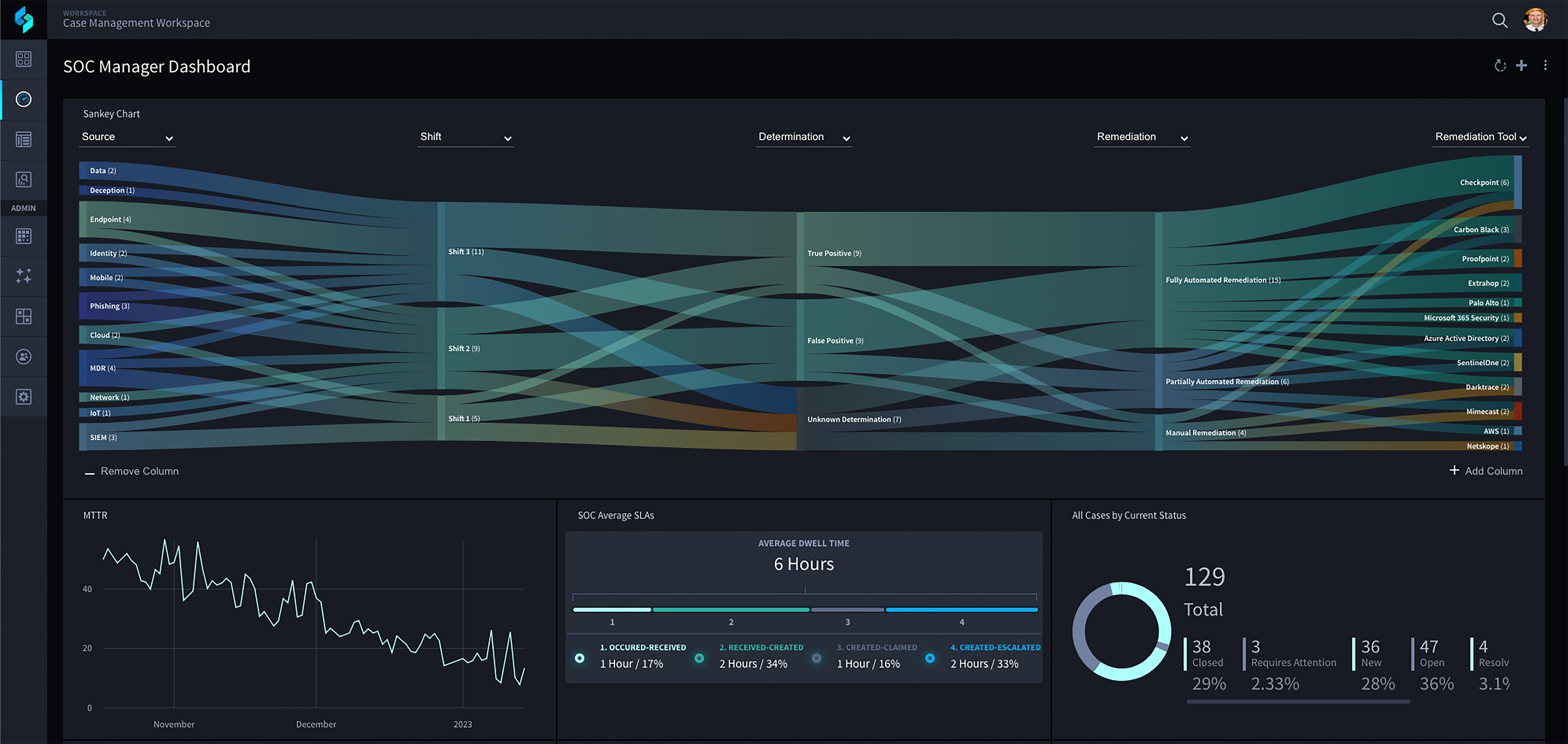
Discover how to pair deterministic automation with agentic AI to handle novel or ambiguous alerts. Apply your unique organization context to Swimlane AI SOC for trustworthy AI at scale.

 English English
  Français
 Deutsch
 日本語
日本語
 한국어
한국어
 Português
 Español