

News
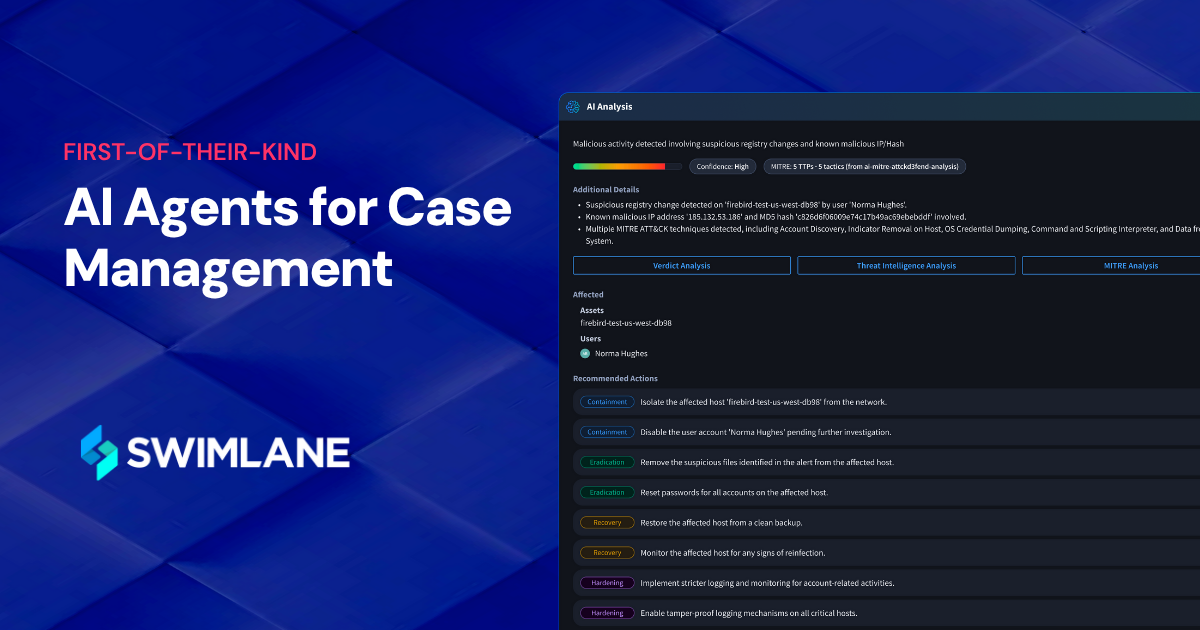
Swimlane Speeds Security Triage with First-of-Their-Kind AI Agents for Case Management
Read More


Incident response involves identifying and mitigating cyber threats before they cause more significant damage. As threats evolve, agentic AI automation enables faster, smarter responses across today’s dynamic environments. Swimlane Turbine and Hero AI bring agentic AI to every stage of the incident response lifecycle, from triage through investigation, containment, remediation, and reporting.
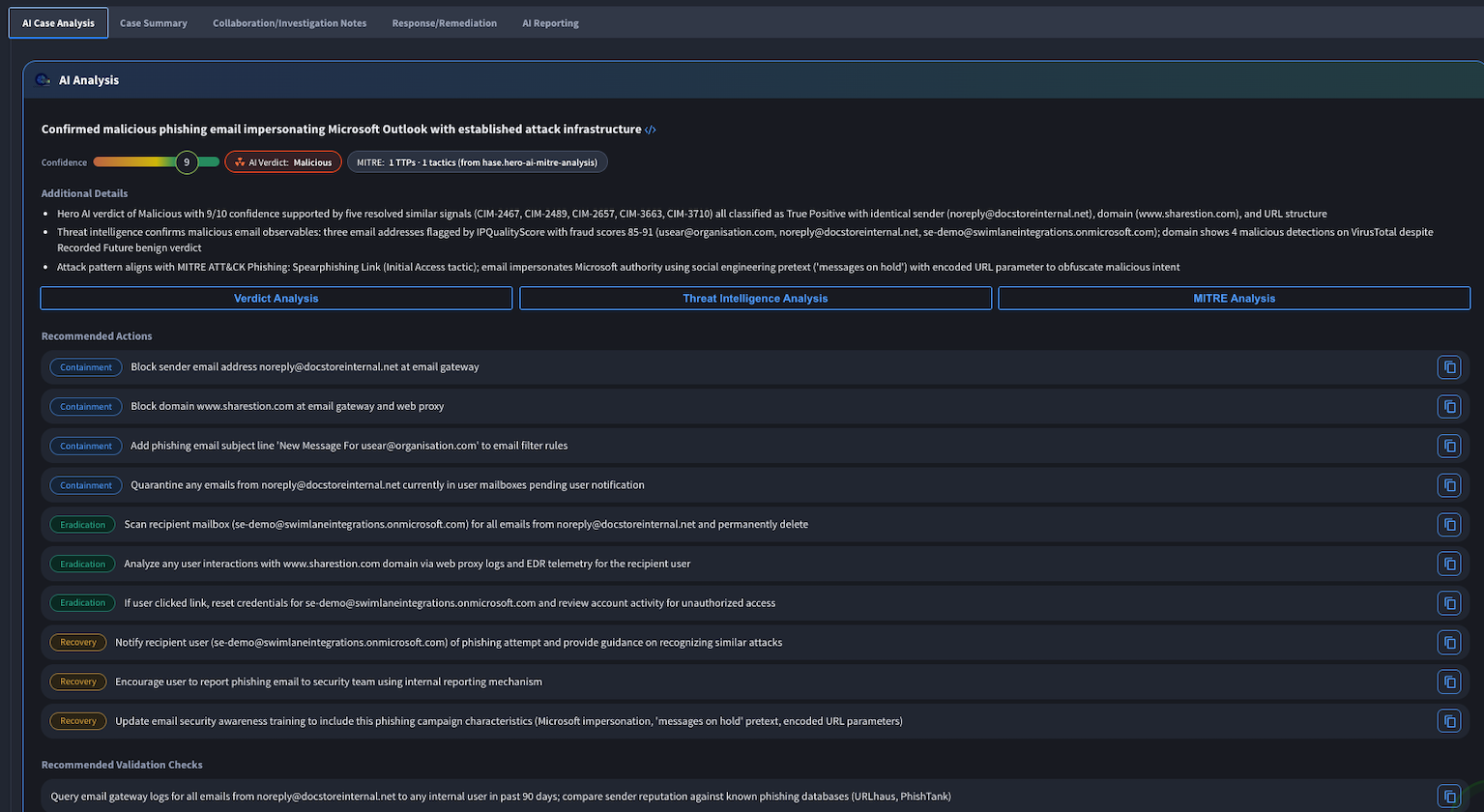
%
Of organizations say that stronger cyber hygiene could have prevented their incident.
%
Surveyed organizations believe that AI and automation are the key to improving cyber hygiene.
hours.
Swimlane’s own security team saved 8 hours per day and cut MTTR in half in the first month with Hero AI.
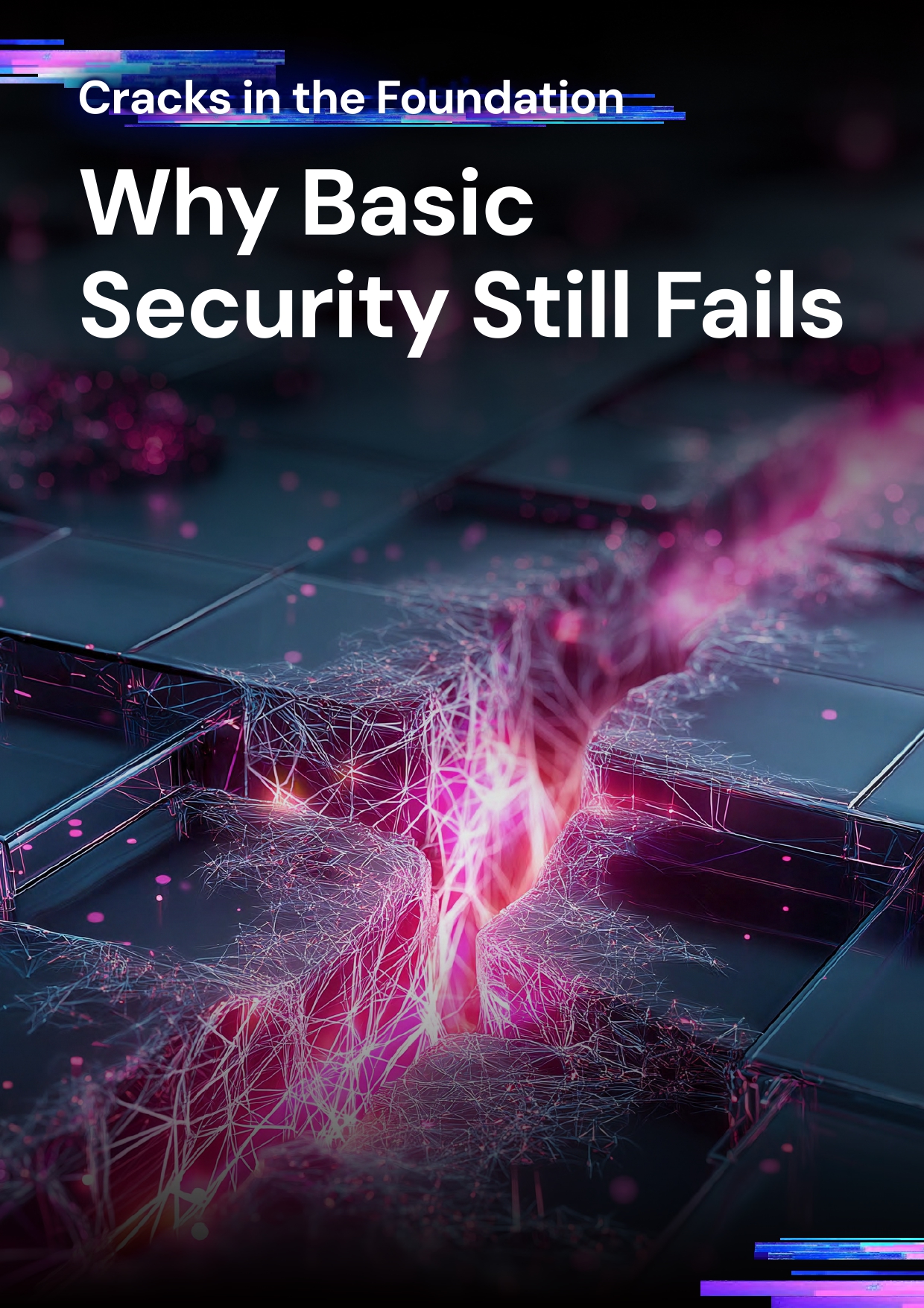
SOCs are overwhelmed. Analysts spend hours toggling between SIEMs, EDRs, and ticketing tools to investigate thousands of daily alerts—most of them false alarms—while a real attack unfolds in minutes.
The impact is real: Swimlane’s 2025 “Cracks in the Foundation” report found that 92% of breached organizations could have prevented the incident with better cyber hygiene and faster response. Incident response automation fixes this by automating tedious tasks, so your team can focus on critical decisions.
Agentic AI plans and executes multi-step tasks on its own, inside the boundaries your team sets. It goes beyond answering questions or recommending next steps. In incident response, an AI agent pulls threat intel, correlates indicators across sources, and builds the incident timeline. It can also take containment actions like isolating an endpoint or blocking a malicious IP, without an analyst driving every click.


Traditional SOAR platforms run pre-built rules and stop where the script ends. Agentic AI adds a reasoning layer that adapts to each incident as it unfolds. It still runs on security orchestration. Swimlane Turbine’s playbooks and integrations move the data and trigger the actions, and the agent chooses which steps each incident needs.
Hero AI, a suite of AI agents operating within Swimlane Turbine, adds that reasoning layer on within deterministic automation. The result pairs SOAR repeatability with the case-by-case judgment of an experienced analyst.

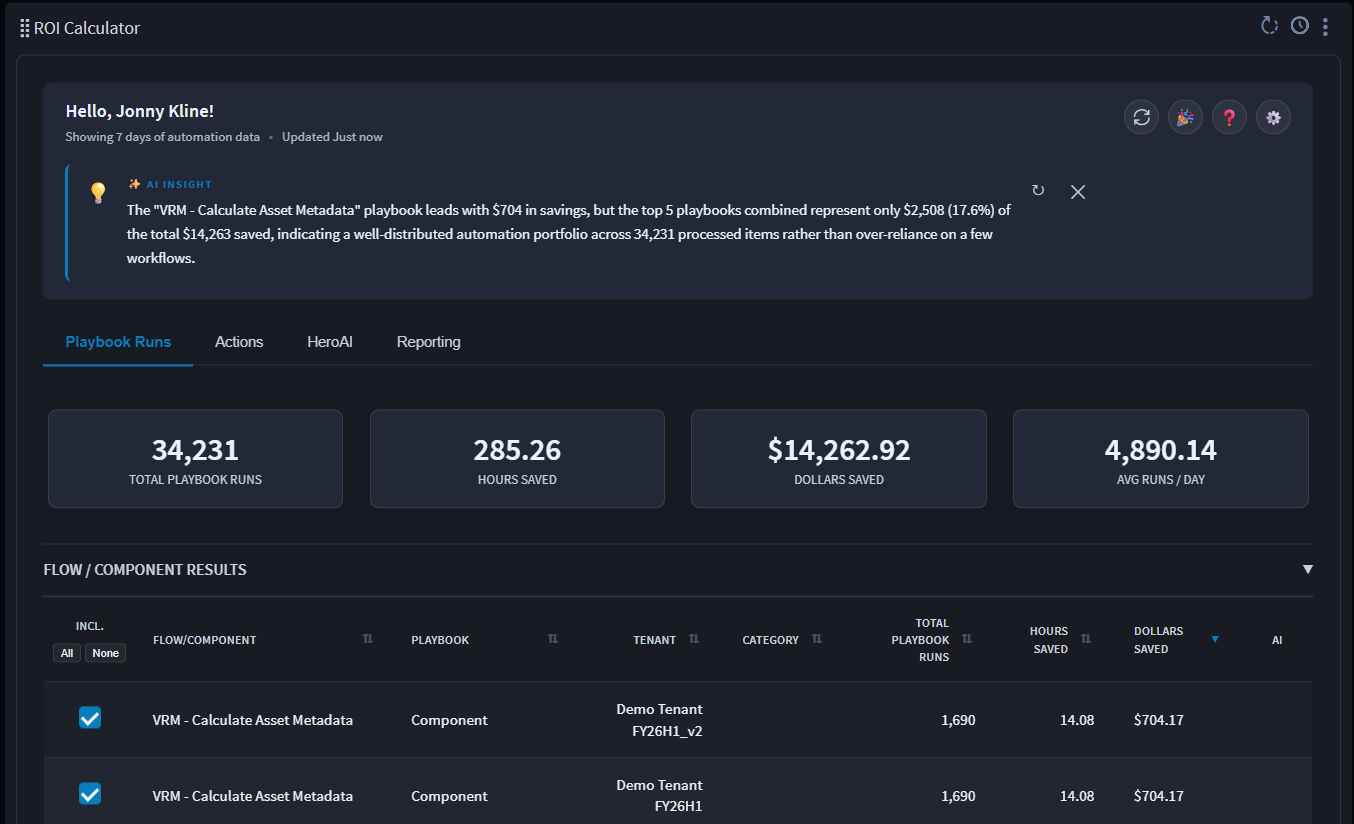
Swimlane’s agentic AI automation delivers measurable gains across the incident response lifecycle:
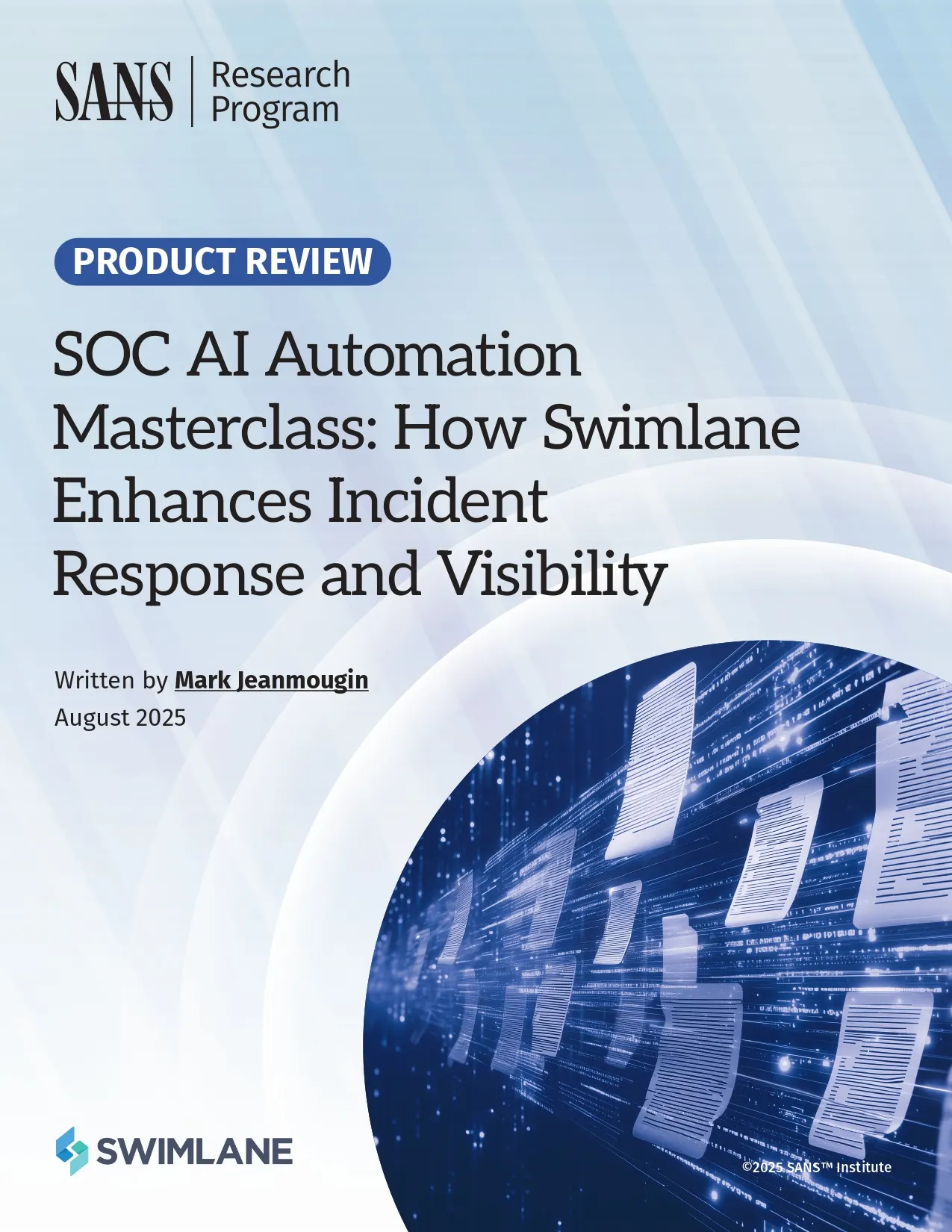
SANS Product Review
Independent analysts have validated this approach. SANS Institute reviewed Swimlane Turbine for incident response and visibility and published its findings in the report below. Separately, TAG Cyber's independent ROI analysis found that organizations can see up to 240% ROI from Swimlane security automation.
Here is how a security team moves an incident from first alert to closed case using Swimlane Turbine and Hero AI

Incident response starts when Turbine ingests an alert from a SIEM, an EDR/XDR platform, or any connected tool. Hero AI’s machine learning-based prioritization scores each alert by risk and business context instead of severity alone, catching the anomaly detection signals that indicate a real threat, whether that is a phishing email, a ransomware indicator, or an insider threat, and routes it to the right playbook or analyst.

Once a case opens, Hero AI agents automatically build an investigation timeline: gathering logging data, enriching indicators of compromise across threat intelligence sources, mapping activity to the MITRE ATT&CK and D3FEND frameworks, and pulling in computer forensics context such as process history and file activity. Analysts get a human-readable reasoning chain for every step the AI agent took, so they can verify the conclusion instead of redoing the work.

When Turbine confirms a threat, whether that is a malware analysis verdict or a known exploit being used against a vulnerable system, it can isolate the affected endpoint, block the malicious IP address, revoke user access, or contain the incident through any connected EDR/XDR or firewall tool.
Turbine closes the loop with GenAI-generated case summaries and after-action reports that translate technical incident response detail into language non-technical stakeholders can use, supporting compliance reporting and post-incident reviews without extra analyst work.
With Swimlane Tubine, all of these stages come together into a single case management, playbook, and reporting workflow:
Agentic AI in incident response works within limits a security team sets, not outside them. Swimlane’s Hero AI agents produce a recommended action, such as isolating an endpoint or revoking access, along with the reasoning and evidence behind it, and a security team decides in advance which actions execute automatically and which route to an analyst for approval. Every action, human or AI, writes to a full audit trail, so a SOC can show exactly what happened during an incident and why, which matters for compliance as much as for trust in the automation itself.
Incident response automation is only as good as the data and actions it can reach. Swimlane Turbine connects to SIEM platforms, EDR and XDR tools, threat intelligence feeds, ITSM systems, and identity providers through a marketplace of prebuilt integrations, plus the ability to connect to any API on-demand. In practice, that means Swimlane can pull alerts from tools like Microsoft Sentinel or CrowdStrike, enrich them with threat intelligence, and push a case update back into whatever system a team already uses, so incident response automation extends the security stack instead of replacing it.
Swimlane’s own security team put these AI agents to work on its production incident response workflow and saw the impact within a month: 8 hours of time savings a day and mean time to respond cut in half. Across Swimlane’s customer base, these agents now handle incident triage and case management work equivalent to more than 60,000 security analysts a day.
Abraxas, a managed security services provider, used Swimlane to consolidate incident response and compliance across a multi-tenant environment. Automating endpoint isolation and process termination let Abraxas act on incidents without waiting on an analyst, and expanding from one threat intelligence source to five gave investigations far more context. "Swimlane as a company really cares about their customers," said Christoph Müller, Abraxas’s Head of Security Solutions.


It's one of the tools that actually allows us to buy time. And when you talk about the velocity of attacks that occur today, time is the most valuable asset that you have.
Jonathan Kennedy
Chief Information Security Officer



It’s clear that security automation tools like Swimlane Turbine represent a great path forward to easing the burden on security teams so they can focus on high-level threats, while also demonstrating value in security investments.
Edward Amoroso
Founder and CEO
Agentic AI enables systems to take intelligent, autonomous actions during an incident. Unlike traditional AI that only assists analysts, agentic AI drives decisions and initiates responses at the point of inception, helping reduce mean time to respond (MTTR) and analyst fatigue.
Swimlane Turbine combines agentic AI and automation to help security teams improve the effectiveness, efficiency, and autonomy of their incident response processes. Turbine enables the design and execution of workflows that ingest telemetry, enrich alerts, recommend actions, take them, and generate complete case summary reports. This approach allows organizations to manage end-to-end incident response with speed, consistency, and precision.
Swimlane Turbine can automate virtually any incident response action the customer authorizes, including alert triage, indicator enrichment, user access revocation, endpoint isolation, case creation, compliance reporting, and threat intelligence lookups. Customers can build playbooks using a mix of traditional automated actors and AI-driven actions.
Security orchestration, automation and response (SOAR) runs predefined playbooks: if this alert fires, do these fixed steps. Agentic AI adds a reasoning layer on top of that orchestration, so an AI agent can adapt its investigation and recommended actions to the specifics of each case instead of following one fixed script. Swimlane Turbine uses both: SOAR-style playbooks and integrations to move data and trigger actions, and Hero AI agents to add judgment on top, plus AI builder agents to maintain the power of SOAR while making it easier to use.
Yes, wherever a security team decides it should. Swimlane lets teams set which incident response actions, such as isolating an endpoint or blocking an IP address, execute automatically and which require analyst approval first. Swimlane logs every action in a full audit trail, regardless of who or what performed it.
Swimlane connects to SIEM platforms, EDR and XDR tools, threat intelligence feeds, ITSM systems, and identity providers through its integration marketplace and Autonomous Integrations capability, which can connect to any API without custom engineering.
Swimlane Turbine case management brings every alert, action, and piece of evidence for an incident into one workspace instead of spreading them across a SIEM, an EDR console, and a ticketing system. The Hero AI verdict agent and investigation agent update the case automatically as new information comes in, and the case becomes the record used for reporting and compliance after the incident closes.
 English English
  Français
 Deutsch
 日本語
日本語
 한국어
한국어
 Português
 Español